Note: This article is for general education only. Always follow the instructions on your bottle and the advice from your eye doctor, pharmacist, or other clinician.
Eye drops look simple. You aim, you squeeze, you win. In real life, though, many people blink, miss, poke themselves with the bottle, or accidentally send half the dose down their cheek like a tiny medical waterfall. The good news is that using eye drops correctly is a learnable skill, not some mystical talent handed down to ophthalmology wizards.
Whether you use artificial tears for dry eye, medicated drops for allergies, prescription drops after surgery, or daily glaucoma medication, technique matters. A good routine can help the medicine stay where it belongs, reduce waste, lower the risk of contamination, and make the whole experience far less dramatic. That is exactly what this guide will help you do.
Why Proper Eye Drop Technique Matters
If you use eye drops the right way, more of the medication stays on the eye long enough to do its job. If you use them the wrong way, you may waste medicine, irritate your eye, or contaminate the tip of the bottle. That is especially important with prescription drops, because missed technique can quietly turn treatment into an expensive guessing game.
Here is the main idea: you do not need to flood your eyeball like you are watering a houseplant. In most cases, one well-placed drop is enough. Extra drops usually spill out, run down the skin, or drain too quickly. So the goal is not “more.” The goal is “accurate.”
Before You Start: A Quick Eye Drop Checklist
1. Read the label
Check that you have the correct bottle, the correct eye, and the correct time of day. This matters more than people think, especially when several eye medications live together in one bathroom cabinet and all the bottles look like cousins at a family reunion.
2. Wash your hands
Wash thoroughly with soap and water, then dry your hands. Clean hands help reduce the chance of introducing germs into the eye area or onto the bottle tip.
3. Check the bottle
Make sure the dropper tip is clean, not chipped, and not cracked. If the instructions say to shake the bottle, shake it gently first. If the product is expired, damaged, or looks cloudy when it should not, do not use it until you confirm it is safe.
4. Remove contact lenses if directed
Some eye drops should not be used while contact lenses are in place. Follow the product label or your clinician’s instructions. In many cases, lenses need to be removed first and reinserted later, not immediately.
5. Get a tissue and a mirror
A mirror can help if you are new to this. A tissue is useful for wiping away excess liquid from your cheek without rubbing your eye. This is not glamorous, but neither is walking around with one tear and one drop of medicine sliding toward your jawline.
How to Use Eye Drops: Step-By-Step Instructions
Step 1: Sit down, stand still, or lie back
Pick a position that feels stable. Many people do well sitting in a chair with their head tilted back. Others prefer lying on a bed or couch, especially if they are nervous, shaky, or helping a child. The best position is the one that keeps your hands steady and your face relaxed.
Step 2: Tilt your head back and look up
Tip your chin slightly upward. Then look toward the ceiling. Looking up helps create space between the eye and lower eyelid, which makes the next step easier.
Step 3: Pull down your lower eyelid to make a pocket
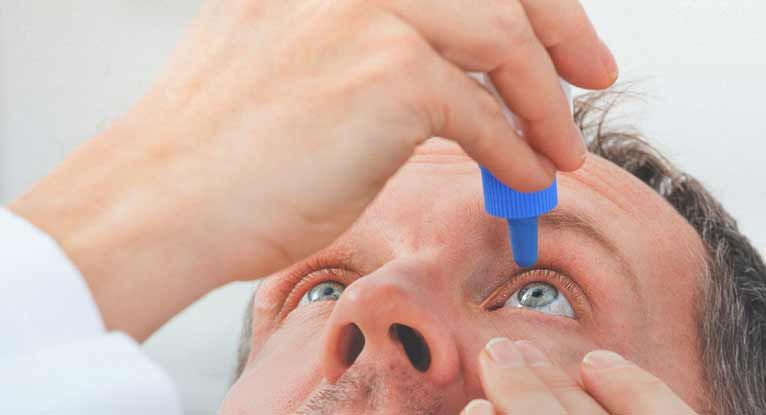
Using one hand, gently pull down the lower eyelid. You are trying to create a small pouch between the lid and the eye. This is where the drop should go. Think of it as landing the drop in the seat, not on the stage.
Step 4: Hold the bottle above the eye without touching it
With your other hand, hold the bottle tip-down above the lower-lid pocket. Keep the tip close enough to aim well, but do not let it touch your eye, eyelid, eyelashes, fingers, or skin. Touching the tip can contaminate the bottle.
Step 5: Squeeze out one drop
Gently squeeze the bottle so that a single drop falls into the pocket. One drop is usually all you need. If you miss completely, try again. If you are not sure whether the drop landed, it is okay to pause, blink once or twice, and assess before going full sprinkler mode.
Step 6: Close your eye gently
Let go of the lower eyelid and close your eye softly. Do not squeeze your eyelids shut like you are bracing for a jump scare. A gentle close helps keep the medicine in place better than forcefully scrunching your face.
Step 7: Press the inner corner of your eye
Use a clean finger to apply light pressure to the inner corner of the closed eye, near the nose, for 1 to 2 minutes. This helps keep the drop from draining too quickly into the tear duct and nose, where it is less helpful and more likely to contribute to side effects.
Step 8: Blot excess liquid
If extra fluid runs onto your cheek, dab it gently with a clean tissue. Avoid rubbing your eye. Rubbing can irritate the eye and may remove some of the medication you just worked so hard to place correctly.
Step 9: Repeat for the other eye if instructed
If your doctor told you to treat both eyes, repeat the same steps on the other side. Do not assume both eyes need treatment unless the instructions say so.
Step 10: Recap the bottle and wash your hands again
Close the bottle right away. Do not wipe or rinse the tip unless the instructions specifically tell you to. Then wash your hands again to remove any medication that may have gotten onto your fingers.
What If You Use More Than One Eye Drop?
If you use two or more different eye drops, wait at least 3 to 5 minutes between them unless your clinician gives different directions. This prevents the second drop from washing out the first one before it has time to work. If your medication guide says 5 minutes, use 5 minutes. That is the safer default.
If you use both eye drops and eye ointment, use the eye drops first, wait several minutes, and then apply the ointment last. Ointment is thicker and can block liquid drops from absorbing well if you use it first.
Common Mistakes That Make Eye Drops Less Effective
Touching the bottle tip
This is one of the biggest mistakes. The tip should stay clean. Once it touches your eye, lashes, or skin, germs can hitch a ride back to the bottle.
Putting in too many drops
More is not better here. Usually, one accurate drop beats three runaway drops every time.
Blinking hard or squeezing the eye shut
A gentle close works better than a dramatic blink-fest. Squeezing hard may push medication out instead of helping it stay in place.
Skipping the wait between medications
If you stack multiple drops too quickly, you can dilute or wash away the first one.
Using the wrong bottle
Eye medications can look frustratingly alike. Keep them clearly labeled and stored in a consistent spot. If necessary, use large-print labels or a color-coded organizer.
Helpful Tips If You Struggle With Eye Drops
Use a mirror
A tabletop or bathroom mirror can make aiming easier, especially when you are first learning.
Brace your hand
Rest part of your hand against your forehead or cheek while holding the bottle. This can reduce shaking and make the bottle easier to control.
Try the lying-down method
If the usual method feels awkward, lie flat and place the drop into the lower-lid pocket from above. Many people find this less stressful.
Refrigerate only if allowed
Some people find cool drops easier to feel, which helps them know the drop went in. But do this only if the product instructions allow refrigeration.
Set alarms for daily medication
If you use prescription drops on a schedule, reminders can help. This is especially useful for glaucoma drops or post-surgery regimens, where consistency really matters.
How to Give Eye Drops to a Child
Giving eye drops to a child can feel like negotiating with a tiny attorney who objects to everything. The trick is to stay calm and simplify the process.
Option 1: Use the standard lower-lid pocket method
If the child can cooperate, use the same step-by-step technique described above.
Option 2: Place the drop in the inner corner of the closed eye
If the child refuses to open the eye, have them lie down and close their eyes. Place a drop in the inner corner near the nose. When they open their eyes and blink, the drop can flow in. This technique is often helpful for babies, toddlers, and very determined preschoolers.
Offer reassurance, keep your voice steady, and praise effort, not perfection. A short routine works better than a long explanation that turns into a dramatic monologue.
Special Situations to Keep in Mind
For dry eye
If you use artificial tears frequently, especially more than four times a day, preservative-free options may be worth discussing with your eye doctor. Some people find that preservative-containing drops become irritating when used often.
For contact lens wearers
Follow the label carefully. Do not assume every eye drop is contact-lens friendly. If you wear lenses and your eyes become painful, red, unusually sensitive to light, or blurry, get medical advice rather than guessing.
For missed doses
If you miss a scheduled dose of prescription eye medication, use it as soon as you remember unless it is almost time for your next dose. In that case, skip the missed dose and return to your regular schedule. Do not double up unless a clinician specifically tells you to do that.
When to Call a Doctor
Some mild stinging can happen with certain eye drops, depending on the medication. But do not ignore serious symptoms. Get medical advice promptly if you have:
- Severe eye pain
- Vision loss or major vision changes
- Marked light sensitivity
- Redness that is getting worse instead of better
- Yellow or green discharge
- Swelling, rash, or signs of an allergic reaction
- Symptoms after using a bottle that may be contaminated, recalled, or damaged
If something feels very wrong, trust that instinct and get care. Eyes are not the body part for brave experimentation.
What Real-Life Experience Teaches You About Using Eye Drops
In real life, the hardest part of using eye drops is usually not the medicine. It is the human being holding the bottle. People often imagine the challenge is technical, but it is usually emotional and practical. The moment the bottle hovers over the eye, the blink reflex kicks in, the hand gets weirdly shaky, and suddenly a fully capable adult is negotiating with one rebellious eyelid.
A very common experience is missing the eye the first few times and assuming you are terrible at it forever. You are not. Most people improve quickly once they stop trying to drop the medicine straight onto the eyeball and instead aim for the lower-lid pocket. That one adjustment often changes everything. People who thought they were “bad at eye drops” usually discover they just needed a better target.
Another common experience is realizing that posture matters more than expected. Someone who struggles while standing over a sink may do perfectly well when lying flat on a bed. Others find that bracing their hand against the forehead makes them instantly steadier. These are small changes, but they make the routine feel less like a trust fall with gravity.
Many patients also say the first week is the hardest because the process feels awkward and annoyingly slow. By the second week, it becomes a routine. They know where the tissue goes, which hand holds the bottle, how long to press the inner corner, and how to keep the bottle tip from getting too close. Repetition turns a stressful task into a pretty boring one, and honestly, boring is a huge win in medical routines.
People using daily prescription drops often talk about the importance of habit. The dose that gets missed is usually not the noon dose on a busy day because the medicine failed. It is the dose that had no routine attached to it. Pairing eye drops with something consistent, like brushing teeth, breakfast, or bedtime, makes adherence much easier. Tiny routines beat heroic memory every time.
Parents and caregivers have their own version of this learning curve. Children may resist eye drops because they do not like surprise sensations near the face. The trick, according to many families, is keeping the process short, predictable, and calm. A simple script, a favorite blanket, a count to three, or the inner-corner method can make a huge difference. The less tension in the room, the easier the drop usually goes in.
There is also the very relatable experience of wondering, “Did the drop actually go in, or is that just my optimism?” Feeling the coolness of the drop, using a mirror, and waiting a moment before reaching for a second squeeze can help. Over time, most people get much better at knowing what a successful drop feels like.
The biggest lesson from real-world experience is reassuringly simple: perfect technique is not required on day one. Better technique is. Once people learn a stable position, the lower-lid pocket, one-drop dosing, and gentle pressure at the inner corner, the whole process becomes easier, cleaner, and much less frustrating. In other words, eye drops stop being a daily showdown and start becoming just another small health habit you know how to handle.
Final Thoughts
Using eye drops correctly is one of those tiny skills that can make a surprisingly big difference. A clean bottle, a steady hand, one well-placed drop, and a minute of patience can improve comfort, reduce waste, and help treatment work the way it is supposed to. If you struggle at first, that is normal. Most people do. The trick is not natural talent. It is a simple method and a repeatable routine.
And once you get the hang of it, you may never again have to wonder whether your medicine landed in your eye, your eyelashes, or somewhere near your left ear.