If you’ve ever worried about forgetting your Wi-Fi password, Finland would like to casually outdo you by planning a facility
that has to “remember” its job for 100,000 years. Not 100. Not 1,000. One hundred thousand. That’s longer than
recorded history, longer than most languages have existed, and definitely longer than your phone’s current charging cable.
The place is called Onkalo (Finnish for “cavity” or “pit”), and it’s a deep geological repository being built on
Finland’s west coast near the Olkiluoto nuclear power plant. The goal: lock away spent nuclear fuel so securely
that future humanswho may live in a world with different coastlines, different climates, and different everythingwon’t have to
babysit it.
Meet Onkalo: Finland’s “Forever” Basement
Onkalo is designed for the final disposal of spent nuclear fuelthe used fuel assemblies removed from nuclear
reactors after they’ve done their energy-producing job. Spent fuel is highly radioactive at first and remains a concern for a
very long time, which is why most countries store it temporarily (often in pools and then in dry casks) while they argue about
what “permanent” should mean.
Finland’s approach is unusually straightforward: instead of betting on perfect institutions for millennia, it’s betting on
physics, geology, and passive engineering. Onkalo’s plan assumes that governments change, budgets shrink, and
people forgetso the repository is designed to stay safe even if nobody maintains it.
Why 100,000 Years? Because Radioactivity Doesn’t Do Deadlines
The “100,000 years” headline is a shorthand for a deeper idea: isolate radioactive material long enough that it no longer poses a
meaningful risk to people and ecosystems. Different radionuclides decay on different timelines. Some fade quickly; others linger.
The long horizon isn’t a dramatic marketing choiceit’s a response to the reality of radioactive half-lives and the need to keep
harmful material out of the biosphere while it declines.
Importantly, experts often point out that the highest-risk window is early on (think centuries to a few thousand
years), when heat output and radioactivity are higher. Over time, the hazard drops. The repository’s job is to keep everything
separated from groundwater pathways and living systems during the period when separation matters most.
How Do You Build a “Tomb” That Doesn’t Need a Security Guard?
Onkalo’s design uses a classic concept in nuclear waste management: the multiple-barrier system. The logic is
simple and reassuring: don’t rely on one perfect layer of protectionstack several “pretty good” ones so the whole system stays
safe even if one barrier performs less than perfectly.
Barrier #1: The Fuel Itself (Yes, Really)
Spent fuel is a ceramic material (uranium dioxide) that doesn’t dissolve easily under many conditions. That doesn’t make it
“harmless,” but it does mean it’s not instantly turning into a radioactive smoothie if water ever gets nearby.
Barrier #2: A Tough Inner Canister
In Finland’s plan, the spent fuel is placed into a robust canister system engineered to resist mechanical stress. Designs often
involve a strong inner structure (commonly associated with cast iron or steel components) that can handle rock pressure and other
physical forces deep underground.
Barrier #3: A Copper Outer Shell
Copper is chosen because it can be highly corrosion-resistant in the low-oxygen conditions expected deep underground. In the KBS-3
style approach (the Scandinavian method that influenced Finland’s design), the copper layer is meant to protect against chemical
attack over extremely long timescales.
Copper isn’t universally lovedsome researchers have raised concerns about long-term corrosion mechanisms, especially involving
groundwater chemistry (for example, sulfides). Finland’s program, like Sweden’s, has had to build an extensive “safety case” to
argue why copper canisters plus the rest of the system remain protective even under conservative assumptions.
Barrier #4: Bentonite Clay, the Slow-Motion Bodyguard
If copper is the suit of armor, bentonite clay is the shock absorber. Bentonite swells when it contacts water,
helping to fill gaps and reduce water flow. It also cushions the canister against small rock movements and helps limit transport
of radioactive materials if a canister ever failed.
Barrier #5: Ancient Bedrock
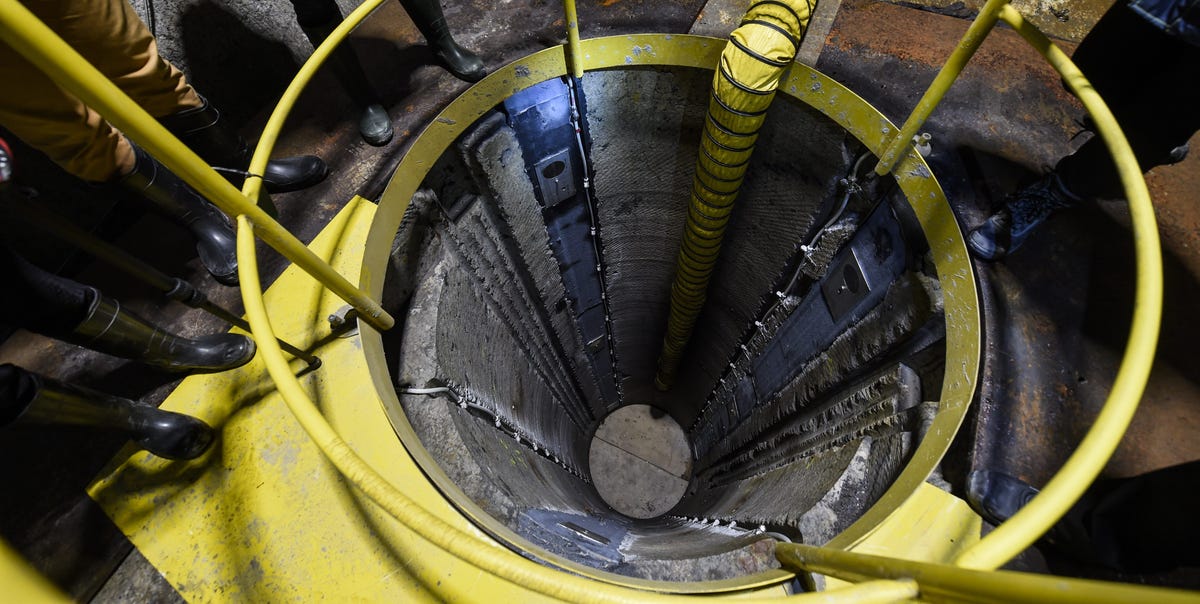
Finally, there’s the big one: hundreds of meters of stable crystalline bedrock. The repository is carved deep
underground so that surface weather, most human activity, and many environmental changes are less likely to disturb it.
A Quick Tour of the Underground Layout
Onkalo is not a single spooky chamber with a dramatic door (sadly for movie posters). It’s a network of tunnels and deposition
areas engineered for industrial-scale placement of waste packages over decades.
Step 1: Cool It First (A Lot)
Spent fuel doesn’t go straight from a reactor into a deep tomb. In many nuclear programs, fuel is first stored in water-filled
pools for cooling and radiation shielding, then often transferred to dry storage. The basic idea is to let the heat and radiation
level drop before doing final packaging and disposal.
Step 2: Encapsulation and Handling
In the Onkalo concept, spent fuel is moved into heavy canisters as part of an encapsulation process. The handling is designed to
minimize human exposure, using remote systems and strict controls. Some reporting describes these canisters as extremely heavy,
emphasizing the industrial seriousness of the operation (this is not a “grab a box and a label maker” situation).
Step 3: The Downward Trip
The canisters travel down to repository depthroughly on the order of 400–450 meters underground in widely
reported descriptionsinto the tunnel system.
Step 4: Deposition Holes and Backfilling
Canisters are placed into vertical deposition holes, surrounded by bentonite clay. Over time, as sections are completed, tunnels
are backfilled and sealed. The end-state is intentionally boring: a quiet, filled-in underground space that doesn’t need active
cooling, pumping, or management.
What Could Go Wrong? The Uncomfortable (But Necessary) Questions
Designing for 100,000 years requires a special kind of humility. It’s not enough to say “the rock looks solid today.” The safety
case has to consider what might change and what failures still wouldn’t cause harm.
1) Corrosion and Chemistry
The biggest dinner-table debate in the technical community is often canister corrosion. Copper performs well in
many low-oxygen environments, but groundwater chemistry can be complicated. That’s why long-term disposal programs obsess over
geochemistry: sulfides, microbes, pressure, temperature, and tiny variations that could matter over long timeframes.
2) Groundwater Pathways
Water is the main vehicle that could transport radioactive materials if barriers failed. So repositories focus on limiting water
contact, slowing flow, and ensuring that even in pessimistic scenarios, radionuclides would move slowly and dilute before reaching
places where people live.
3) Ice Ages and Climate Whiplash
Finland has to plan for something most infrastructure projects ignore: glaciation. Over tens of thousands of
years, northern Europe can plausibly see major ice sheets again. Thick ice changes pressure, groundwater movement, and landforms.
A repository safety case must model those possibilities and still show acceptable performance.
4) Human Intrusion (a.k.a. “Future Humans With Shovels”)
One of the weirdest parts of nuclear waste management is deciding whether to mark the repository. Warning signs can erode. Symbols
can be misunderstood. And a giant monument might attract curious diggers like a “Treasure Here!” sign.
Some modern thinking leans toward making the final site intentionally unremarkablereduce the chance that someone, thousands of
years from now, decides to excavate because it looks important. (Nothing says “do not open” like “this looks extremely openable.”)
Why Finland Got This Far When Others Didn’t
The engineering is impressive, but Finland’s real superpower might be governance. Many countries know how to dig
tunnels; fewer know how to build public legitimacy for a project spanning multiple generations.
Reporting and analysis often highlight a “consent-based” flavor to siting in Finland and Sweden: communities are engaged early,
benefits and risks are discussed openly, and the process doesn’t start by bulldozing trust. That’s not the only ingredientFinland
also has a smaller nuclear fleet than some nationsbut it’s a major one.
What the United States Can Learn (Without Copy-Pasting Finland)
In the United States, commercial spent fuel is typically stored at reactor sites in pools and in dry casks, and the long-running
political challenges around permanent disposal have left the country without an operating deep geological repository for spent fuel.
That’s not because Americans forgot how to build; it’s because siting and governance are brutally hard.
US federal agencies have explored multiple disposal conceptsmined repositories in different rock types, and even deep boreholes
for certain waste formsbecause geology, waste types, and political constraints vary. Finland’s Onkalo is inspiring, but it isn’t a
plug-and-play solution for a bigger country with different laws, different geology, and different levels of local trust.
Still, Finland provides a concrete example of a core idea: permanent disposal is a project of institutions as much as
infrastructure. The technical case must be strong, but the social contract must also survive the next election cycle… and
the next… and the next 5,000 of them.
Common Misunderstandings (Clearing Up the Glow-in-the-Dark Stuff)
“Isn’t nuclear waste basically liquid evil?”
No. It’s hazardous, but it’s managed using well-understood engineering controls. The waste is solid, packaged, and handled with
layers of containment and shielding. The biggest challenge is longevity, not magic.
“Why not just recycle it?”
Some countries reprocess spent fuel, separating usable materials. But reprocessing has tradeoffs: cost, complexity, and
proliferation concerns, plus it still leaves radioactive waste that needs disposal. “Recycle” helps in certain strategies; it
doesn’t erase the disposal problem.
“Why not launch it into space?”
Because rockets sometimes fail, and a launch accident would be an extremely bad day. Geological disposal is attractive precisely
because it becomes passiveno ongoing power, no pumps, no daily heroics required.
Conclusion: A Quiet Promise Across Deep Time
Onkalo is often described as a “tomb,” but it’s really a pledge: the people who benefited from nuclear energy take responsibility
for what remains. Finland’s repository doesn’t claim perfection. It claims something more realisticlayered protection, conservative
modeling, and a design meant to keep working even after all the paperwork turns to dust.
If it succeeds, the greatest compliment Onkalo could receive is also the least exciting: future humans never think about it at all.
Just a patch of ordinary land above an extraordinary act of long-term engineeringquietly doing its job for 100,000 years.
Experience Add-On: What It Feels Like to Stand at the Doorway of 100,000 Years
Imagine traveling to Finland’s west coast on a gray, sea-scented morning, where the landscape looks like it’s been edited for calm:
pines, rock, and that particular northern light that makes everything feel freshly rinsed. There’s no cinematic skull-shaped mountain,
no dramatic thunderclap. Just infrastructureroads, fencing, signsbecause the most serious projects rarely come with mood lighting.
The “tomb” vibe creeps in slowly. It starts when you realize the surface buildings are almost the least important part. The real
project lives below your feet, and it’s measured in geology, not in construction seasons. You pass safety checks and procedure
reminders, and you start to feel the weight of the placenot fear, exactly, but responsibility. The tone is closer to a hospital
than a haunted house: serious, methodical, and allergic to improvisation.
If you picture an underground descent, you might imagine a rickety elevator and a horror-movie flicker. In reality, the mind-bender
is the opposite: how normal it can seem. The ride down is controlled, deliberate, and engineered to be boring. Then the doors open
into a tunnel that looks like a cross between a subway service corridor and a mining operationlong, lit, and relentlessly practical.
Sound changes underground; footsteps have a crisp echo, and conversations feel smaller, as if the rock itself is listening politely
but not planning to respond.
The deeper you go, the more your sense of time gets weird. Your phone might still say it’s Tuesday, but your brain starts doing
accidental math. You think: “How old is the bedrock?” Then: “How long is 100,000 years?” Then you remember that 100,000 years ago,
modern cities weren’t even a rumor. Suddenly, the usual human scaledeadlines, calendars, trending topicsfeels like confetti.
Standing in a broad tunnel, you can picture the future operation: heavy canisters moved with extreme care, placed into deposition
holes, wrapped in swelling bentonite clay, and then sealed behind layers of backfill. It’s not dramatic in the action-movie way.
It’s dramatic in the “this is what adulthood looks like” way. Every step says: don’t rely on luck; rely on redundancy.
The strangest emotional moment might be the simplest: realizing that success looks like disappearance. Eventually, the tunnels are
meant to be filled and sealed. The work is designed to end. No grand monument. No permanent staff. No “Welcome Back!” sign for the
year 12,026. The place aims to become forgettable on purposebecause the safest legacy for hazardous material is to be managed so
well that it never becomes a story again.
When you return to the surface, the air feels louder. Trees move in the wind. A gull complains about something important, like being
a gull. And you’re left with a lingering thought: we build plenty of things for ourselves, but Onkalo is one of the rare projects
built for people who will never know our names. That’s a humbling kind of engineeringequal parts science, ethics, and deep-time
patience.