Sending a spacecraft to Mars is already the aerospace equivalent of threading a needle while riding a roller coaster. Now imagine trying to do it with a rocket built largely by giant metal 3D printers, backed by two young companies that want to turn deep space into something closer to a delivery route than a once-in-a-generation stunt. That was the big, eyebrow-raising promise behind the Relativity Space and Impulse Space plan to launch a commercial Mars mission using a 3D printed rocket.
When the partnership was announced in 2022, the target was as early as 2024: a private mission to carry an Impulse Space Mars vehicle on Relativity Space’s Terran R rocket, then deliver a commercial payload to the Red Planet’s surface. The date was bold. In hindsight, it was also extremely aggressive. The mission did not launch in 2024, and Terran R has continued development toward a later debut. Still, the story remains important because it captures a turning point in spaceflight: private companies are no longer talking only about launching satellites. They are talking about building a repeatable path to Mars.
Why This Mars Plan Turned Heads
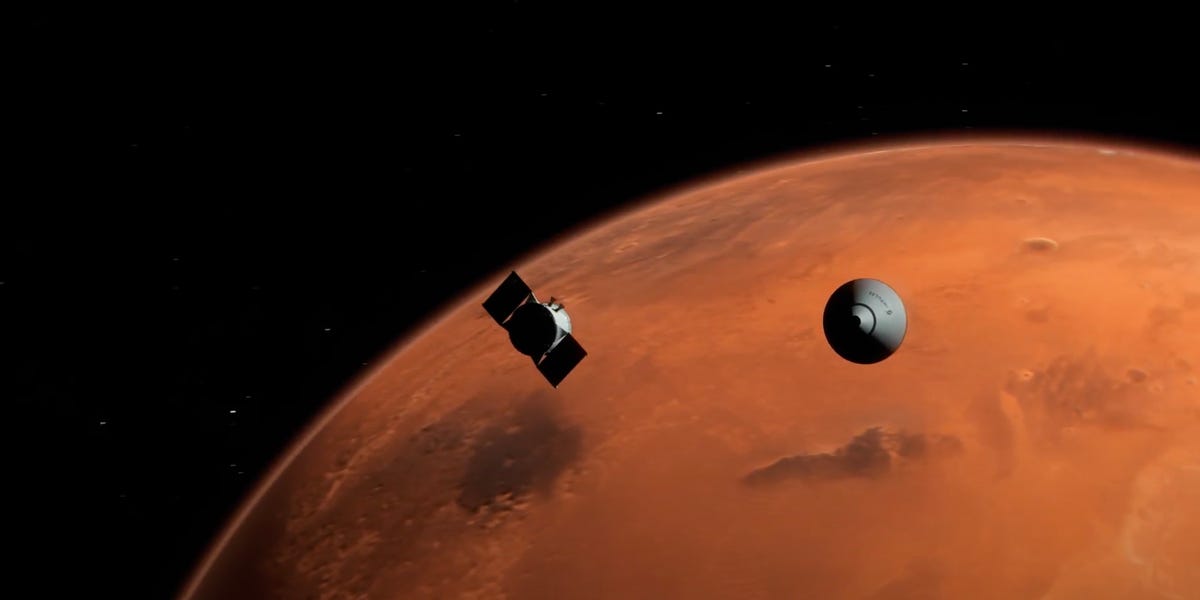
The mission concept sounded like something from a science-fiction pitch meeting: launch from Cape Canaveral, send a Mars cruise vehicle across interplanetary space, separate an entry capsule near the planet, survive the brutal dive through the Martian atmosphere, and land a payload on the surface. The twist was the launch vehicle. Relativity Space planned to use Terran R, a reusable rocket built with large-scale additive manufacturing, better known as industrial 3D printing.
This was not desktop printing with plastic filament and a hopeful hobbyist whispering, “Please don’t warp.” Relativity’s approach uses massive robotic systems to print metal rocket structures. The company’s larger vision is to reduce part counts, simplify supply chains, speed up design changes, and eventually manufacture complex aerospace hardware with less dependence on traditional tooling. In simple terms: fewer pieces, fewer welds, fewer headaches, and ideally fewer engineers staring into the middle distance at 2 a.m.
The Companies Behind the Mission
Relativity Space: The 3D Printed Rocket Builder
Relativity Space, based in Long Beach, California, became famous for pursuing rockets made largely through 3D printing. Its first vehicle, Terran 1, launched in March 2023. The rocket did not reach orbit because of an upper-stage anomaly, but it passed key flight milestones, including the high-stress Max-Q portion of ascent. For a rocket made mostly with printed metal structures, that was a major proof point: the vehicle got off the pad, flew through heavy aerodynamic loads, and demonstrated that printed rocket bodies were not just a flashy manufacturing gimmick.
After that flight, Relativity retired Terran 1 and shifted focus to Terran R, a much larger reusable rocket aimed at the commercial launch market. Terran R is designed for heavier payloads and broader missions, including satellite deployments and potentially deep-space launches. The Mars mission plan with Impulse Space made Terran R more than a business rocket; it made it a symbol of the company’s long-term ambition.
Impulse Space: The In-Space Transportation Specialist
Impulse Space was founded by Tom Mueller, a propulsion veteran and one of SpaceX’s earliest employees. The company focuses on in-space transportation: moving payloads after launch, changing orbits, reaching more difficult destinations, and eventually supporting missions beyond Earth orbit. For the Mars plan, Impulse Space would provide the Mars cruise vehicle, entry system, and lander.
That division of labor makes sense. Relativity handles the big throw from Earth. Impulse handles the deep-space delivery. If launch is the cannon shot, Impulse is the carefully guided arrow after the rocket has done its roaring, smoky, crowd-pleasing part.
How a 3D Printed Rocket Changes the Conversation
Traditional rocket manufacturing is painfully complex. Large rockets can contain thousands of parts, many of which require specialized tooling, long lead times, and delicate assembly. Additive manufacturing changes the equation by allowing engineers to print complex shapes directly from digital designs. Instead of building a component from many smaller parts, a company can print larger integrated structures.
That matters for rockets because every kilogram, joint, bracket, valve, and weld has consequences. Rockets are basically controlled explosions wearing business suits. When manufacturing becomes simpler, engineers can iterate faster. When designs can be updated digitally, hardware development can move closer to software-style improvement cycles. No, a rocket will never be as easy to update as an app. If your app crashes, people complain. If your rocket crashes, everyone gets a press release and a root-cause investigation.
Relativity’s Stargate printing platform is central to this vision. The company has promoted the idea that autonomous 3D printing could reduce the number of parts in launch vehicles and make production more flexible. For missions to Mars, this idea carries an even bigger implication: one day, manufacturing tools may need to work beyond Earth. A future Mars settlement cannot wait six months for a replacement bracket to arrive by interplanetary mail.
The Mission Architecture: From Earth to Mars
The proposed Mars mission involved several difficult steps. First, Terran R would launch from Florida and place the Impulse Space Mars vehicle onto a trajectory toward Mars. This maneuver is known as trans-Mars injection, and it requires careful timing because Earth and Mars only line up favorably about every 26 months.
After launch, the cruise vehicle would spend months traveling through interplanetary space. During that period, it would need power, communications, navigation, thermal control, and propulsion capability. Deep space is not empty in the way a quiet room is empty. It is cold, radiation-filled, unforgiving, and very bad at offering roadside assistance.
Near Mars, the entry capsule would separate and aim for the atmosphere. This is where the mission becomes especially difficult. Mars has enough atmosphere to burn up spacecraft but not enough to slow them down easily. Engineers often call Mars entry, descent, and landing one of the hardest problems in planetary exploration. The spacecraft must survive heating, slow down, deploy systems at precise times, and land without turning into an expensive crater.
Why the 2024 Target Was So Ambitious
The original 2024 timeline grabbed attention because it compressed a huge amount of development into a short window. Terran R had not yet flown. Impulse’s Mars vehicle still required development, testing, integration, and mission validation. A Mars launch window does not politely wait while teams finish paperwork. If a company misses the opportunity, the next favorable alignment comes roughly two years later.
That is why the 2024 goal should be understood as a statement of ambition rather than a completed milestone. The mission did not happen in 2024, but the announcement still pushed the industry conversation forward. It suggested that Mars could become a commercial destination, not just a government science target. It also showed how quickly new space companies are willing to set goals that would have sounded outrageous a generation ago.
The Business Case for a Commercial Mars Mission
At first glance, Mars does not look like a practical business destination. There are no hotels, no fuel stations, no coffee shops, and no one to complain about slow Wi-Fi. But commercial Mars missions could eventually serve governments, universities, research institutions, technology companies, and future infrastructure builders.
NASA has already demonstrated the value of commercial partnerships in low Earth orbit and lunar delivery services. If private companies can lower the cost of reaching Mars, more experiments and instruments could fly. Instead of waiting many years for a flagship mission, smaller payloads might hitch rides on commercial landers. That could accelerate science, test technologies, and create a market for planetary logistics.
The early market would likely be small and risky. But so was the early satellite market. So was commercial launch. So was reusable rocketry. Space businesses often begin as ideas that sound financially suspicious until the technology matures and the demand becomes visible.
What Terran 1 Proved Before Terran R
Terran 1’s 2023 flight is a key part of the story because it moved 3D printed rocketry from factory demonstration to flight reality. Although the rocket did not reach orbit, it survived major portions of ascent. That matters because critics of large-scale 3D printed rockets often wondered whether printed structures could handle launch loads at full scale.
The flight gave Relativity valuable data and a dramatic lesson in the oldest truth of aerospace: testing is the price of progress. Rockets rarely become reliable because everything goes perfectly the first time. They become reliable because engineers gather data, find weaknesses, redesign parts, and try again. The glamour is in the launch footage. The actual progress is in the spreadsheets, telemetry, and meetings where nobody wants to be the person who says, “Let’s revisit the valve behavior.”
Why Mars Is Harder Than It Looks
Mars has defeated many missions over the decades. Reaching the planet requires precise orbital mechanics, durable spacecraft systems, and reliable communications across millions of miles. Landing is even harder. A lander must hit a narrow atmospheric corridor, manage intense heating, slow down from interplanetary speeds, and touch down safely on uneven terrain.
For a commercial company, the challenge is not only technical. It is also financial and operational. Investors need confidence. Customers need payload opportunities. Regulators need safety reviews. Engineers need schedules that do not violate the laws of physics or human sleep. A private Mars mission must succeed not just as a spacecraft, but as a business model.
The Bigger Meaning of 3D Printing for Space Exploration
The most exciting part of this story may not be the original 2024 date. It may be the manufacturing philosophy behind the rocket. Space exploration has always depended on extreme customization. That makes hardware expensive and slow. Additive manufacturing offers a path toward faster design cycles and more adaptable production.
In the long run, 3D printing could matter on the Moon, Mars, and in orbital construction. Crews may need to print tools, replacement parts, brackets, habitat components, or even structural elements using local materials. The dream is not simply to print rockets on Earth. The dream is to make space infrastructure less dependent on Earth.
Relativity Space has often framed its technology in that wider context. If humanity wants to become multiplanetary, it will need manufacturing methods that can travel. You cannot build a civilization with overnight shipping when the shipping lane is 140 million miles long.
What Happened After the 2024 Goal?
The 2024 Mars target slipped, and that is not surprising. Terran R remained in development, and Relativity adjusted its strategy after Terran 1. The company moved away from the smaller rocket and concentrated on the larger reusable vehicle that better fits commercial demand. Impulse Space, meanwhile, continued building its in-space transportation capabilities.
In aerospace, schedule slips are not automatically signs of failure. Sometimes they are signs that reality has entered the meeting room and taken a chair. The important question is whether the underlying technology and market still make sense. In this case, the answer remains interesting. Commercial Mars delivery is still difficult, but the need for lower-cost planetary access has not disappeared.
Specific Examples That Show the Trend Is Real
NASA’s Perseverance rover showed the traditional high-end Mars model: a major government mission, launched on a proven rocket, with years of planning and a sophisticated landing system. NASA’s commercial lunar payload program showed a different model: paying private companies to deliver instruments to another world. Relativity and Impulse tried to extend that commercial logic to Mars.
Meanwhile, reusable rockets have already changed expectations in Earth orbit. SpaceX made booster landings seem almost normal, which is wild if you pause long enough to remember that a skyscraper-sized machine falling from space and landing upright is not normal. Blue Origin, Rocket Lab, Firefly, and other companies have also pushed new commercial models. The Mars plan fits into this broader movement: private companies are taking on missions once reserved for national agencies.
Challenges Still Ahead
Several challenges remain before a 3D printed rocket can help deliver a private payload to Mars. Terran R must fly successfully. The Mars vehicle must prove it can operate in deep space. The lander must survive entry, descent, and landing. Customers must trust the service. Insurance, regulation, launch range coordination, planetary protection, and communications infrastructure all matter.
There is also the question of reliability. Additive manufacturing can reduce complexity, but it must meet aerospace quality standards every time. Printed metal parts require inspection, validation, repeatability, and careful process control. In rocketry, “probably fine” is not a quality assurance category.
Why the Story Still Matters
Even though the 2024 date came and went, the ambition behind the mission remains worth watching. Relativity Space and Impulse Space helped make a once-radical idea feel discussable: a commercial company could send a payload to Mars using a rocket manufactured in a radically different way.
That is how aerospace changes. First, an idea sounds ridiculous. Then it becomes a test article. Then it becomes a failed launch with useful data. Then it becomes a working system. Then, one day, people act as if it was obvious all along. Reusable rockets followed that path. Commercial crew followed that path. A 3D printed rocket to Mars may be somewhere near the messy, fascinating middle of that journey.
Experience Notes: Lessons from Following the 3D Printed Rocket to Mars Story
The first experience this story offers is a lesson in healthy skepticism. When a company announces a Mars mission “as early as” a certain year, that phrase deserves attention. “As early as” is doing a lot of work. It means the date is possible under favorable conditions, not guaranteed by cosmic contract. Readers, investors, and space fans should enjoy ambitious timelines without mistaking them for completed missions.
The second lesson is that failure can be productive when it produces data. Terran 1 did not reach orbit, but it still answered important questions about large-scale 3D printed rocket structures. In engineering, partial success can be extremely valuable. That is difficult for casual observers because launches look binary: orbit or no orbit, success or failure, champagne or awkward press conference. Real development is more layered. A test can fail its headline goal and still move the technology forward.
The third experience is about the power of manufacturing. People often focus on engines, payloads, and dramatic launch videos, but the factory may be just as important as the rocket. If 3D printing can shorten production cycles and reduce complexity, it could reshape how launch vehicles are designed. The companies that win the next phase of spaceflight may not simply have the best rockets. They may have the best way to build, test, modify, and rebuild them.
The fourth lesson is that Mars punishes optimism that is not backed by systems engineering. A Mars mission requires launch performance, spacecraft reliability, navigation accuracy, thermal control, communications, planetary entry technology, and landing precision. Every subsystem must cooperate across months and millions of miles. One weak link can end the mission. Mars is not impressed by branding, pitch decks, or dramatic renderings.
The fifth experience is more inspiring: ambitious goals pull talent forward. Even when timelines slip, a serious attempt to commercialize Mars delivery can attract engineers, suppliers, customers, and public attention. It gives teams a difficult target and forces them to build capabilities that may be useful for many other missions. A company aiming for Mars may end up improving launch manufacturing, satellite deployment, in-space propulsion, or lunar logistics along the way.
For students, makers, and entrepreneurs, the takeaway is simple: big ideas need both imagination and brutal honesty. Relativity Space and Impulse Space showed imagination by proposing a private Mars landing with a 3D printed rocket. The industry’s next step requires the brutal honesty of testing, delays, redesigns, and real flight results. That combination is not as tidy as a movie montage, but it is how hard technology becomes real.
Conclusion
“An ambitious team aims for Mars in 2024 with a 3D printed rocket” is more than a catchy headline. It is a snapshot of a space industry becoming faster, stranger, more commercial, and more willing to challenge old assumptions. The 2024 target did not become a launch, but the idea behind it still matters: 3D printed rockets could reduce manufacturing friction, private companies could expand access to deep space, and Mars may eventually become a destination served by more than government flagship missions.
Relativity Space and Impulse Space may not have rewritten Mars history on the original schedule, but they helped widen the industry’s imagination. In spaceflight, imagination is not enough. You still need engines, structures, software, money, patience, and a disturbing number of checklists. But without imagination, nobody points a printed metal rocket toward Mars in the first place.
Note: This article is written for web publication and is based on publicly available information from official aerospace sources, NASA educational materials, and reputable U.S. space and technology reporting. No external source links or citation placeholders are embedded in the article body.