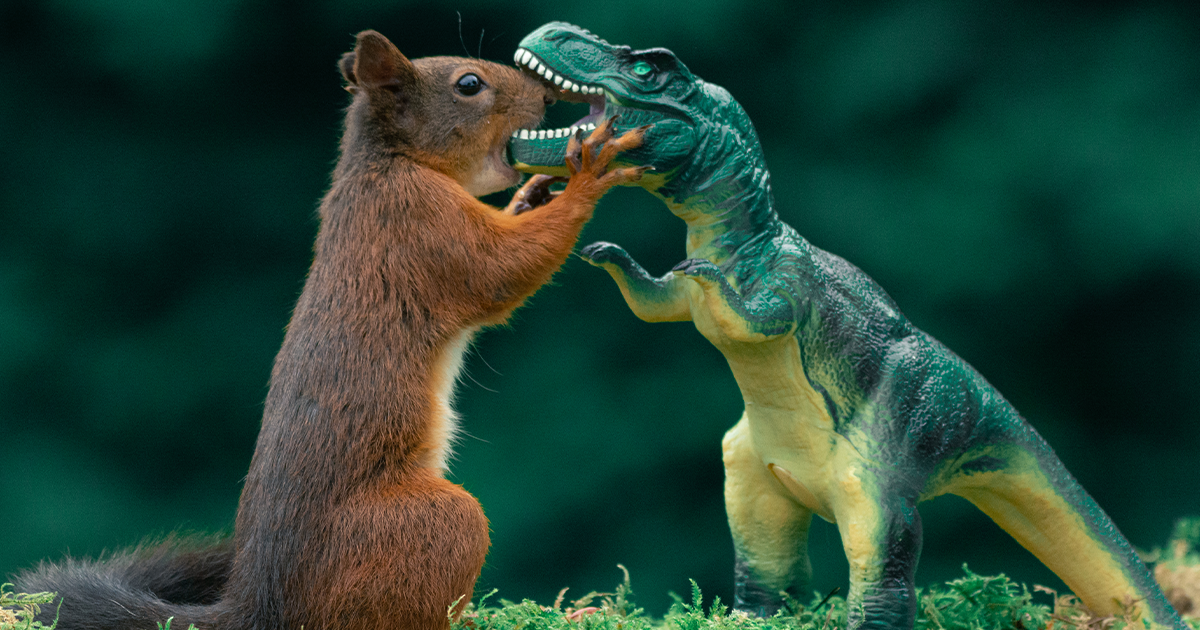
If you ever needed proof that nature has a sense of humor, allow me to present the extremely serious, absolutely scientific, and completely delightful spectacle of squirrels interacting with dinosaurs. Not real dinosaurs, obviously. If that had happened, I would not be writing this article. I would be busy collecting every journalism award on Earth.
Instead, this photo series turns a simple idea into a genuinely memorable visual story: quick, curious squirrels meeting tiny dinosaur props in the woods and behaving as if they have just wandered into the world’s smallest blockbuster. The result is funny, chaotic, oddly cinematic, and much more skillful than it looks at first glance. These pictures work not just because squirrels are cute or because dinosaurs are cool, but because they combine timing, patience, wildlife knowledge, and a playful imagination that never feels forced.
That is what makes 19 Pictures Of Squirrels Interacting With Dinosaurs Taken By Me such a fun concept for readers. On the surface, it is adorable nonsense. Underneath, it is a smart piece of visual storytelling built on real squirrel behavior: curiosity, speed, food-caching instincts, and a total refusal to behave like trained performers. In other words, the squirrels are not actors. They are tiny freelancing chaos goblins. The photographer’s job is simply to be ready when the magic happens.
Why This Squirrel-and-Dinosaur Photo Series Works So Well
The best animal photography usually gives us one of two things: wonder or personality. This series manages to deliver both. The wonder comes from the scene itself. A squirrel perched on a toy T. rex, staring down a plastic predator, looks like a freeze-frame from the world’s cutest survival movie. The personality comes from the squirrel. Every head tilt, tail flick, leap, pause, and snack-grab makes the animal look less like a generic woodland creature and more like a tiny, opinionated main character.
There is also a built-in contrast that makes the images instantly clickable. Dinosaurs are giant, ancient, dramatic, and associated with thunderous danger. Squirrels are small, modern, twitchy, and associated with backyard acrobatics and stolen birdseed. Put them together and the scale joke writes itself. Suddenly the dinosaur seems ridiculous, the squirrel seems brave, and the viewer gets a visual punchline in a split second.
But here is the thing that separates a forgettable gimmick from a genuinely strong photo set: the scenes still feel rooted in nature. The squirrels are not over-styled. The props do not overwhelm the frame. The humor comes from the interaction, not from digital trickery or over-editing. That gives the pictures a handmade charm. They feel discovered, not manufactured, and that authenticity is a big part of their appeal.
The Real Squirrel Behavior Behind the Funny Pictures
Curiosity does most of the heavy lifting
Squirrels are naturally curious, especially when something unfamiliar appears in their territory. That curiosity is gold for a photographer. A plastic dinosaur placed in the right spot is not just a prop; it is a question mark. The squirrel approaches, sniffs, circles, climbs, grabs the nut, and creates a moment that no storyboard could fully predict.
Food is the motivator, but timing is the real star
Anyone who has spent time photographing wildlife knows that snacks may bring an animal near the scene, but they do not guarantee a compelling shot. The actual image depends on timing. Squirrels move fast, change direction faster, and have zero interest in your shooting schedule. That is why the best squirrel photography often depends on patience, burst shooting, careful observation, and the willingness to accept that many setups will produce absolutely nothing except a numb leg and a renewed respect for rodents.
Squirrels are smarter than people give them credit for
Part of the fun in these images is that squirrels already seem like little strategists. Real research backs up that impression. Squirrels cache food, use spatial cues to relocate stash sites, and sometimes even fake-bury food to throw off thieves. That means they are not just cute props in a human joke. They are active participants with sharp instincts, quick decisions, and surprisingly complex behavior. When a squirrel appears to “outsmart” a dinosaur toy by stealing the walnut from its mouth, the comedy lands because it feels believable.
Urban and backyard wildlife already lives close to us
Another reason these images resonate is that squirrels are familiar. They are not distant safari animals. They are the unofficial gymnasts of parks, gardens, campuses, and neighborhood trees. Because they already live close to people, a playful series like this feels accessible. It says you do not need a plane ticket or a giant production budget to make memorable wildlife images. Sometimes the most entertaining subject is the squirrel glaring at you from the fence like you owe him rent.
19 Picture Moments That Give the Series Its Personality
- A squirrel freezes nose-to-snout with a toy T. rex, looking like it is conducting a very tense diplomatic summit.
- One brave little acrobat climbs onto a dinosaur’s back as if it just invented woodland rodeo.
- A walnut balanced in a reptilian jaw turns the whole scene into a prehistoric snack trap.
- A squirrel leaps across the frame, tail flying behind it like a fuzzy action-movie cape.
- Another pauses on a dinosaur’s head with the expression of a tiny conqueror surveying new territory.
- One image feels like a chase scene, even though the “monster” cannot move and the squirrel knows it.
- A side glance from the squirrel makes it look deeply unimpressed by 65 million years of hype.
- A perfectly timed paw placement creates the illusion that the squirrel is steering the dinosaur.
- One squirrel appears to whisper a secret into a plastic ear, which is both charming and mildly unhinged.
- A mid-bite photo transforms a simple snack grab into a heroic survival moment.
- The contrast between rough bark, soft fur, and glossy toy scales adds unexpected visual texture.
- A low angle makes the dinosaur look huge for half a second, until the squirrel casually ruins the illusion.
- One frame suggests friendship, another suggests theft, and both are equally believable.
- A squirrel peeking from behind a dinosaur tail looks like the world’s smallest special-effects reveal.
- There is always one shot where the animal seems to be judging the entire project. That one is essential.
- A blurred leap becomes useful rather than wasted, because motion adds energy and a sense of surprise.
- The funniest images often come from near-misses, when the squirrel barely acknowledges the prop at all.
- A perfectly centered shot turns the meeting into a mock movie poster for a woodland blockbuster.
- The strongest image usually feels accidental: one split second where curiosity, movement, light, and comedy all agree to cooperate.
How I Approach Squirrel Photography Without Overdoing the Gimmick
Keep the setup simple
When the concept is this playful, there is a temptation to make it bigger, louder, and busier. That would be a mistake. A strong squirrel photo series works best when the environment still feels natural. A single dinosaur prop, clean composition, and one clear action beat are usually enough. If the frame gets crowded, the joke disappears.
Let the animal lead the scene
The squirrel decides whether the picture happens. Period. Good wildlife photography means respecting that fact. You do not chase, corner, or force an interaction. You wait. You learn the routes the squirrels prefer. You notice where they hesitate, where they perch, where they jump, and when they are comfortable enough to ignore your presence. That respect does not weaken the image. It improves it.
Authenticity matters more than perfection
One reason these pictures feel so satisfying is that they do not rely on obvious digital fakery. In a time when audiences are increasingly skeptical about manipulated wildlife images, practical setups feel refreshing. A real squirrel, a real prop, a real outdoor setting, and a real split-second reaction carry a charm that Photoshop cannot imitate.
Humor and craft can coexist
Funny photography is sometimes treated as if it is less serious than dramatic landscape work or classic wildlife portraiture. That is nonsense. Comedy still requires composition, timing, light, subject knowledge, and editing judgment. In fact, humor can be harder because the image has to work instantly. If viewers do not get the joke right away, the frame loses power. A squirrel photo series like this succeeds because it is playful without being sloppy.
What Readers Love Most About “19 Pictures Of Squirrels Interacting With Dinosaurs Taken By Me”
Readers love images like these because they offer a rare mix of comfort and surprise. The comfort comes from the subject. Squirrels are familiar, lively, and expressive. The surprise comes from the setup. Dinosaurs belong to fantasy, movies, childhood obsession, and big-screen chaos. Put the two together and the brain does a tiny double take. That moment of “Wait, what am I looking at?” is exactly what strong shareable content needs.
There is also a wider appeal here for people who enjoy squirrel photography, funny animal pictures, dinosaur toy photography, and lighthearted wildlife storytelling. The series does not depend on expensive gear talk or insider photography jargon. It invites ordinary readers in. You do not need to understand shutter speed to enjoy a squirrel stealing lunch from a toy velociraptor like it is the most natural thing in the forest.
That accessibility is important for SEO, too. Articles built around visual humor often perform best when they balance entertainment with useful context. Readers want the cute pictures, yes, but they also want the backstory: how the idea happened, why squirrels behave the way they do, what makes the photos work, and whether they could try something similar themselves. That is where the article earns its keep instead of acting like a flimsy caption stretched into a page.
My Experience Photographing Squirrels and Dinosaurs
What surprised me most while working on this idea was how quickly a silly concept turned into a lesson in patience. On paper, photographing squirrels with toy dinosaurs sounds like one of those projects that should come together in an afternoon. Put down a prop, toss in a walnut, click a few frames, and go home feeling like a woodland Spielberg. Reality had other plans. The squirrels did not care about my concept art, my imagined shot list, or my desire to create a tiny prehistoric epic before lunch. They cared about safety, timing, snack opportunities, and whether the weird plastic creature in front of them looked suspicious.
That was actually the best part. Instead of controlling everything, I had to slow down and pay attention. I started noticing how squirrels approach new objects, how they pause before committing to a jump, how quickly they abandon a route that feels wrong, and how often the funniest moments happen just before or just after the shot you thought you wanted. The images became better when I stopped trying to direct them like actors and started treating them like wild neighbors with strong opinions and very busy schedules.
I also learned that props only work when they support the natural behavior rather than overpower it. The dinosaur was there to create a visual twist, but the squirrel still had to remain the star. If the prop looked too dominant, the frame felt staged in a bad way. If it was placed naturally, suddenly everything clicked. The squirrel climbing over a dinosaur’s back did not look forced. It looked like a curious animal using the landscape the way squirrels use every stump, branch, fence, and garden ornament they encounter.
Emotionally, the project was a great reminder that playful art still takes real work. There were quiet stretches with no useful frames, awkward angles, empty branches, and moments where I thought the entire setup was too ridiculous to succeed. Then, without warning, a squirrel would dart into place, grab the walnut, plant one tiny paw on a dinosaur skull, and hand me the exact kind of image that makes all the waiting feel worthwhile. Those moments were brief, but they felt electric.
Most of all, the experience made me appreciate squirrels more. They are often treated as background wildlife, the little gray or red blur people barely notice in parks and yards. But once you spend time watching them closely, they become endlessly entertaining. They are athletic, expressive, adaptable, and a little dramatic in the best possible way. Pair that with a dinosaur prop and you do not just get a joke. You get a character study with fur, claws, and excellent comedic timing.
Final Thoughts
19 Pictures Of Squirrels Interacting With Dinosaurs Taken By Me is the kind of title that instantly makes people curious, and the concept behind it earns that curiosity. It is funny, yes, but it also highlights something genuinely lovely about wildlife photography: the best images often come from meeting familiar animals on their terms and letting imagination do the rest. Squirrels bring the speed, instincts, and attitude. Dinosaurs bring the absurdity. The camera simply catches the moment where the two worlds collide.
And honestly, that may be the secret sauce. Great visual content does not always need to be grand or serious. Sometimes it just needs one clever idea, a patient eye, and a squirrel willing to turn a toy dinosaur into the funniest co-star on the internet.