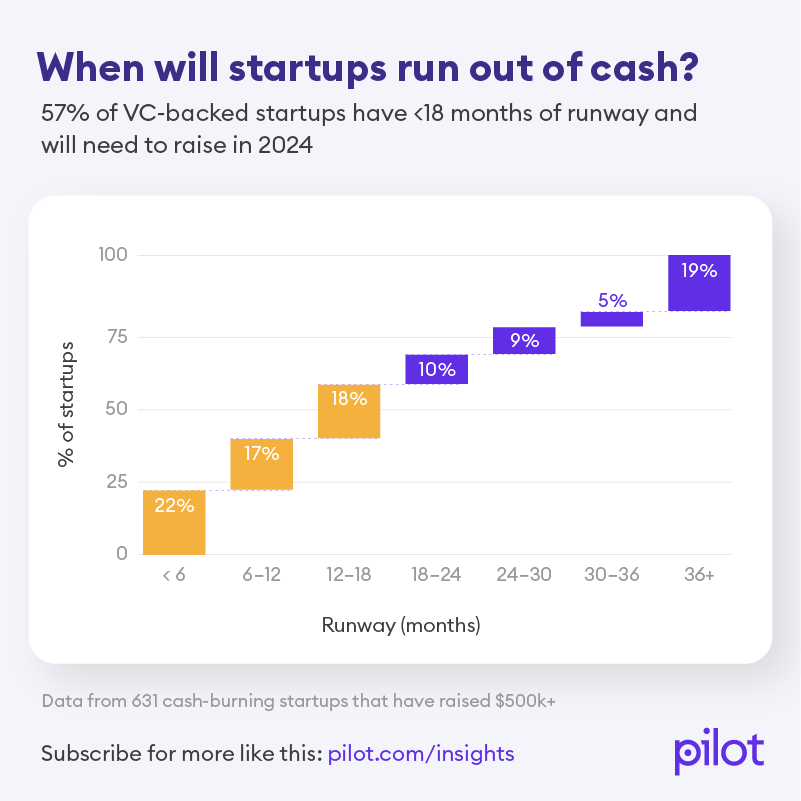
For venture-backed startups, 2024 arrived like a board meeting with no snacks: tense, necessary, and slightly uncomfortable. Pilot’s analysis of startup cash balances found that 57% of venture-backed startups had fewer than 18 months of runway remaining, meaning many would likely need to raise more capital by mid-2024 if they followed the usual fundraising rule of starting the process with at least six months of cash left.
That single statistic tells a much bigger story. The venture market was not completely closed, but it was no longer the easy-money buffet of 2020 and 2021. Investors became more selective, valuations cooled, IPO markets stayed sluggish, and founders had to prove something that sounded painfully old-fashioned: the business could eventually make money.
In other words, “growth at all costs” was quietly replaced by “growth, but please bring receipts.”
Why Pilot’s 57% Runway Warning Matters
Runway is the amount of time a startup can keep operating before it runs out of cash. If a company has $2 million in the bank and burns $200,000 per month, it has about 10 months of runway. Simple math, terrifying emotional impact.
Pilot’s 57% figure is important because fundraising itself takes time. A founder rarely wakes up on Monday, sends five emails, and closes a round by Friday unless that founder is selling artificial intelligence to people who already own three Patagonia vests. In a normal environment, fundraising can take three to six months. In a tougher market, it may take longer, especially for startups without strong revenue growth, efficient customer acquisition, or a clear path to profitability.
That means a company with 12 months of cash does not really have 12 months to “figure things out.” It may have six months to improve metrics, start investor conversations, update the pitch deck, clean up financial reporting, and decide whether to raise equity, pursue venture debt, cut costs, or seek a strategic acquisition.
The Venture Market Changed After the Boom Years
To understand why so many startups needed to raise more in 2024, you have to rewind to the boom. During 2020 and 2021, venture capital flowed quickly. Low interest rates pushed investors toward riskier assets, software companies were rewarded for fast growth, and many startups raised large rounds at generous valuations.
Then the market shifted. Interest rates rose, public technology stocks corrected, IPO windows narrowed, and venture firms became more cautious. Startups that had raised money at high valuations suddenly faced a very different investor mood. The question was no longer, “How fast can this company grow?” It became, “How efficiently can this company grow, and does it deserve another round?”
That shift created a funding gap. Many startups had enough cash to survive for a while, but not enough to comfortably reach the next milestone. Others had raised at valuations that were difficult to justify in the new market. For those companies, raising more money in 2024 was possible, but it often came with harder terms, lower valuations, or pressure to show real traction.
AI Startups Had the Spotlight, But Not Everyone Got the Confetti
One of the strangest parts of the 2024 venture market was that funding headlines often looked better than the founder experience felt. Artificial intelligence attracted enormous investor interest, and large AI rounds helped lift overall venture totals. But that did not mean capital was evenly available across the startup ecosystem.
For AI infrastructure companies, model companies, and startups with obvious enterprise AI use cases, investors were willing to write big checks. For many other startups, especially those in crowded SaaS categories, consumer products, or sectors with slower revenue growth, fundraising remained difficult.
This created a two-speed venture market. On one side: AI companies with hot narratives, huge market maps, and investors eager to get exposure. On the other side: perfectly reasonable startups being asked to show better margins, stronger retention, lower burn, and more disciplined hiring before anyone reached for the checkbook.
What Investors Wanted in 2024
In 2024, investors did not stop caring about growth. They simply became allergic to sloppy growth. A startup could still raise capital, but the bar was higher. Founders needed to demonstrate that each dollar spent created meaningful business value.
1. Strong Revenue Growth
Revenue growth remained the headline metric. Investors wanted to see that customers were buying, renewing, expanding, and ideally not requiring heroic levels of discounting. A startup growing revenue efficiently had a far better fundraising story than one growing mostly through expensive experiments and optimistic spreadsheets.
2. Lower Burn Rate
Burn rate became a boardroom obsession. Founders had to know exactly where cash was going and which expenses directly supported growth. Fancy offices, oversized teams, and “brand awareness” campaigns with mysterious ROI became harder to defend.
3. Clear Path to Profitability
Profitability did not have to arrive tomorrow, but investors wanted to see the route on the map. Startups that could explain when margins would improve, how customer acquisition costs would decline, and what operational leverage would look like had an advantage.
4. Better Financial Reporting
Messy books became a liability. In a competitive fundraising market, founders needed clean monthly financials, accurate cash forecasts, reliable revenue metrics, and a believable operating plan. Nothing ruins investor confidence faster than a founder saying, “I think our gross margin is around… vibes.”
The Rise of Bridge Rounds and Insider Support
One visible trend in 2024 was the increased use of bridge rounds. A bridge round gives a startup more time before a larger priced financing. It can be useful when a company is close to important milestones but not quite ready for a full Series A, Series B, or later-stage round.
Bridge rounds can be helpful, but they are not magic. They often depend on existing investors’ confidence. If insiders believe the company can hit the next milestone, they may provide enough capital to extend runway. If insiders are skeptical, a bridge can become difficult or expensive.
For founders, the lesson is simple: communicate early. Investors dislike surprises, especially when the surprise is, “We have 11 weeks of cash left and our CFO just discovered a spreadsheet error named Final_Final_Actual_Real.xlsx.”
Down Rounds Became Less Taboo
A down round happens when a startup raises money at a lower valuation than its previous round. During the boom, down rounds were treated like something whispered about in dark hallways. By 2024, they became more common and, in many cases, more practical.
A down round is not automatically a death sentence. Sometimes it is simply the price of resetting expectations. If the company has real customers, strong technology, and a viable market, a valuation reset can give it the capital needed to keep building. The hard part is managing dilution, employee morale, and investor confidence.
Founders who handled down rounds well usually did three things: they were transparent, they preserved enough option pool to keep key employees motivated, and they used the reset to create a more realistic plan. Nobody loves a lower valuation, but everyone loves survival more than vanity.
Cost Cutting Was Not Just About Layoffs
When people hear “extend runway,” they often think of layoffs. Unfortunately, team reductions were part of the 2024 startup story. But smart cost management goes beyond cutting headcount.
Startups also renegotiated vendor contracts, reduced cloud waste, narrowed product roadmaps, delayed nonessential hires, consolidated software tools, and focused marketing spend on channels with measurable payback. Some companies moved from “hire ahead of growth” to “hire after proof.” That may sound less glamorous, but glamour does not pay AWS invoices.
The best founders did not cut randomly. They protected the parts of the business that created customer value and reduced spending that did not directly support retention, revenue, or product quality.
Why Some Startups Still Raised Successfully
Despite the tough environment, many startups did raise capital in 2024. The winners usually had one or more of the following advantages: rapid revenue growth, strong gross margins, a clear AI angle, enterprise demand, repeat founders, strategic investor interest, or unusually efficient operations.
For example, a vertical SaaS company serving a profitable niche with high retention could still attract investors, even if it was not the trendiest startup at the conference. A cybersecurity company solving a painful enterprise problem could still command attention. A health tech company with proven outcomes and strong compliance discipline could still build a serious case.
The point is not that fundraising became impossible. It became more honest. Investors wanted fewer fireworks and more evidence.
What Founders Should Do Before Raising More
For founders facing a 2024-style fundraising environment, preparation matters more than optimism. A good pitch deck is helpful, but a good operating plan is better. Before entering the market, founders should pressure-test the company from an investor’s point of view.
Know Your Runway by Scenario
Do not rely on a single cash forecast. Build a base case, conservative case, and aggressive case. Know what happens if revenue is 20% lower than expected, if fundraising takes six months instead of three, or if a major customer delays payment.
Show Milestone Discipline
Investors want to know what the next round will unlock. Will the money help reach $1 million in ARR, launch a regulated product, expand into enterprise accounts, or reach cash-flow breakeven? Capital should have a job description.
Clean Up the Data Room
A strong data room includes financial statements, cap table, customer metrics, contracts, pipeline data, hiring plan, product roadmap, and legal documents. If the data room looks like a junk drawer, investors will assume the business may be one too.
Talk to Insiders First
Existing investors can provide honest feedback and may help anchor a round. If insiders are not supportive, founders need to understand why before approaching new investors.
Alternative Capital Options for Startups
Raising a traditional equity round is not the only option. Some startups used venture debt, revenue-based financing, customer prepayments, strategic partnerships, grants, or acquisition conversations to extend runway.
Each option has trade-offs. Venture debt can reduce dilution but adds repayment obligations. Customer prepayments can validate demand but may create delivery pressure. Strategic partnerships can bring credibility but may limit flexibility. Acquisition talks can preserve value but may distract the team.
The best choice depends on the company’s stage, revenue predictability, investor support, and market position. The worst choice is pretending the cash problem will solve itself because the founder is “manifesting abundance.” Manifestation is not a treasury strategy.
The Founder Mindset Shift: From Blitzscaling to Building
The 2024 funding environment forced a healthier conversation about what makes a startup durable. Growth still mattered, but disciplined execution mattered more. Founders had to become better operators, not just better storytellers.
This was painful, but not entirely bad. Companies that survived learned to prioritize customers, measure cash carefully, and build products people actually needed. Teams became leaner. Roadmaps became sharper. Investor updates became more honest. The market, in its deeply annoying way, taught a useful lesson: a startup is not a fundraising machine with a product attached. It is a business.
Experience Section: Lessons From the 2024 Startup Fundraising Reality
One practical experience from the 2024 venture market is that founders who started fundraising early had far more options than those who waited until the cash balance looked like a phone battery at 2%. The old advice to begin fundraising with at least six months of runway became even more important. In a cautious market, investor conversations moved slowly. Partners wanted more diligence, more proof, and more time to compare deals. Founders who waited too long often found themselves negotiating from weakness.
Another lesson is that financial clarity became a competitive advantage. Startups with clean books, accurate burn forecasts, and clear unit economics could answer investor questions quickly. That created confidence. By contrast, founders who could not explain their cash conversion cycle, gross margin, customer acquisition cost, or net revenue retention looked unprepared, even if the product was promising. In 2024, the finance function was not just back-office housekeeping. It was part of the fundraising story.
A third experience is that investor updates mattered more than many founders expected. Startups that kept existing investors informed throughout the year had an easier time asking for bridge support or introductions. Regular updates built trust before the emergency. The best updates were not novels. They included revenue, burn, runway, customer wins, challenges, hiring changes, and specific asks. When a founder communicates consistently, investors are less likely to panic when the market gets rough.
Fourth, many teams discovered that cutting costs works best when it is strategic, not dramatic. Panic cuts can damage the product, scare customers, and exhaust employees. Smart cuts remove low-return spending while protecting the company’s core engine. For example, a startup might reduce experimental marketing channels but keep customer success strong because renewals are critical. Another might pause a secondary product line to focus engineering energy on the feature that drives enterprise deals. The goal is not to look smaller. The goal is to become more focused.
Fifth, founders learned that narratives had to match numbers. In 2021, a big vision could carry a lot of weight. In 2024, the vision still mattered, but it had to be supported by evidence. If a company claimed to be “AI-powered,” investors wanted to know whether AI improved margins, retention, workflow speed, or customer outcomes. If a company claimed enterprise demand, investors wanted pipeline quality, sales cycle length, and signed contracts. The market became less patient with buzzwords wearing a blazer.
Finally, the most resilient founders treated fundraising as one part of company building, not the entire game. They talked to customers, improved pricing, reduced churn, sharpened positioning, and built realistic plans. Some raised more capital. Some extended runway and delayed fundraising. Some accepted down rounds. Some found acquirers. The common thread was urgency without chaos. That is the founder skill 2024 rewarded: staying calm enough to make hard decisions before the market makes them for you.
Conclusion
Pilot’s warning that 57% of venture-backed startups had fewer than 18 months of runway was not just a scary statistic. It was a signal that the startup world had entered a new operating cycle. Capital was still available, but it was selective. Investors still wanted growth, but not at the expense of financial discipline. AI companies captured attention, but every startup needed stronger fundamentals.
For founders, the message is clear: know your runway, manage burn, communicate with investors, and build a business that can survive outside the glow of a perfect funding market. Raising more in 2024 was not impossible. But it required better metrics, cleaner financials, and a sharper story than the boom years demanded.
Note: This article is synthesized from real startup-financing information and market commentary from reputable U.S. business, venture capital, startup finance, and private-market research sources, including Pilot, Carta, PitchBook-NVCA, Crunchbase, Silicon Valley Bank, Axios, Reuters, EY, J.P. Morgan, High Alpha, Bessemer Venture Partners, CB Insights, and related venture market analyses.