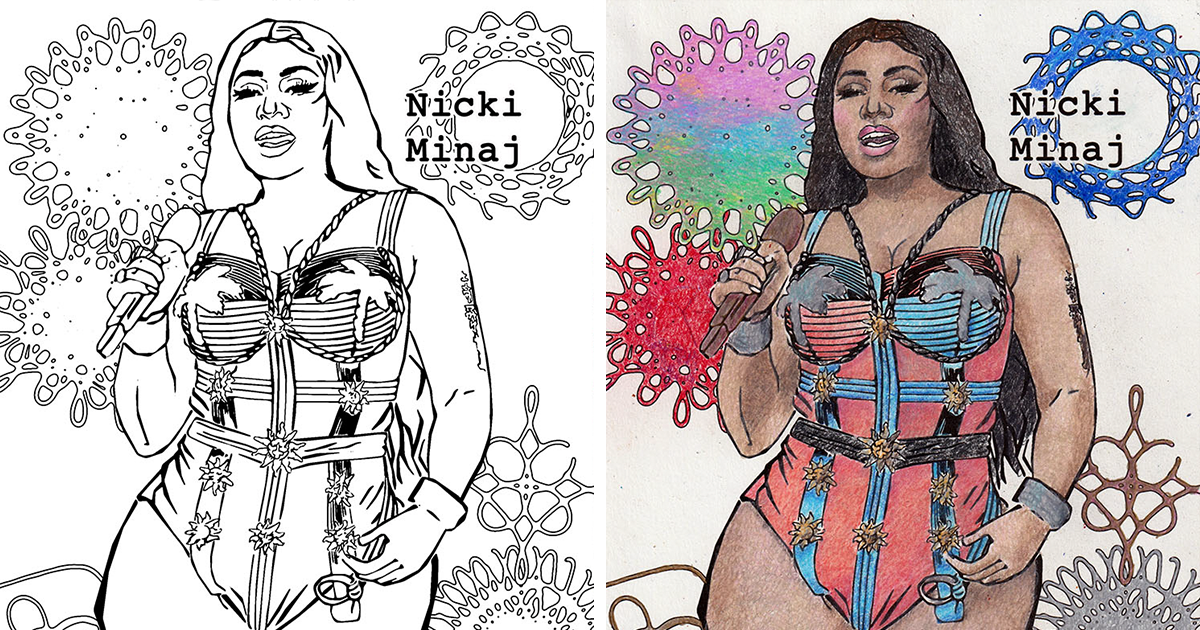
Some people relax by lighting a candle. Others organize a drawer, walk the dog, or bravely pretend their inbox does not exist. Then there are artists who pick up pencils, open a sketchbook, and turn inspiration into something you can color. That is the heart of “We Are Awesome: I Create Coloring Pages Of Powerful And Inspiring Women (35 Pics)”a creative idea that celebrates women who changed culture, science, sports, civil rights, literature, and everyday life.
At first glance, coloring pages may look simple. A face. A floral border. A quote. A strong pose. A few clean lines waiting for crayons, markers, or colored pencils. But when those pages feature powerful women, the activity becomes more than a quiet afternoon project. It becomes a small act of remembrance, a pocket-sized history lesson, and a reminder that courage comes in many outfits: lab coats, tennis skirts, court robes, headscarves, paint-stained dresses, marching shoes, and sometimes pajamas because inspiration does not always follow a dress code.
Coloring pages of inspiring women work because they combine creativity with connection. They invite children and adults to slow down, learn a name, notice a story, and participate in the image. You are not just looking at Ruth Bader Ginsburg, Harriet Tubman, Katherine Johnson, Serena Williams, Maya Angelou, Malala Yousafzai, Frida Kahlo, or Marie Curie. You are choosing the colors, shaping the mood, and spending time with what their lives represent: persistence, imagination, justice, knowledge, and the nerve to keep going when the world says, “Please be smaller.” Spoiler alert: they did not.
Why Powerful Women Make Beautiful Coloring Page Subjects
A great coloring page needs more than a recognizable face. It needs personality. Powerful women bring that naturally. Think of the visual language attached to different kinds of greatness. A scientist can be surrounded by stars, formulas, microscopes, or orbit paths. A poet might appear with birds, books, sunbursts, or handwritten lines. An athlete can be framed by movement, energy, and bold shapes. An activist might stand with open hands, marching banners, or symbolic flowers. These details help tell the story before a single word is read.
That is why inspiring women coloring pages are so effective for classrooms, family activities, art journals, community workshops, and personal self-care. They make history touchable. Instead of memorizing names like they are dusty labels in a museum drawer, people can interact with the image. Coloring turns a passive lesson into an active one. Suddenly, a child asking, “Who is she?” opens the door to a conversation about civil rights, space travel, education, literature, sports, law, art, or leadership.
For adults, the appeal is different but just as meaningful. Coloring offers a gentle way to step away from noise. It gives the hands something soothing to do while the mind rests. When the subject is an inspiring woman, the experience also feels emotionally nourishing. You are not just filling empty space; you are spending a few peaceful minutes with someone who made the world bigger.
The Creative Power Behind “We Are Awesome”
The phrase “We Are Awesome” is not subtle, and that is exactly why it works. It has the energy of a group text from your most encouraging friend. It is cheerful without being fluffy, bold without being stiff, and broad enough to include famous icons as well as everyday heroes. In a world that often teaches women to shrink, apologize, or be “less much,” the phrase lands like a glitter cannon of affirmation.
Creating coloring pages of powerful and inspiring women is also a form of visual storytelling. Each drawing becomes a tiny biography. The artist must decide what to emphasize: the eyes, the posture, the symbols, the background, the mood. A portrait of Ruth Bader Ginsburg may include her famous collar and a calm, determined expression. A page inspired by Frida Kahlo might use flowers, leaves, and bold facial lines. A Katherine Johnson design could include stars, equations, and orbit paths to honor the mathematical brilliance that helped advance American spaceflight. A Serena Williams page might feel dynamic, muscular, and electric, because honestly, drawing Serena without energy would be like drawing thunder as a whisper.
The best pages do not flatten these women into perfect statues. They keep them human. They suggest strength, yes, but also creativity, vulnerability, humor, discipline, and complexity. That matters because real inspiration is not made of marble. It is made of choices, setbacks, work, mistakes, recovery, and the stubborn decision to continue.
Coloring as Calm, Focus, and Self-Care
Coloring has become popular among adults for a reason. The activity is simple enough to begin immediately, but focused enough to quiet the mental tabs we all keep open. Choose a color. Fill a shape. Stay inside the lines, or ignore the lines if your inner rebel brought snacks. Repeat. The rhythm can feel grounding, especially after a stressful day.
It is important to understand that coloring is not the same as professional art therapy. Art therapy is a mental health practice guided by trained professionals. However, coloring for pleasure and self-care can still be valuable. It can support relaxation, mindfulness, and creative expression. For many people, that is enough. Not every healing activity has to arrive wearing a white coat and holding a clipboard. Sometimes it comes as a box of pencils and a page that says, “You are allowed to breathe now.”
Coloring pages of inspiring women add another layer. They create a positive emotional theme. Instead of coloring random swirls, you are working with images tied to courage and possibility. That can make the experience feel less like distraction and more like restoration. It is a reminder that other people have faced impossible-looking walls and still found doors, ladders, windows, orwhen necessarya very determined hammer.
Representation Matters on the Page
When children see only one type of hero, they learn a narrow version of greatness. When they see women from different races, countries, professions, body types, ages, and backgrounds, the definition expands. A girl who loves numbers may find herself in Katherine Johnson. A child who writes poems in the margins of homework may feel seen by Maya Angelou. A student who cares about fairness may connect with Rosa Parks or Ruth Bader Ginsburg. A young athlete may recognize the fire in Serena Williams. A child who has felt different may look at Frida Kahlo and see that uniqueness can become power.
Representation is not decoration. It is permission. It tells viewers, “There is more than one way to be brilliant.” That message is especially useful in coloring pages because the format is approachable. A poster can be admired from across the room. A coloring page comes closer. It sits on the table. It invites touch, choice, and attention.
For educators and parents, these pages can become conversation starters. Who was this woman? What problem did she face? What did she create, protect, discover, write, argue, or change? What qualities helped her? What would we ask her if she could sit at the kitchen table with us? Would she approve of purple hair in this portrait? Probably. Powerful women tend to understand bold choices.
Examples of Inspiring Women Who Belong in a Coloring Collection
Ruth Bader Ginsburg: Justice With a Collar
Ruth Bader Ginsburg became a symbol of persistence, legal brilliance, and gender equality. A coloring page inspired by her might include her judicial robe, signature collar, law books, stars, or balanced scales. Her image works beautifully because her visual identity is instantly recognizable. More importantly, her life reminds viewers that change often comes through careful arguments, long patience, and the ability to keep your face composed when nonsense enters the room.
Harriet Tubman: Courage in Motion
Harriet Tubman’s story carries extraordinary emotional force. Born into slavery, she escaped and then risked her life repeatedly to guide others toward freedom. She was also connected to the Civil War and the women’s suffrage movement. A coloring page inspired by Tubman might use lanterns, stars, pathways, trees, or a night sky. The visual theme is clear: movement toward freedom, even when the road is dangerous.
Katherine Johnson: The Math Behind the Moon
Katherine Johnson, the NASA mathematician whose calculations contributed to major U.S. space missions, is a perfect subject for STEM-themed coloring pages. Her portrait can be surrounded by planets, rockets, numbers, and graceful orbital curves. Children who think math is just a worksheet full of tiny traps may discover that math can also help send humans into space. That is a serious upgrade from “solve for x.”
Marie Curie: Science That Glowed
Marie Curie’s scientific legacy is monumental. She became the first woman to receive a Nobel Prize and remains one of the most recognized scientists in history. A coloring page inspired by Curie can include laboratory glassware, radiant lines, notebooks, and symbolic atoms. Her story teaches that curiosity can be revolutionary, especially when it refuses to leave the laboratory just because society said science was not for women.
Malala Yousafzai: A Voice for Girls’ Education
Malala Yousafzai became globally known for defending girls’ right to education. Her image belongs in any collection about powerful women because her courage is tied to a universal idea: learning should not be a privilege guarded by fear. A coloring page could feature books, pencils, flowers, a rising sun, or open classroom doors. It would be especially meaningful for students, who may suddenly see school not as a daily inconvenience, but as a right worth protecting.
Maya Angelou: Words With Wings
Maya Angelou was a poet, memoirist, performer, and civil rights activist whose work continues to inspire readers. A coloring page based on her life might include birds, sunrise imagery, open books, or flowing script. Her presence in a coloring collection reminds people that language can carry pain, pride, humor, memory, and freedom all at once. Also, any page involving poetry gives colorers full permission to use dramatic shades. Poets would want it that way.
Serena Williams: Power, Precision, and Presence
Serena Williams changed tennis with strength, skill, and a competitive presence that felt almost cinematic. A coloring page of Serena can be bold and energetic, with motion lines, tennis balls, trophies, and confident posture. Her story is not just about winning; it is about redefining what athletic excellence looks like. She made power elegant, focus fierce, and victory very, very loud.
Why These Pages Work for Kids and Adults
For kids, inspiring women coloring pages can make learning feel like play. They support fine motor skills, color recognition, attention, and creativity while introducing real people who shaped the world. The child does not need to absorb an entire biography in one sitting. Even one memorable fact can plant a seed. “She helped astronauts.” “She fought for education.” “She would not give up her seat.” “She wrote books that changed lives.” These small facts can grow into curiosity.
For adults, the pages offer a different gift: reflection. Coloring an inspiring woman can become a quiet ritual. It asks, “What kind of strength do I need today?” Some days call for Tubman courage. Some require Ginsburg patience. Some need Serena-level confidence. Some need Maya Angelou’s voice. Some need Frida Kahlo’s refusal to be visually or emotionally ordinary. And some days, frankly, need all of them plus coffee.
The flexibility of coloring pages also makes them useful across settings. Teachers can use them during Women’s History Month or biography units. Parents can print them for weekend activities. Libraries can include them in community programming. Therapists, coaches, and group leaders can use them as gentle prompts for discussion. Artists can use them as warmups. Adults can use them to relax without doomscrolling into a swamp of bad headlines and suspiciously targeted ads.
Design Details That Make Inspiring Women Coloring Pages Stand Out
Strong coloring pages are not overloaded. Too many tiny details can turn relaxation into an eye exam. The best designs balance clean portrait lines with meaningful symbols. A good page gives enough detail to feel rich, but enough open space to let the colorer make choices.
Here are design elements that work especially well:
- Symbolic backgrounds: Stars for scientists, books for writers, flowers for artists, courts or scales for legal figures, and pathways for activists.
- Readable quotes: Short empowering phrases can frame the image without crowding it.
- Bold outlines: Clear lines make the page friendly for both children and adults.
- Patterned clothing: Robes, scarves, dresses, jackets, and sportswear can become fun coloring zones.
- Inclusive variety: A collection should celebrate women from many cultures, identities, ages, and fields.
The goal is not to create a perfect historical document. The goal is to create a beautiful invitation to learn more. A coloring page can open the door; curiosity walks through it.
The Emotional Message: We Are Awesome
The magic of this project is that it does not treat inspiration as something distant. “We Are Awesome” includes the viewer. It suggests that greatness is not locked in the past or reserved for people with statues, awards, or extremely serious Wikipedia pages. Greatness can live in classrooms, kitchens, studios, offices, gardens, hospitals, sports courts, laboratories, protests, libraries, and living rooms with pencil shavings on the table.
That message matters. Many people are tired. Many are overwhelmed. Many feel as if history is something that happens somewhere else, created by people with better lighting and more dramatic theme music. Coloring pages of powerful women gently disagree. They say history is made by people who choose, again and again, to act with courage. And creativity is one way of keeping that courage visible.
Personal Experience: What Creating These Coloring Pages Can Teach You
Creating coloring pages of powerful and inspiring women can change the way you look at art. At first, the process may seem simple: choose a person, draw the portrait, add decorations, clean up the lines, and prepare the page for coloring. Easy, right? Absolutelyjust like baking a wedding cake is “just flour.” Once you begin, you realize every artistic choice carries meaning.
The first challenge is choosing the women. A list of 35 sounds generous until you begin writing names. Suddenly, 35 feels tiny. How do you fit centuries of courage into a single collection? Scientists, activists, athletes, writers, artists, judges, educators, astronauts, musicians, inventors, leaders, and everyday community builders all deserve space. The selection process becomes a lesson in humility. You quickly understand that inspiration is not rare; attention is.
Then comes the research. This part can be surprisingly emotional. Reading about women who faced discrimination, violence, poverty, illness, censorship, racism, sexism, exile, or public ridicule can be heavy. But it is also energizing. Their stories are not neat motivational posters. They are complicated, human, and often uncomfortable. That complexity makes the artwork stronger. You begin drawing not just a face, but a life.
Designing the page requires balance. You want the portrait to be recognizable, but you also want it to be enjoyable to color. Too many shadows can make the design muddy. Too few details can make it feel unfinished. You learn to simplify without disrespecting the subject. You learn that a single flower, book, star, collar, tennis racket, or bird can say more than a crowded background trying to shout the entire biography at once.
Coloring the finished page teaches another lesson: the viewer becomes part of the artwork. Someone may color Frida Kahlo’s flowers in electric blue. Someone else may give Ruth Bader Ginsburg a golden collar. A child may color the night sky around Harriet Tubman with pink stars because pink stars are obviously superior. These choices are not mistakes. They are engagement. They show that the subject has moved from history into imagination.
There is also a meditative rhythm in the work. Drawing line after line, cleaning curves, testing printable designs, and coloring samples can feel like a quiet conversation with the women on the page. Their stories keep you company. On difficult days, Katherine Johnson’s precision may remind you to solve one problem at a time. Malala’s courage may remind you that a voice can be small and still carry far. Maya Angelou’s words may remind you that survival can become music. Serena Williams may remind you to take up space with your whole chest. That is not a bad creative support team.
The most rewarding part is seeing other people respond. A parent may print the pages for a child. A teacher may use them in a lesson. An adult may color one after work and feel calmer. Someone may discover a woman they had never heard of before. That moment is the quiet success of the project. The page did its job. It made someone pause, create, and care.
In the end, making coloring pages of inspiring women is about more than art. It is about celebration, memory, and permission. It says that women’s stories deserve beauty. It says learning can be joyful. It says rest can still be meaningful. Most of all, it says the title is true: we are awesome. Not flawless, not finished, not always holding it together with matching socksbut awesome all the same.
Conclusion
“We Are Awesome: I Create Coloring Pages Of Powerful And Inspiring Women (35 Pics)” is more than a charming art project. It is a celebration of women whose lives continue to teach courage, creativity, intelligence, justice, and resilience. These coloring pages invite people of all ages to slow down, learn, and create. They turn history into something personal and hands-on, proving that inspiration does not have to sit behind glass in a museum. Sometimes it can be printed on paper, colored at the kitchen table, and taped proudly to the fridge like the masterpiece it is.
Note: This article is written as original, publish-ready content and synthesizes real background information from reputable health, art, education, history, science, literature, and sports sources.