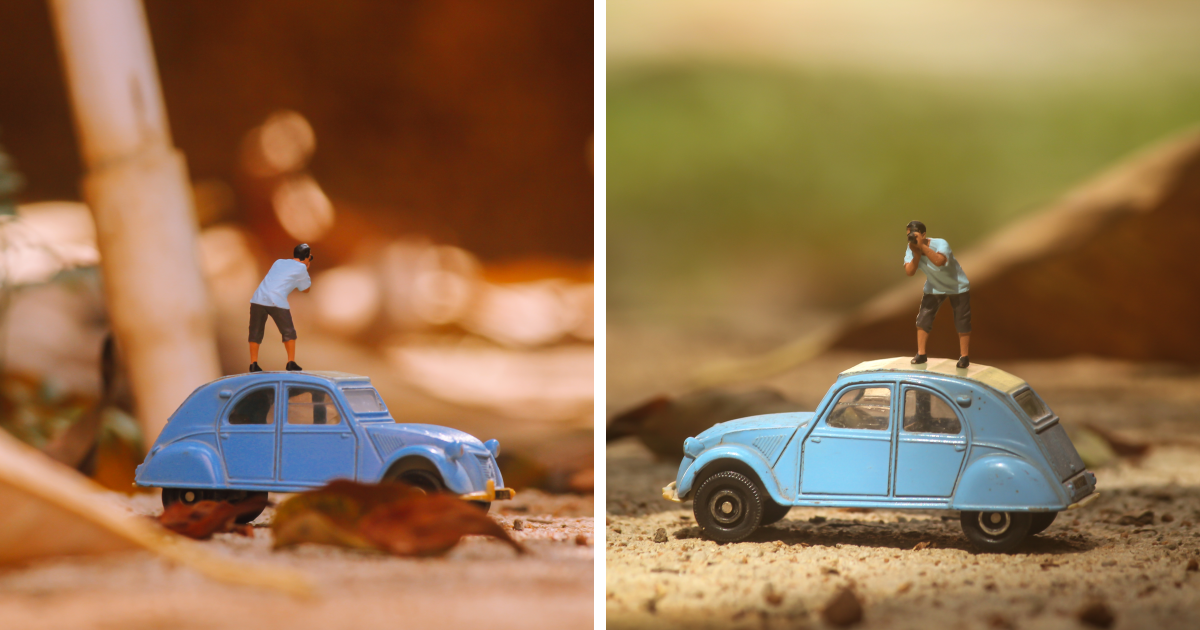
The first thing I learned from joining a miniature photographer on an adventure is that “small” is a deeply misleading word. Small sounds simple. Small sounds like something you can put in your pocket and forget until laundry day. But in miniature photography, small is a full-sized universe wearing tiny shoes.
On the morning I joined the photographer, his entire studio fit into a backpack: a camera, a macro lens, a few miniature figures, tweezers, sticky putty, a small reflector, a flashlight, cotton swabs, a collapsible tripod, and enough patience to qualify as a spiritual discipline. I brought coffee and optimism. He brought a two-inch construction worker who, by noon, would be “repairing” a cracked sidewalk like it was the Hoover Dam.
That is the charm of miniature photography. It turns ordinary objects into cinematic landscapes. A spilled cup of coffee becomes a muddy river. A loaf of bread becomes a mountain range. A puddle becomes an ocean if the camera crouches low enough and the photographer believes hard enough. And trust me, belief is importantespecially when you are lying on the sidewalk trying not to explain to strangers why a tiny plastic fisherman is casting a line into a bottle cap.
What Is Miniature Photography?
Miniature photography is a creative photography style that uses small-scale figures, models, props, or handmade sets to tell visual stories. It often blends macro photography, forced perspective, diorama building, toy photography, and fine-art composition. The goal is not simply to photograph something tiny. The goal is to make the tiny thing feel emotionally huge.
Some miniature photographers work outdoors, placing figures in real urban settings. Others build tabletop scenes using paper, foam, food, clay, model trains, dollhouse furniture, or everyday household objects. A broccoli crown can become a forest. A toothbrush can become a futuristic monorail. A stack of books can become a city skyline. Suddenly, your messy desk is not a problemit is a location scout’s dream.
Well-known miniature artists have helped popularize this visual language. Slinkachu’s street installations use tiny figures in public spaces to make viewers look again at the world beneath their feet. Tatsuya Tanaka’s famous miniature calendar transforms ordinary objects into playful scenes every day. Lori Nix builds detailed miniature dioramas and photographs them as haunting, cinematic environments. Christopher Boffoli and the MINIMIAM project use food as a giant landscape for tiny people. Their work proves that scale is not just a measurement; it is a storytelling tool.
The Adventure Begins: Finding Big Stories in Tiny Places
Our adventure started in a park, which sounds peaceful until you realize the photographer was less interested in trees and more interested in crumbs. “That sesame seed looks like a boulder,” he said, with the seriousness of someone discovering a new planet. Within minutes, he had placed a miniature hiker beside it and framed the shot so the seed became a desert rock formation.
This is the first secret of miniature photography: the photographer is not hunting for objects. He is hunting for metaphors. A crack in the pavement is not damage; it is a canyon. A leaf is not yard waste; it is a sailboat, tent, umbrella, or prehistoric jungle canopy. A spoon is not a spoon. It is a silver slide, a spaceship runway, or a frozen lake for miniature skaters who have absolutely no idea how lucky they are to be made of plastic.
Good miniature photography depends on seeing two realities at once. There is the real world, where a bottle cap is trash. Then there is the miniature world, where that same bottle cap becomes a hot tub, a satellite dish, or a tiny stadium. The photographer moves between those realities like a magician with a macro lens.
Why Miniature Photography Works So Well
It Plays With Scale
Scale is the engine of miniature photography. When a tiny figure stands beside a strawberry, the strawberry becomes enormous. When that same figure stands on a keyboard, the keys become office towers. This shift delights the viewer because the brain recognizes the familiar object but must reinterpret it. The image becomes a visual joke, a puzzle, and a story at the same time.
It Makes Everyday Objects Feel New
Miniature scenes refresh boring environments. A kitchen counter becomes a construction zone. A cereal bowl becomes a swimming pool. A pencil shaving becomes a curly wooden wave. This is why miniature photography performs well online: it gives viewers the satisfying “wait, what am I looking at?” moment that makes them pause instead of scroll.
It Combines Humor With Emotion
The best miniature photographs are not only cute. They often carry humor, loneliness, wonder, or social commentary. A tiny commuter standing on a phone screen can say something about modern life. A miniature family under a mushroom cap can feel like a fairy tale. A worker climbing a cupcake can be absurd, delicious, and oddly heroic. That emotional range keeps the style from becoming a novelty.
The Gear Behind the Tiny Magic
Miniature photography does not require a museum-sized budget, though photographers can definitely spend like dragons guarding treasure if left unsupervised. A basic setup can include a camera or smartphone, small figures, a steady surface, a light source, and a willingness to look slightly ridiculous in public.
A macro lens is useful because it allows the camera to focus close to small subjects and capture fine details. However, macro photography introduces one of the biggest challenges in the genre: depth of field. When the camera gets close, the area that appears sharp can become extremely narrow. A figure’s face may be sharp while its backpack turns into a creamy blur. Sometimes that blur is beautiful. Sometimes it looks like the backpack entered witness protection.
To manage this, miniature photographers often use smaller apertures, careful focusing, tripods, and controlled lighting. Some use focus stacking, a technique where several images focused at different distances are combined to create a sharper final result. Others embrace shallow depth of field to make the scene feel cinematic and dreamy. The right choice depends on the story.
Lighting: The Tiny Sun Must Be Managed
Lighting can make or break a miniature scene. A small figure under harsh noon sun may cast a giant shadow that ruins the illusion. A soft side light, on the other hand, can make a toy explorer look like the lead actor in a dramatic wilderness film.
During our shoot, the photographer used a small LED light and a white card to bounce light into shadows. Nothing fancy. No giant studio setup. Just a tiny sun, a tiny person, and a full-sized human squinting like a jeweler. He angled the light low to mimic sunrise for a scene where two miniature travelers crossed a mossy “field.” The moss was growing beside a tree root. In the photograph, it looked like a valley at the edge of an enchanted forest.
That is another miniature photography lesson: light tells the viewer what kind of world they are entering. Warm light feels nostalgic. Cool light feels mysterious. Backlighting can turn dust, mist, or water droplets into atmosphere. Even a flashlight through wax paper can create soft, cinematic illumination. The equipment matters less than the intention.
Composition: Where the Tiny Story Lives
Miniature photography rewards careful composition. Because the subjects are so small, every millimeter matters. Move the camera slightly higher, and the illusion collapses. Move it lower, and the tiny figure suddenly gains heroic importance. The photographer repeatedly adjusted his angle until the figure’s eye line matched the object-world around it.
He explained that miniature photography often works best at “eye level” with the figure. This makes the viewer feel invited into the miniature world rather than looking down at it. A low camera angle can make a crumb look like a cliff or a soda can look like a skyscraper. Perspective is the secret sauce. Actually, in one shot, barbecue sauce was also the secret sauce. It became a “lava river.” Art is messy. Bring napkins.
Foreground and background also matter. A blurred foreground can create depth. A recognizable background object can reveal the joke. For example, a tiny swimmer in a spoonful of blue gelatin is funny because the viewer eventually realizes the “pool” is dessert. The best compositions balance illusion and revelation: the viewer should believe the tiny world for a second, then smile when the trick becomes clear.
Storytelling With Miniature Figures
A miniature photograph without a story is just a small object standing near a big object, which is fine, but not unforgettable. A strong miniature image suggests action. Someone is climbing, escaping, repairing, exploring, fishing, painting, waiting, celebrating, or making a questionable life choice near a doughnut.
The photographer carried different figures for different moods: hikers, workers, swimmers, cyclists, photographers, painters, and businesspeople. Each one implied a different narrative. A worker beside a cracked wall suggested repair. A traveler on a leaf suggested adventure. A lone figure under a streetlamp suggested solitude. The props did not need to explain everything; they needed to open a door.
This is where miniature photography becomes more than a technical hobby. It becomes visual writing. The photographer asks the same questions a storyteller asks: Who is this character? What do they want? What obstacle stands in their way? Why should the viewer care? The only difference is that the hero may be six millimeters tall and standing on a cookie.
Outdoor Miniature Photography: Beauty, Chaos, and Curious Dogs
Shooting miniatures outdoors adds natural texture and unpredictable drama. Pavement, bark, moss, sand, snow, puddles, and rusted metal can all become convincing landscapes. But the outdoors also brings wind, changing light, insects, pedestrians, and dogs who believe every miniature figure is a snack with legs.
We spent nearly twenty minutes setting up a scene with a tiny camper beside a “lake,” which was actually rainwater collected in a shallow dip. The reflection was perfect. The light was soft. The camper looked poetic. Then a pigeon landed nearby and ruined the mood with the confidence of a feathered landlord. The photographer laughed, reset the scene, and waited for the reflection to settle.
That patience is essential. Miniature photography is slow looking. It asks you to notice what most people step over. A twig becomes architecture. Sand becomes terrain. A gum wrapper becomes a metallic wall. The world does not need to be exotic; it needs attention.
Indoor Miniature Photography: The Tabletop Becomes a Movie Set
Indoor miniature photography offers more control. You can manage light, background, props, and timing without worrying about wind or pigeons with main-character energy. A dining table can become a studio. Foam board can become a wall. Flour can become snow. A blue towel can become the ocean. A desk lamp can become sunset.
The photographer showed me a small kit he uses for tabletop scenes: colored paper, putty, tweezers, spray bottle, small brushes, and household objects with interesting textures. He said the trick is to avoid overcrowding the scene. One strong idea beats twenty props fighting for attention. In miniature photography, clutter becomes chaos quickly. A tiny figure standing beside one giant paperclip may be charming; a tiny figure buried under twelve props looks like a craft drawer had an emotional breakdown.
Editing Without Killing the Charm
Editing is part of the miniature photography process, but restraint matters. A little contrast, clarity, crop adjustment, or color correction can help the image feel polished. Removing dust or a visible support can also strengthen the illusion. But over-editing can make the scene feel artificial in the wrong way.
The photographer preferred to build as much as possible in camera. If a miniature worker needed to stand on a vertical surface, he used a tiny dot of putty. If the background needed color, he used paper or fabric. If the scene needed mist, he used a spray bottle. The more the effect existed physically, the more believable the final image felt.
Miniature Photography Ideas for Beginners
Start With Food
Food is one of the easiest gateways into creative miniature photography. A donut can become a construction site, a slice of cake can become a cliff, and rice grains can become snow or stones. Food brings texture, color, and humor naturally. Just remember to photograph quickly if the prop melts, wilts, or mysteriously disappears because someone in the house “didn’t know it was art.”
Use Office Supplies
Paperclips, sticky notes, pencils, tape, erasers, and keyboards make excellent miniature environments. They are familiar, geometric, and easy to arrange. A tiny worker painting a highlighter or a climber scaling a binder clip can create a strong visual gag with almost no budget.
Explore Nature Close Up
Moss, pebbles, leaves, bark, flowers, and water droplets can look spectacular at miniature scale. Nature already builds convincing worlds; the photographer simply adds a character and chooses the angle. A small hiker on a mushroom or a kayaker in a leaf-shaped puddle can feel like a fantasy scene.
Try Forced Perspective
Forced perspective makes objects appear larger, smaller, closer, or farther away through camera placement. It is especially powerful in miniature photography because it can blend real-world backgrounds with tiny figures. A small model placed close to the lens can appear life-sized against a distant street, wall, or landscape.
What I Learned From Joining the Adventure
By the end of the day, I had dirt on my knees, too many photos of a tiny cyclist near a peanut shell, and a new respect for photographers who create entire worlds from overlooked things. Miniature photography is playful, but it is not careless. It demands planning, patience, lighting knowledge, composition skills, and the ability to explain to strangers that no, you have not lost a contact lens; you are photographing a tiny astronaut next to a gumdrop.
The adventure changed how I looked at ordinary spaces. Sidewalk cracks became canyons. Coffee foam became clouds. A wrinkled napkin became a mountain pass. The photographer did not add magic to the world as much as reveal the magic that scale usually hides.
That may be the biggest reason miniature photography is so engaging. It reminds us that wonder is not always far away. Sometimes it is sitting on the kitchen counter, hiding behind a spoon, waiting for someone with a camera to kneel down and notice.
Extra Field Notes: My 500-Word Experience Joining A Miniature Photographer
The most memorable part of joining a miniature photographer was not the gear, the editing, or even the tiny figures. It was the pace. I am used to photography being quick: see something, raise the camera, click, move on. This adventure was different. Every scene required waiting, adjusting, testing, laughing, failing, and trying again. It felt less like taking pictures and more like building a tiny theater where the actors refused to stand up straight.
At one point, we tried to create a scene with a miniature backpacker walking across a “desert” made from cinnamon powder. It smelled incredible, which is not something most dramatic desert landscapes can claim. The first problem was footprints. The figure’s base kept dragging through the cinnamon, creating marks that looked less like a desert trail and more like a raccoon had gone line dancing. The second problem was scale. A cinnamon clump that looked invisible to my eye became a boulder through the macro lens. The photographer carefully broke it apart with a toothpick, then used a soft brush to smooth the surface. The final shot looked like a traveler crossing a warm, golden wasteland. In real life, it was a spoonful of spice on a plate.
Another scene used a puddle beside a curb. The photographer placed a tiny person with an umbrella near the water’s edge and waited for passing cars to stop shaking the reflection. I kept thinking the moment was ruined. He kept seeing possibilities. When the reflection finally settled, the curb became a harbor wall and the puddle became a quiet city lake. That was when I understood how miniature photography trains patience. It is not about forcing the world to cooperate; it is about noticing the split second when it does.
I also learned that humor is a serious tool. One of our best images showed a tiny road crew “repairing” a cracked cookie. It was silly, but the composition, lighting, and focus had to be precise. Comedy did not make the work easier. If anything, it made the details more important. The viewer needed to recognize the cookie, understand the construction scene, and enjoy the absurdity in one glance. That kind of clarity takes craft.
By the time we packed up, I felt like I had spent the day in two worlds. In one, we walked through parks, sidewalks, and kitchen counters. In the other, we crossed deserts, repaired cliffs, explored forests, and stood beside lakes no deeper than a thumbprint. Miniature photography made the familiar feel undiscovered. It showed me that adventure does not always require a plane ticket, hiking boots, or a dramatic soundtrack. Sometimes all it takes is a tiny figure, a patient eye, and the willingness to look very closely at the ordinary until it becomes extraordinary.
Conclusion
Joining a miniature photographer in his adventure taught me that creativity often begins at ground level. Miniature photography is a blend of macro technique, storytelling, lighting, composition, humor, and imagination. It transforms ordinary objects into remarkable scenes and invites viewers to slow down, look closer, and rediscover the everyday world from a new angle.
Whether you are using a professional camera, a smartphone, a macro lens, or a desk lamp and a toy figure, the heart of miniature photography remains the same: build a believable little world, give it a story, and let the viewer feel like they have stumbled upon a secret. The world is already full of tiny adventures. The real trick is learning how to see them.