Five centuries after Leonardo da Vinci took his last breath, the man is still somehow “online.”
Not in the “posting hot takes” sense (thank goodness), but in the way his ideas keep popping upevery time we talk
about innovation, art-meets-science, or the weirdly powerful urge to doodle a helicopter in the margins of a meeting agenda.
This article is a celebrationnot the dusty kind with polite clapping, but the lively kind where we poke around his notebooks,
admire his paintings, and steal a few habits from the greatest curiosity machine the Renaissance ever assembled.
We’ll look at the human behind the legend, the inventions that were centuries early, and why his “life’s work” still feels
like a work in progress (which, honestly, is relatable).
Why “500 Years Later” Still Hits So Hard
Leonardo died in 1519. The year 2019 marked 500 years since his death, sparking exhibitions, documentaries, digitization projects,
and renewed public obsession with his art and engineering mind. Even though we’re now beyond that anniversary moment,
“500 years later” has become shorthand for something bigger: the rare kind of legacy that doesn’t fadeit mutates, multiplies,
and keeps inspiring new generations of artists, engineers, doctors, designers, and chronic overthinkers.
And that’s the real reason we’re still celebrating. Leonardo isn’t famous because he made a cool painting or two.
He’s famous because he modeled a way of thinking: observe intensely, connect unlikely dots, and never stop asking,
“What if?” (Even if the answer is “a tank shaped like an angry turtle.”)
The Mind Behind the Myth: How Leonardo Built His Genius
Apprenticeship, discipline, and a lifetime of “Wait, what if…”
Leonardo was born in 1452 and trained in the workshop world of Renaissance Italy, where art was also engineering,
chemistry, carpentry, and high-stakes client management. Workshops weren’t just about talent; they were about process:
drawing, measuring, experimenting, failing, and trying again until your materials finally agreed with your imagination.
What set Leonardo apart wasn’t merely skillit was range. He treated painting like a science of perception
and treated science like an art of seeing. His curiosity didn’t have a filter. Anatomy? Yes. Water flow? Absolutely.
Optics, geometry, architecture, stage machinery, flight, weaponry, botany, mappingLeonardo’s interests were basically
a full university catalog with no tuition bill and no required electives (because he took them all).
The notebook habit that quietly changed everything
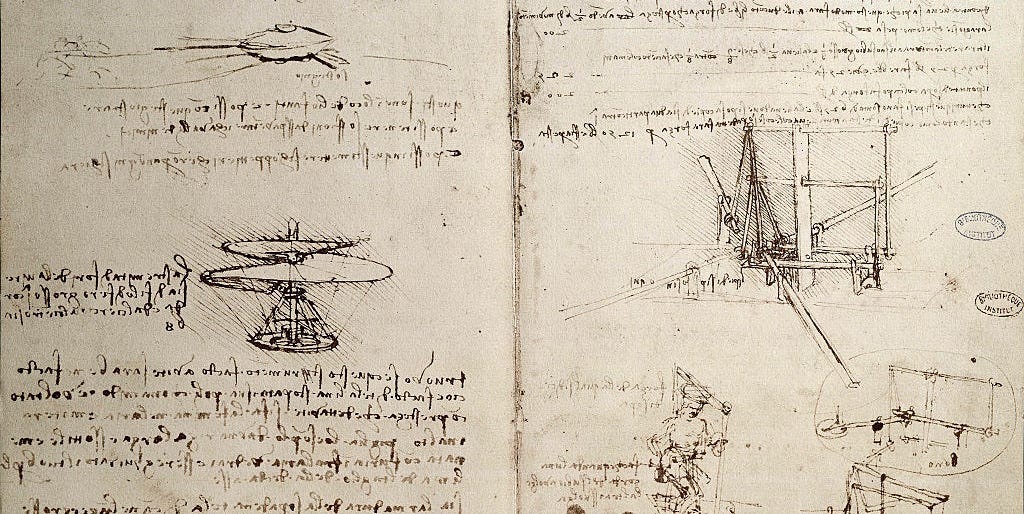
If Leonardo had one “superpower,” it might be this: he captured thinking in motion. His notebooks weren’t polished journals.
They were working labspacked with sketches, diagrams, lists, questions, and observations. He wrote constantly,
often in mirror writing, as if his ideas were moving too fast for normal traffic lanes.
The magic is not that he “had ideas.” Lots of people have ideas. The magic is that he worked his ideaspage after page,
returning to problems, refining forms, and testing concepts on paper long before the physical world was ready.
Art That Feels Like Psychology: Leonardo’s Greatest Hits (and Why They’re Still Unsettlingly Good)
The Mona Lisa: small painting, enormous cultural gravity
The Mona Lisa is famous enough to have its own atmosphere. But beyond the hype is a real technical achievement:
Leonardo’s subtle modeling of light and shadow (often discussed under “sfumato”) creates a softness that feels almost alive.
The expression reads differently depending on where you looka neat trick that keeps your brain engaged, like it’s solving a puzzle.
The result is less “portrait” and more “relationship.” You don’t just view the painting; you negotiate with it.
And you lose. Politely.
The Last Supper: storytelling through body language
In The Last Supper, Leonardo turns a religious scene into a study of human reaction. The gestures,
spacing, and facial expressions carry the emotional plot. You can practically hear the room: suspicion, grief, denial,
outrageeach figure broadcasting a different internal headline.
It’s not just composition; it’s behavioral design. Leonardo understood that people “read” images the way they read other people:
through posture, micro-expressions, and context. That insight is part of why his work still feels modern.
The Notebooks: Where Leonardo’s Inventions Really Lived
If the paintings are Leonardo’s public face, the notebooks are his brain’s backstage pass. They reveal a method:
observe nature, break it into mechanics, then recombine it into new possibilities.
His pages wander across disciplines because his mind did. You’ll see studies of birds next to machine parts,
water patterns next to architectural layouts. This isn’t randomnessit’s cross-pollination. Leonardo was building
a personal search engine long before the internet, powered by two tools: attention and ink.
Flight: the obsession that never let go
Leonardo’s fascination with flight shows up as both poetic wonder and mechanical problem-solving.
He studied how birds balance, steer, and generate liftthen translated those observations into designs
meant to help humans leave the ground.
You’ll often hear about the “ornithopter,” a wing-flapping concept inspired by animals. Whether or not any such design
could have worked as imagined, the deeper point is this: Leonardo approached flight as a systemmaterials, force,
control surfaces, and the body’s role in motion.
The “aerial screw”: the helicopter’s weird ancestor
One of Leonardo’s most famous concepts is the spiral “aerial screw,” often compared to a proto-helicopter.
It’s the kind of idea that makes you smile because it’s both brilliant and slightly chaoticlike a cinnamon roll
that wants to be aviation.
Modern engineers can debate its practicality, but conceptually it’s striking: a rotating device interacting with air
to generate lift. That’s a big leap in imagination for the era, and it helps explain why he’s still framed as an inventor
“ahead of his time.”
Leonardo’s Most Talked-About Inventions (and What They Actually Teach Us)
Let’s be honest: people love lists of “Leonardo invented the ____.” The reality is more nuanced.
Many designs were concepts, studies, or proposals rather than built prototypes. But their value isn’t limited to
whether they launched, rolled, or dramatically exploded. Their value is in how they demonstrate Leonardo’s approach:
model the world, then remix it.
1) The self-propelled cart: automation before the word existed
Leonardo sketched vehicles that could move without being pulledoften described today as early “self-propelled” devices.
Whether you call it a proto-car or a mechanical stage trick, the theme is the same: stored energy + controlled motion.
He wasn’t just drawing transportation; he was exploring automation.
2) The armored vehicle (“tank” energy, Renaissance edition)
One iconic design resembles a protective shell with weaponry around itfrequently compared to a tank concept.
It reflects Leonardo’s engineering imagination applied to conflict: mobility, protection, intimidation, and force projection.
Even if never built, the design shows systems thinking under constraints: materials, movement, and human operation.
3) Bridges and civil engineering: portable, practical, and quietly revolutionary
Leonardo wasn’t only dreaming up dramatic machines. He also designed bridges and infrastructure concepts that speak to
his practical sideespecially his interest in making structures efficient, deployable, and responsive to real needs.
These ideas connect to his broader fascination with how forces move through materialsan engineer’s mindset living inside an artist’s hand.
4) Diving and underwater concepts: curiosity with an ethical brake
Among Leonardo’s studies are underwater ideasbreathing apparatus concepts and related notes.
What’s striking is not just the imagination, but the awareness of misuse. He worried about inventions being applied
for destructive ends. That tensioninnovation vs. consequencesfeels extremely 21st century for a 16th-century thinker.
5) Mechanics everywhere: gears, pulleys, and motion as a language
Throughout the notebooks, Leonardo treats motion like a dialect he’s learning fluently. He sketches transmission systems,
linkages, and mechanical principles that later became standard tools in engineering. Even when an “invention” didn’t become
a product, it often clarified a principle.
Anatomy: Leonardo the Artist-Scientist Before “Scientist” Was a Job Title
Leonardo’s anatomical drawings are among the most breathtaking intersections of art and medicine ever produced.
He performed dissections, studied muscles, bones, organs, and proportion, and tried to understand not just
what the body looked likebut how it worked.
What makes these studies special is their dual purpose. For art, anatomy improved realism and expression.
For knowledge, it pushed toward a more direct, observational understanding of human structure.
Leonardo’s pages turn the body into both a landscape and a machinerendered with empathy and precision.
In a world where medical knowledge was still tangled with tradition and limited tools, Leonardo’s insistence on firsthand observation
was a major intellectual posture: don’t just repeat what you’ve heardlook.
Mapping, Water, and the Science of Systems
Leonardo was fascinated by waterits flow, turbulence, and power. He studied it the way modern people binge-watch
a new series: intensely, repeatedly, and with a suspicious amount of note-taking.
He also produced highly detailed mapping work (including plans associated with Renaissance cities), revealing a spatial intelligence
that connects art, engineering, and governance. Mapping isn’t only about geography; it’s about how humans move through space,
how resources flow, and how design shapes life. Leonardo cared about all of that.
So… Was Leonardo “Ahead of His Time,” or Are We Just Catching Up?
The phrase “ahead of his time” can be lazy, but in Leonardo’s case it points to something real:
he worked on problems that required a future ecosystemstronger materials, better manufacturing, more standardized measurement,
and broader scientific frameworks.
Still, it’s not only technology that makes him feel modern. It’s his mindset:
- He observed relentlessly. Nature was his textbook, and he read it like his life depended on it.
- He drew to think. Sketching wasn’t decoration; it was computation.
- He crossed disciplines. Art informed science, science informed art, and both informed engineering.
- He iterated. Many pages return to the same theme, refining ideas over time.
- He stayed curious. Leonardo didn’t “finish” curiosity. He lived in it.
If modern innovation has a lesson from Leonardo, it’s not “be a genius.” That’s not actionable.
The actionable lesson is “build a system that produces insight”: keep records, practice observation, and connect ideas
across boundaries. Genius looks a lot like habitsperformed obsessively.
How We Celebrate Leonardo Today: Museums, Models, and Digital Renaissance
Today’s Leonardo celebration is part museum culture, part education, part technology. Major institutions and media projects
have helped bring his notebooks and inventions into public reach through digitization, interactive models, and documentaries.
Instead of treating Leonardo as a statue on a pedestal, we increasingly treat him as a living workshopone we can visit,
explore, and learn from.
Interactive 3D reconstructions of his designslike flying machines, an armored vehicle concept, and self-moving deviceshelp translate
sketches into spatial understanding. Seeing a concept “stand up” in three dimensions doesn’t just entertain; it clarifies how he thought:
mechanism first, aesthetics included.
Experiences, 500 Years Later: How to Feel Leonardo in Real Life (Not Just Read About Him)
Let’s add something practical: how do you experience Leonardotodaywithout needing a time machine, a Florentine wardrobe,
or a personal patron named “Duke”?
1) Try a “Leonardo afternoon” at a museum (or a digital collection)
Go to a museum with Renaissance art or scientific illustration and do one thing differently: slow down aggressively.
Pick one painting or drawing and stay with it for ten minutes. Yes, ten. At minute three, your brain will complain.
At minute seven, you’ll start noticing things: hand positions, subtle shadows, where the viewer’s eye is being guided,
how a figure’s posture implies emotion. This is Leonardo’s worldattention as a tool.
No museum nearby? Use a high-resolution digital scan from a reputable collection. Zoom in until you see brushwork,
line confidence, and corrections. You’ll realize masterpieces are not magicalthey’re constructed.
2) Carry a tiny notebook for one week (and make it messier than you want)
Leonardo’s notebooks weren’t “content.” They were thinking spaces. Try carrying a pocket notebook for seven days and fill it with:
a quick sketch of something you notice, a question you can’t stop thinking about, a diagram of how something works,
or a list of ideas that seem ridiculous (those are often the good ones).
The rule: do not self-edit. If you make it pretty, you’ll make it cautious. Leonardo wasn’t cautious on the page.
He was in motion.
3) Do a “systems walk”: study water, light, or motion like it’s your job
Take a walk and pick a theme Leonardo lovedwater, light, mechanicsand treat the world like a lab.
Watch how water moves around obstacles. Notice reflections, glare, and how shadows change shape.
Observe doors, hinges, bike chains, escalatorsmotion everywhere. Snap photos, draw tiny diagrams, write down questions.
The goal isn’t to become an expert in hydrodynamics in 30 minutes. The goal is to sharpen the habit of noticing.
That habit is the hidden engine behind Leonardo’s output.
4) Build something smallon purposeand learn from the failure
Leonardo sketched mechanisms because he wanted to understand them. You can do the same at a modern scale:
build a simple rubber-band powered car, a paper helicopter, a mini-bridge from popsicle sticks, or a basic pulley system.
When it fails (and it will), don’t “fix it” immediately. First, describe what happened like a Renaissance detective.
What moved? What resisted? What broke first? That analysis is the real invention.
5) Watch (or read) Leonardo with a new lens: not “facts,” but methods
When you watch a documentary or read a biography, listen for the process: how he approached problems, how he used drawing,
how he combined disciplines. Then steal one method and apply it to your work. Designer? Sketch to think.
Developer? Diagram before coding. Writer? Map ideas visually. Doctor or student? Practice observation without assumptions.
The most “Leonardo” thing you can do isn’t to admire him. It’s to build your own workshop mindsetcurious, cross-disciplinary,
and stubbornly committed to seeing what’s actually there.
Conclusion: Leonardo’s Real Invention Was a Way of Thinking
Leonardo da Vinci didn’t just leave behind paintings and sketches. He left a blueprint for how creative intelligence can work:
mix disciplines, observe deeply, document relentlessly, and let questions lead the way.
Five hundred years later, we’re still catching insights from his pagessometimes through museum glass, sometimes through digital scans,
sometimes through the simple realization that drawing a problem can change how you understand it.
Leonardo’s legacy isn’t a closed book. It’s an open notebookstill inviting us to pick up a pen and keep going.