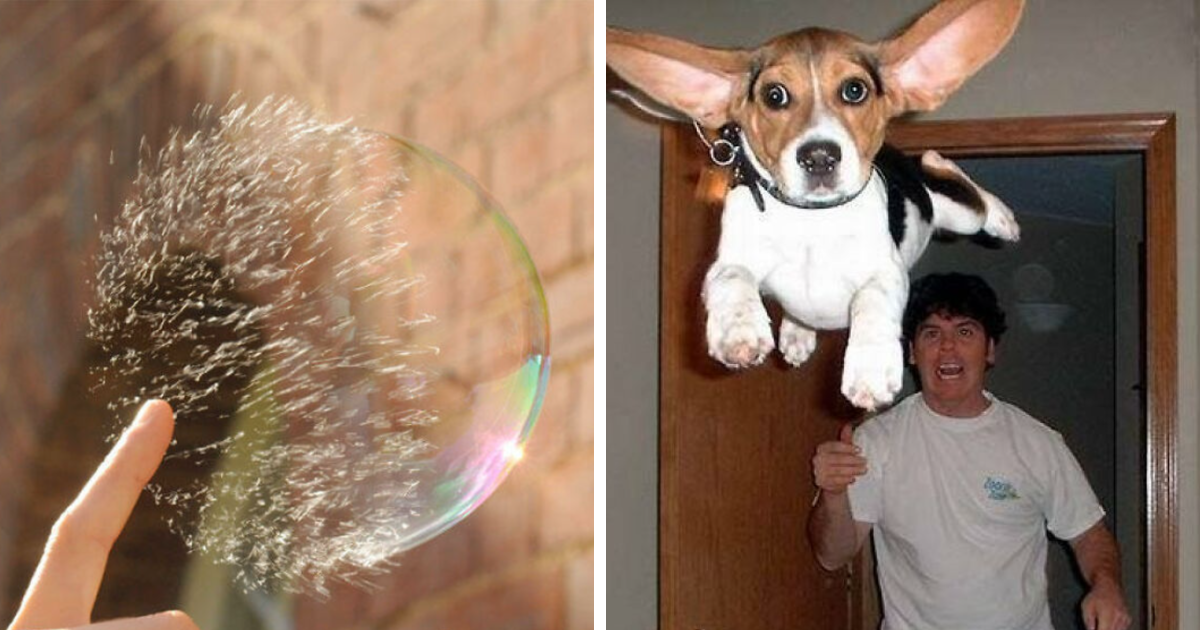
Some photographs are beautiful because the lighting is perfect. Others work because the photographer found an extraordinary subject. And then there are those rare, ridiculous, almost suspiciously well-timed pictures where the universe appears to have spent the afternoon arranging an elaborate visual joke.
A bird flies behind someone’s head and suddenly gives them wings. A dog moves at exactly the wrongor rightsecond and appears to replace its owner’s face. A basketball hovers over a player’s head like a perfectly fitted orange hat. A person walks past an advertisement just as the model on the billboard seems to interact with them. Nobody yelled, “Places, everyone!” Yet somehow every element lands precisely where it needs to be.
That is the irresistible charm behind perfectly-timed images. They transform fractions of a second into tiny optical illusions, visual punchlines, and stories that may never happen again. Photography has celebrated this ability to seize fleeting combinations for generations. Henri Cartier-Bresson’s work became famously associated with the “decisive moment”the point when action, visual structure, and meaning briefly come together inside one frame.
The funniest part? Even when photographers prepare carefully, reality still gets the final vote.
Why Perfectly-Timed Images Are So Satisfying
A normal photograph tells us what something looked like. A perfectly-timed photograph makes us perform a double take.
At first, our brain recognizes familiar pieces: a human, an animal, a street sign, a shadow, an airplane, a statue. A fraction of a second later, those pieces combine into something entirely different. Suddenly the man’s head appears to belong to the horse behind him. The moon becomes a basketball. A fountain seems to shoot water from someone’s mouth. A dog’s nose becomes part of a human face.
That tiny moment of visual confusion is half the fun.
Perfect timing is especially effective when unrelated objects accidentally form a believable relationship. Photography Life describes visual puns as compositions in which separate elements share an amusing or surprising visual connection. Street photography is particularly fertile territory because people, advertisements, vehicles, architecture, animals, reflections, and shadows are constantly rearranging themselves.
The photographer’s job is essentially to notice when ordinary reality is about to become wonderfully weird.
The “Decisive Moment” Was Around Long Before Burst Mode
Modern cameras make timing easier, but the obsession with catching an exact instant certainly didn’t begin with twenty or thirty frames per second.
Cartier-Bresson’s photographs helped popularize an approach in which photographers remained alert to the instant when gesture, geometry, movement, and meaning reached their strongest combination. Museums and photography institutions still use his work when discussing the importance of rapid observation, framing, and anticipation. The International Center of Photography has even described the decisive moment as the point when forms reach a particularly interesting harmony.
One famous example is Cartier-Bresson’s Behind the Gare Saint-Lazare, made in 1932. A man is captured in midair as he jumps across a wet area, with his reflection suspended beneath him. Another fraction of a second and the geometry changes completely.
That basic principle survives in today’s funniest perfectly-timed photos. The subject matter may involve dogs, tourists, sports, billboards, or badly placed lamp posts rather than Parisian street scenes, but the underlying challenge remains identical: press the shutter before reality ruins everything.
The Anatomy of a Perfectly-Timed Photograph
1. The Accidental Body Swap
Few photographic accidents can compete with the classic body-part illusion.
Someone stands in front of a horse and acquires a horse head. A bird spreads its wings behind a pedestrian and turns an exhausted commuter into a budget superhero. One person’s legs line up beneath another person’s torso. A dog’s snout appears precisely over its owner’s mouth.
That last scenario is not merely hypothetical. TIME reported on a widely shared dog selfie in which the animal moved into exactly the right position to make its nose appear to replace part of its owner’s face. The planned cute portrait became something dramatically strangerand considerably funnier.
These photos work because a camera compresses three-dimensional space into two dimensions. Objects separated by several feet can appear attached if their edges line up from the photographer’s viewpoint.
2. Animals With Impeccable Comedy Timing
Animals are magnificent collaborators because they respect absolutely none of the photographer’s plans.
A seagull may fly through a family portrait. A cat may stick its head through a gap at exactly the right second. A dog may leap behind a person and appear to launch from the person’s back like an unusually furry jetpack.
Wildlife adds another layer of difficulty because both position and behavior are unpredictable. You can prepare your exposure, focus on the correct area, and anticipate a bird’s movement, but the final wing position or facial expression may last only an instant.
This is where patience becomes almost as important as camera speed. The photographer waits, watches behavior, predicts what might happen next, and tries very hard not to sneeze at the important moment.
3. Signs And Billboards Joining Real Life
Advertising designers probably never imagined their work would someday interact with random pedestrians, but street photographers have other plans.
A person may stand beneath a giant pointing hand. Someone carrying food walks past an advertisement featuring a hungry face. A bus stop model seems to whisper into a commuter’s ear. A pedestrian unknowingly completes a sentence printed on a wall.
The cleverest examples don’t require manipulation. Instead, the photographer recognizes a promising background and waits for the missing ingredient to enter the frame.
This technique has deep roots in street photography. Photographers often scout locations, watch how light changes, and anticipate where people will move rather than simply reacting after something interesting has already happened.
4. Sports Frozen At Peak Absurdity
Sports photographers spend enormous amounts of effort trying to capture peak action. Occasionally, peak action also turns into peak comedy.
A soccer ball covers a player’s face. Two athletes overlap and appear to have acquired extra limbs. A basketball balances visually on someone’s head. Water exploding around a swimmer forms a bizarre temporary hairstyle.
The Associated Press emphasizes visual storytelling in its sports photography, while discussions of decisive moments in sports repeatedly stress both technical preparation and understanding the game. Knowing what athletes are likely to do next gives photographers a better chance of being ready before the critical action begins.
In other words, photographing sports isn’t simply pointing a fast camera at chaos and hoping the memory card handles the emotional burden.
5. Shadows, Reflections, And Forced Perspective
Sometimes the subject isn’t moving much at all. Instead, the magic comes from viewpoint.
Forced perspective can make a person appear to hold the moon, push over a building, drink from a waterfall, or balance an airplane between two fingers. Reflections can produce equally strange combinations, particularly around windows, puddles, mirrors, and polished buildings.
Shadows are even less cooperative. A completely innocent pose can create a silhouette that seems to belong to an entirely different creature. Add several moving people and one conveniently angled afternoon sunbeam, and reality begins producing its own low-budget special effects.
Good composition makes these illusions convincing. Clean edges, separation between important subjects, balanced visual weight, and removing unnecessary distractions can make an image feel intentional rather than merely cluttered.
Perfect Timing Is Part Luck, Part Preparation
The temptation is to call every great coincidental photo lucky. Luck certainly matters. Nobody can order a pigeon to cross the sun at precisely 4:17:03 p.m. while a stranger opens an umbrella underneath it.
But experienced photographers increase their odds.
They notice backgrounds before subjects arrive. They understand where interesting light will fall. They pre-focus when appropriate. They follow movement through the viewfinder. They learn the rhythm of sports, wildlife, ceremonies, and crowded streets.
PetaPixel has featured street photography centered on exactly this relationship between preparation and coincidence: a photographer can find a promising position and wait for the right arrangement, yet still be surprised by what happens one second later.
Joel Meyerowitz similarly described street photography as a process of noticing gestures, relationships, and simultaneous events while developing the instinct necessary to respond in a fraction of a second.
So perhaps “lucky” isn’t quite sufficient. The photographer gets luckybut first has to be present, observant, ready, and pointing the camera in the correct direction.
How Camera Technology Helps Catch Fleeting Moments
The photographers of earlier generations generally had fewer chances per second. Digital cameras have dramatically expanded the technical toolkit.
Continuous shooting lets photographers record sequences while action unfolds. Nikon specifically recommends continuous shooting for sports because it allows multiple frames to be captured while the shutter remains pressed, while Sony’s guidance for moving subjects combines faster shutter speeds, continuous autofocus, and continuous shooting to improve the chance of catching the strongest instant.
Fast shutter speeds can freeze subjects that would otherwise blur. Adobe’s photography guidance explains that faster shutter speeds can isolate fractions of a second, while slower exposures intentionally reveal movement through blur.
Some newer cameras go even further with pre-capture technology. Certain systems can temporarily buffer frames before the photographer fully presses the shutter, effectively giving the photographer a small safety net when reacting to lightning, wildlife, or sudden action.
Technology, however, doesn’t automatically create interesting photographs. A camera could record thousands of perfectly sharp frames of absolutely nothing interesting. The machine improves the odds of recording the moment; the photographer still has to recognize why the moment matters.
Why One Frame Can Be Funnier Than An Entire Video
Video explains what happened before and afterward. A photograph doesn’t have that obligation.
That limitation is precisely what makes these images so entertaining.
Freeze someone halfway through a jump and gravity seems temporarily canceled. Photograph two strangers overlapping and they become one anatomically questionable citizen. Stop a dog mid-yawn and you may capture an expression suggesting it has just received a surprise tax bill.
Our minds know the illusion probably disappeared immediately after the shutter fired, but the photograph refuses to move on. It preserves the visual misunderstanding forever.
This is also why sequences can change our interpretation of an image. Elliott Erwitt, famous for humorous observations of everyday life, sometimes presented groups of consecutive photographs because the developing action itself created the joke or narrative. A single frame can be iconic, while surrounding frames reveal how briefly that arrangement existed.
The Best Perfectly-Timed Images Still Need Composition
Timing cannot rescue every photograph.
Imagine capturing the world’s most perfectly positioned flying duck only to discover that a trash can dominates half the foreground, your thumb occupies the lower corner, and the horizon appears to be sliding into the ocean.
Congratulations: you documented history badly.
The strongest perfectly-timed images combine coincidence with visual clarity. The viewer should quickly understand the subject and then discover the surprise. Lines guide attention. Empty space separates overlapping forms. Background clutter doesn’t compete with the gag. The important objects are arranged clearly enough that the illusion reads almost instantly.
That relationship between timing and organization explains why the “decisive moment” remains such a useful idea. MoMA describes Cartier-Bresson’s reputation in terms of his ability to seize lasting images from constantly changing experience, while the Smithsonian has emphasized the combination of event significance and precise organization inside the frame.
The camera freezes time, but composition tells us where to look.
What These 80 Perfectly-Timed Images Remind Us About Photography
A collection of 80 improbable alignments is entertaining because every photograph feels like evidence that reality has a mischievous side.
Some frames result from deliberate patience. Others are beautiful accidents discovered only after someone checks the camera. Many sit somewhere between the two: the photographer recognized potential, prepared for it, and then received an unexpected bonus from the universe.
The bigger lesson is simple. Interesting photographs aren’t limited to exotic destinations, expensive studios, or once-in-a-lifetime events. They can happen at a bus stop, basketball court, backyard barbecue, subway platform, beach, dog park, or family picnic.
The necessary ingredients are usually already moving around us. Photography simply asks us to notice when they briefly fit together.
From Behind The Camera: What Chasing Perfect Timing Actually Feels Like
Imagine spending an afternoon trying to intentionally capture one of these seemingly effortless photographs.
You start confidently. There is a colorful mural beside a busy sidewalk, and you realize that if someone walks through one particular spot, the painted wings on the wall will appear to grow directly from their shoulders. Easy.
You frame the scene and wait.
The first pedestrian walks too close to the wall. The second stops to check a phone. The third is positioned perfectly but gets blocked by a delivery truck approximately four milliseconds before you press the shutter.
Then nobody walks past for five minutes.
Photography is excellent at teaching patience, usually through methods that resemble mild psychological warfare.
Eventually another person approaches. You prepare. The spacing looks right. The person’s head moves into position. You press the shutter.
This time everything works.
The feeling is strangely satisfying because you didn’t control the subject. You controlled only your own position, framing, camera settings, and decision about when to react. The rest belonged to chance.
That experience changes how photographers look at ordinary places. A boring street corner becomes a collection of possible alignments. Reflections in store windows become layered compositions. Posters become potential characters. Shadows become subjects. Instead of asking only, “What should I photograph?” you begin asking, “What might happen here if I wait another thirty seconds?”
Sports create a different version of the same experience. Suppose you’re photographing a basketball game. Following the ball alone is rarely enough. You start learning patterns: where rebounds tend to go, when a player may drive toward the basket, where defenders will converge, and when emotion may explode after a major play.
The technically sharp photograph may not be the memorable one. Perhaps the better frame arrives half a second later, when three players react differently while the crowd erupts behind them.
Wildlife requires another kind of patience. An animal can remain motionless for ten minutes and then perform the interesting behavior during the exact second you look away to adjust a setting. After several such incidents, photographers become extremely reluctant to blink.
Street photography might be the most playful version. You notice a bright yellow advertisement, then someone wearing the exact same yellow jacket enters the scene. Now another pedestrian raises an umbrella. A taxi approaches. For two seconds, colors, gestures, and shapes begin organizing themselves. You shoot several frames.
Later, one image stands out.
Maybe it wasn’t even the frame you expected.
That discovery is another important part of the experience. Sometimes photographers recognize the decisive moment immediately. Other times the comedy doesn’t reveal itself until the photograph is reviewed on a larger screen. A background character may be making an extraordinary expression. Two distant objects may have overlapped unexpectedly. A bird may have entered the frame unnoticed.
The lesson isn’t to fire the shutter randomly and hope for miracles. It is to stay observant long enough for probability to become your accomplice.
Take more photographs, but also look more carefully. Predict movement. Study backgrounds. Watch the edges of the frame. Return to promising locations. Learn how your camera responds. And when something begins to line up, don’t spend five seconds debating whether it deserves a picture.
Five seconds is an eternity in perfectly-timed photography.
By then, the bird has flown away, the pedestrian has crossed the street, the dog has stopped making that ridiculous face, and the universe has moved on to its next joke.
Conclusion: Reality Has Better Special Effects Than We Think
The greatest perfectly-timed images occupy a delightful space between skill and accident. Photographers can choose shutter speed, focus, lens, viewpoint, and composition. They can study behavior and anticipate movement. They can wait patiently for people to enter carefully chosen backgrounds.
What they cannot completely control is the final collision of events.
That uncertainty is what gives these photographs their personality. Each one preserves a fraction of a second when unrelated pieces of reality accidentally agreed to cooperate. A moment earlier, there was no photograph. A moment later, there wasn’t one either.
For one brief instant, though, everything lined up.
Click.
And suddenly an ordinary scene became unforgettable.
Note: The illustrative situations discussed above describe common forms of perfectly-timed and coincidental photography; documented historical and technical examples are identified where relevant rather than attributing fictional details to specific photographs.