A garage door opener has one basic job, but modern models seem determined to become the overachievers of the home-improvement world. The best garage door openers of 2025 do more than lift a heavy door. They connect to smartphones, illuminate dark corners, operate during power outages, monitor deliveries, and quietly avoid waking anyone sleeping above the garage.
Unfortunately, shopping for one can feel like comparing lawnmower engines, Wi-Fi routers, and security cameras at the same time. Horsepower matters, but so do drive type, door compatibility, noise, lighting, battery backup, smart-home support, warranty coverage, and installation requirements.
To simplify the decision, we evaluated current manufacturer specifications, reputable product-testing guides, safety information, warranty terms, and practical ownership concerns. These six models represent the strongest choices for different homes, budgets, and garage layouts.
Quick Comparison of the Best Garage Door Openers
| Garage Door Opener | Best For | Drive Type | Power | Battery Backup | Smart Control |
|---|---|---|---|---|---|
| Chamberlain B6755T | Best Overall | Belt | 1-1/4 HP equivalent | Yes | myQ |
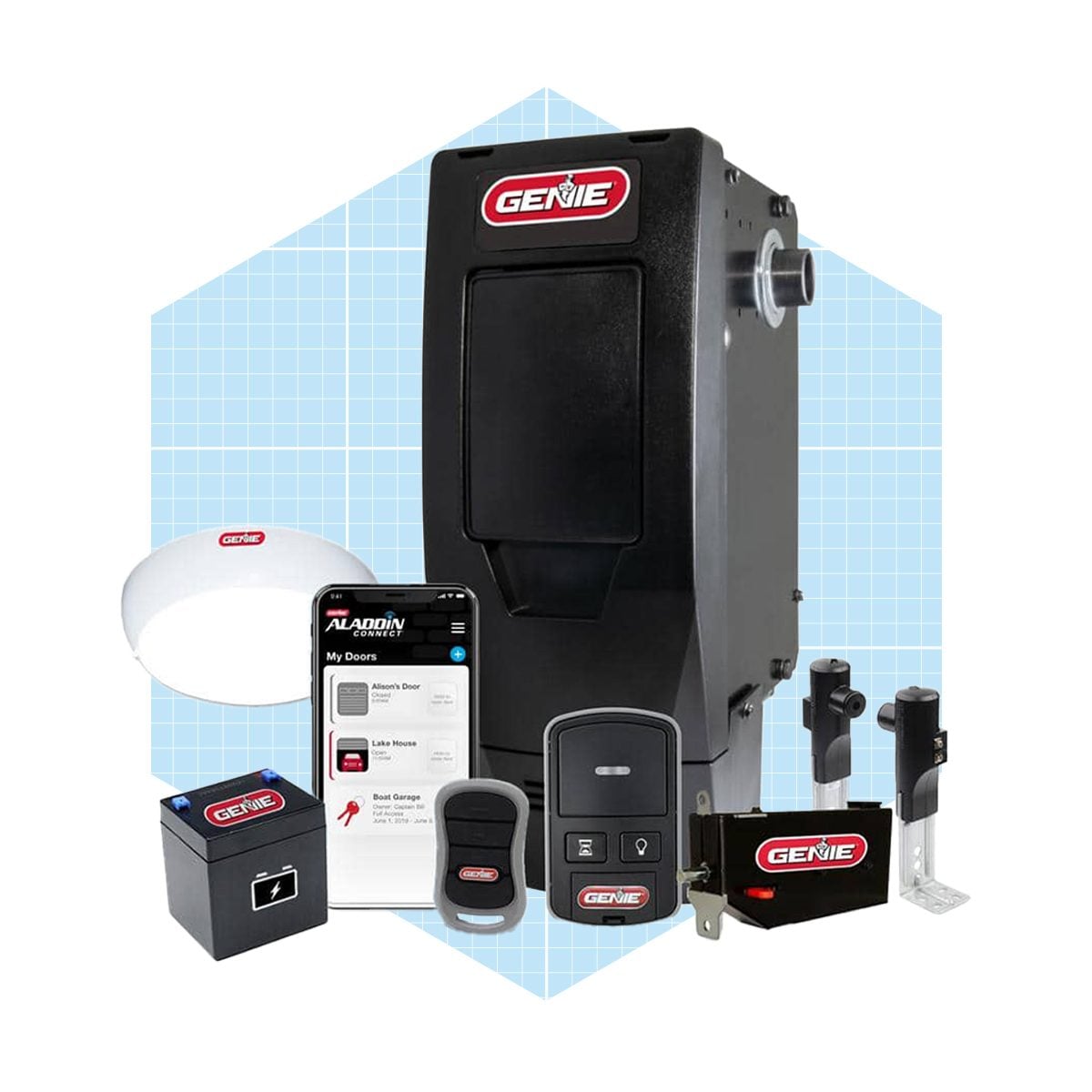
| Genie StealthDrive Connect 7155-TKV | Quiet Operation | Belt | 1-1/4 HPc | Yes | Aladdin Connect |
| LiftMaster 98022 | Wall-Mounted Installation | Direct wall mount | Doors up to 850 pounds | Yes | myQ |
| Genie MachForce Connect 4063 | Heavy Doors and Speed | Screw | 2 HPc | Optional | Aladdin Connect |
| Chamberlain B4603T | Best Value Belt Drive | Belt | 3/4 HP equivalent | No | myQ |
| Craftsman CMXC1220 | Best Budget Chain Drive | Chain | 1/2 HP equivalent | No | Craftsman myQ |
1. Chamberlain B6755T: Best Garage Door Opener Overall
Why It Earned the Top Spot
The Chamberlain B6755T is the garage door opener for homeowners who would rather buy one capable system than assemble features piece by piece. It combines a quiet belt drive, a strong DC motor, battery backup, built-in Wi-Fi, bright LED lighting, and an integrated camera.
Its lifting force is comparable to a 1-1/4-horsepower AC motor, giving it enough muscle for most residential sectional doors, including heavier insulated and double-width models. Soft-start and soft-stop operation reduces the sudden jerking and ceiling vibration associated with older openers.
The integrated 2,000-lumen lighting system is another meaningful advantage. Instead of producing one gloomy circle beneath the motor, it spreads light throughout the garage. That is useful when unloading groceries, working at a bench, or looking for the screwdriver that was definitely placed “right there.”
Through the myQ app, users can check door status, receive activity notifications, and operate the door remotely. The built-in 130-degree camera adds live video monitoring, although some advanced video-storage features may require a paid plan.
Potential Drawbacks
The B6755T costs more than a basic opener, and its smart-home ecosystem is centered heavily on Chamberlain’s myQ platform. Buyers who want broad, native compatibility with numerous third-party automation systems should investigate integration support before purchasing.
Best for: Homeowners who want an all-in-one opener with strong lifting power, excellent lighting, video monitoring, quiet operation, and backup power.
2. Genie StealthDrive Connect 7155-TKV: Best for Quiet Operation
A Strong Choice for Attached Garages
When a garage sits beneath a bedroom, beside a nursery, or directly under a home office, noise stops being a minor specification. It becomes the sound of someone arriving late and announcing it to the entire house.
The Genie StealthDrive Connect 7155-TKV addresses that problem with a steel-reinforced belt and a smooth DC motor rated at 1-1/4 HPc. The belt eliminates much of the metal-on-metal clatter produced by conventional chain-drive systems, while the motor delivers enough lifting force for standard residential sectional doors.
Integrated Aladdin Connect technology allows users to open, close, and monitor the garage through a smartphone. It can also work with supported Alexa and Google Assistant functions, giving it broader voice-assistant flexibility than some competing smart openers.
The included battery backup can provide up to 50 operating cycles after an initial power failure under the manufacturer’s stated conditions. The package also includes two preprogrammed remotes, a wireless keypad, safety sensors, and a multifunction wall console. That generous accessory bundle reduces the number of “apparently sold separately” surprises waiting at the end of installation.
Potential Drawbacks
The multi-piece rail still requires careful assembly, alignment, and ceiling mounting. Homeowners with eight-foot doors may also need a compatible extension kit.
Best for: Attached garages, rooms above the garage, smart-home users, and anyone who prefers a smooth hum to a mechanical parade.
3. LiftMaster 98022: Best Wall-Mounted Garage Door Opener
Premium Performance Without a Ceiling Rail
The LiftMaster 98022 mounts beside the garage door and connects directly to the torsion shaft. By eliminating the traditional ceiling rail and trolley, it frees valuable overhead space for storage racks, lighting, vehicle lifts, or a cleaner-looking garage ceiling.
Its DC motor is designed for smooth, low-vibration operation and can handle compatible sectional doors weighing up to 850 pounds. The opener includes battery backup, a remote 1,000-lumen LED light, built-in Wi-Fi, a smart control panel, and an automatic garage door lock that secures the door after it closes.
The wall-mounted configuration is especially attractive in garages with high, cathedral, or obstructed ceilings. It also helps reduce vibration transmission into living spaces because the motor is not hanging from the ceiling structure.
Compatibility Matters
This is not a universal replacement for every garage. The 98022 is intended for compatible sectional doors with torsion-spring assemblies. It is not designed for common extension-spring arrangements or every low-headroom track configuration.
LiftMaster also positions this as a professionally installed product. That increases total project cost, but a trained installer can confirm shaft dimensions, spring condition, door balance, clearance, and electrical requirements before mounting the unit.
Best for: Premium garages, heavy compatible doors, overhead-storage projects, and homeowners who want an automatic lock with a space-saving design.
4. Genie MachForce Connect 4063: Best for Heavy Doors and Fast Opening
Fast, Powerful Screw-Drive Operation
The Genie MachForce Connect 4063 is built for buyers who value speed and lifting strength more than whisper-level operation. Its 2 HPc DC motor and screw-drive rail can open a compatible garage door at speeds of up to 12 inches per second, according to Genie.
A screw-drive system uses a threaded steel mechanism instead of a belt or exposed chain. It offers direct power transfer and fewer flexible drive components, making it an appealing option for heavy residential doors and frequent daily use.
Aladdin Connect Wi-Fi technology is built in, allowing remote operation, status monitoring, virtual access, and notifications through a smartphone. The system also supports Genie’s Intellicode rolling-code security, HomeLink, Car2U, preprogrammed remotes, and diagnostic monitoring.
The motor and screw drive receive limited lifetime warranty coverage under Genie’s stated terms. Battery backup is not included with every version, but compatible backup hardware may be available as an add-on.
Potential Drawbacks
Although Genie describes the DC motor as quiet, a screw-drive opener can still transfer more mechanical sound than a premium belt-drive model. Climate, lubrication requirements, rail alignment, and door condition can also affect long-term noise.
Best for: Heavy sectional doors, homeowners who dislike waiting for a slow opener, and buyers who want strength with integrated smart control.
5. Chamberlain B4603T: Best Value Belt-Drive Opener
The Practical Middle Ground
The Chamberlain B4603T provides many of the features people actually use without charging for a built-in camera or battery system they may not need. Its 3/4-horsepower-equivalent DC motor is paired with a belt drive, making it suitable for most standard residential doors while keeping operation smooth and relatively quiet.
Integrated Wi-Fi connects the opener to the myQ app for remote control, notifications, scheduling features, and door-status checks. Bluetooth helps simplify initial setup, while soft-start and soft-stop movement reduces abrupt motion.
The built-in 1,000-lumen LED light is brighter and more evenly distributed than a single replaceable bulb. A wireless keypad, three-button remote, motion-detecting wall control, and safety sensors are included with the standard package.
Chamberlain provides lifetime warranty coverage for the motor and belt and five-year coverage for parts under its published warranty terms. That combination makes the B4603T an attractive long-term value rather than merely a low-cost purchase.
Potential Drawbacks
There is no battery backup. During an outage, users must operate the manual release or wait for power to return. Homeowners in California should select a model that complies with the state’s battery-backup requirements for newly installed residential openers.
Best for: Buyers who want quiet belt-drive performance, strong lighting, app control, and solid warranty coverage without paying for a camera.
6. Craftsman CMXC1220: Best Budget Chain-Drive Opener
Dependable Features at a Lower Price
Not every garage needs a camera, a wall-mounted motor, or enough LED output to guide small aircraft. For a standard lightweight door, the Craftsman CMXC1220 offers practical smart functionality in a straightforward chain-drive package.
Its lifting capacity is comparable to a 1/2-horsepower AC opener, making it appropriate for many single-car and lightweight double doors that are properly balanced. The chain drive is rugged and familiar, although it will generally produce more vibration and mechanical noise than a belt.
Built-in Wi-Fi connects to the Craftsman myQ app, allowing remote door control, activity alerts, and access management. The two included one-button remotes offer a stated range of up to 1,500 feet under favorable conditions. Safety reversing sensors and an interior wall control are also included.
The opener supports two light bulbs for front-and-rear illumination, but bulbs are not included. Warranty coverage is more modest than that of premium Chamberlain and Genie models, with four years on the motor and one year on the chain under the published terms.
Potential Drawbacks
This model lacks battery backup, integrated LED lighting, and premium sound insulation. Chain tension may also need occasional inspection or adjustment.
Best for: Detached garages, lightweight doors, rental properties, and budget-conscious homeowners who still want smartphone control.
How to Choose the Best Garage Door Opener
Match the Opener to the Door
The opener does not carry the entire weight of a garage door. Properly adjusted springs counterbalance most of that weight. However, the opener must still match the door’s size, construction, condition, and operating frequency.
A 1/2-horsepower-equivalent opener is generally suitable for lightweight, properly balanced doors. A 3/4-horsepower or stronger model provides additional reserve for insulated, wood, oversized, or frequently operated doors. A door that feels unusually heavy when lifted manually may have a spring or balance problem that should be corrected before installing a larger motor.
Understand the Drive Types
Belt-drive openers provide the quietest traditional ceiling-mounted operation. They are ideal for attached garages but usually cost more than chain models.
Chain-drive openers are durable, affordable, and widely supported. Their main disadvantage is noise and vibration.
Screw-drive openers provide fast, direct operation and strong lifting capability. Correct installation and compatibility with the local climate remain important.
Wall-mounted openers free ceiling space and reduce overhead vibration. They require compatible torsion-spring hardware and sufficient side clearance.
Decide Whether Battery Backup Is Essential
A backup battery keeps the opener operating when household electricity fails. It is particularly valuable when the garage is the primary entrance, when severe storms are common, or when manually lifting the door would be difficult.
California law requires battery backup on qualifying newly installed residential garage door openers. Buyers elsewhere should still consider the feature based on outage frequency and accessibility needs.
Check Smart-Home Compatibility Carefully
“Smart” does not always mean “works with everything.” Chamberlain, LiftMaster, and Craftsman generally center their connected features on myQ. Genie uses Aladdin Connect and advertises support for selected Alexa and Google Assistant functions.
Before purchasing, verify the exact functions supported by your preferred ecosystem. Receiving an alert may be supported even when direct voice-controlled closing is restricted for safety reasons.
Do Not Ignore Lighting
Integrated LED lighting can significantly improve garage visibility. Output around 1,000 lumens is useful for routine parking and entry, while a 2,000-lumen system offers broader illumination for larger garages and work areas.
Models that use replaceable bulbs provide flexibility, but the bulbs must meet the manufacturer’s size and wattage limits. Some LED bulbs can also create radio-frequency interference that reduces remote-control range.
Garage Door Opener Safety Tips
Automatic residential garage door openers sold in the United States must meet federal entrapment-protection requirements. Modern systems use photoelectric safety sensors and automatic reversal technology to help prevent a closing door from trapping a person, pet, or object.
Safety sensors should be aligned near the floor and kept free of dust, boxes, garden tools, and spiderwebs. Test the automatic reversing function regularly according to the manufacturer’s instructions. If the door fails a reversal test, stop using automatic operation until the system is adjusted or repaired.
Wall controls should be mounted out of children’s reach, and remote transmitters should not be treated as toys. Never walk or drive beneath a moving garage door, even when running late enough to believe normal physics will make an exception.
A garage door should also move smoothly by hand after the opener is disconnected. Binding tracks, damaged rollers, broken cables, and improperly adjusted springs place additional stress on the motor. Spring and cable repairs should be handled by trained garage-door technicians because those components store substantial energy.
Frequently Asked Questions
What is the best garage door opener for most homes?
The Chamberlain B6755T is the strongest all-around choice for homeowners who want quiet operation, battery backup, smart control, excellent lighting, and a built-in camera. Buyers who do not need video monitoring can save money with the Chamberlain B4603T or Genie 7155-TKV.
Is a belt-drive opener better than a chain-drive opener?
A belt drive is usually quieter and smoother, making it better for an attached garage. A chain drive is often more affordable and remains a dependable choice for a detached garage where noise is less important.
How much power does a garage door opener need?
Many properly balanced residential doors work well with a 1/2- or 3/4-horsepower-equivalent opener. Heavy wood, insulated, oversized, or frequently used doors may benefit from a stronger model. Door balance and spring condition matter as much as the motor rating.
Can I install a garage door opener myself?
Many ceiling-mounted retail models are designed for experienced DIY installation. The job commonly involves assembling a rail, attaching structural supports, wiring safety sensors, setting travel limits, and working from a ladder. Wall-mounted models and doors requiring spring adjustments are better handled by professionals.
Will a smart garage door opener work without Wi-Fi?
The wall button and compatible radio remotes generally continue to operate without Wi-Fi. Smartphone control, remote notifications, video access, and cloud-connected features will be unavailable until the network connection returns.
How long should a garage door opener last?
A quality opener may provide approximately 10 to 15 years of service, although lifespan varies with usage, door balance, climate, installation quality, and maintenance. Rollers, hinges, springs, batteries, remotes, and sensors may require attention before the motor itself fails.
Real-World Experiences and Ownership Lessons
Quiet Operation Is More Noticeable Than Extra Power
One of the clearest practical lessons from comparing modern garage door openers is that homeowners notice sound every day, while maximum motor power is appreciated only occasionally. A properly balanced standard door rarely challenges a good 3/4-horsepower-equivalent opener. The noise difference between an old chain system and a modern DC belt drive, however, is obvious during every trip.
In an attached garage, a belt-drive model can change the character of the room above it. The door still makes some sound because rollers move through metal tracks and hinges flex between panels, but the sharp motor vibration and chain chatter are greatly reduced. Replacing worn rollers can make an equally important difference. Installing a quiet opener on a door with rusty steel rollers is a little like buying noise-canceling headphones and then wearing a saucepan as a hat.
Smart Alerts Are More Useful Than Remote Opening
Remote opening receives most of the marketing attention, but status notifications often become the more valuable feature. An alert can reveal that the door was left open after the morning rush, that a teenager arrived home, or that a contractor accessed the garage at the expected time.
Remote control remains useful for deliveries and visitors, but it depends on stable Wi-Fi coverage. Garages often sit at the far edge of a home network, behind insulated walls, concrete, metal doors, vehicles, and several shelves filled with objects nobody remembers buying. Checking the Wi-Fi signal before installation can prevent frustrating setup failures later.
A mesh-network node or properly positioned access point may be needed for reliable video streaming from camera-equipped models. Basic door commands require less bandwidth, but weak connections can delay notifications or cause the app to report an outdated door status.
Battery Backup Changes How an Outage Feels
Without backup power, a garage door opener becomes a ceiling decoration during an outage. The emergency release allows manual operation, but that assumes the user can reach the cord, lift the door safely, and reconnect the trolley afterward.
Battery-equipped models remove much of that inconvenience. They are especially helpful for older adults, households that use the garage as the main entrance, and homes where the garage has no convenient secondary door. The battery will not run indefinitely, and its capacity decreases with age, so it should still be tested and replaced according to the manufacturer’s schedule.
Installation Quality Can Matter More Than Brand
A premium opener mounted to weak framing, paired with an unbalanced door, or configured with misaligned sensors can perform worse than a modest opener installed correctly. Before replacing the motor, the door should move freely, remain balanced when partially open, and travel through the tracks without binding.
Ceiling-mounted systems require secure structural attachment rather than a hopeful collection of screws placed wherever the drywall seems emotionally supportive. The rail must align with the center of the door, travel limits must be calibrated, and safety sensors must face one another without obstruction.
Wall-mounted openers demand even more compatibility checking. Torsion-shaft dimensions, available side clearance, drum placement, outlet location, track configuration, and door condition all influence whether the installation will work. This is why the LiftMaster 98022 is usually best treated as a dealer-installed upgrade rather than a casual Saturday experiment.
These ownership lessons are synthesized from manufacturer documentation, published product evaluations, safety guidance, and recurring user experiences. Individual results will vary according to the door, garage structure, network quality, installation, climate, and maintenance routine.
Final Verdict
The Chamberlain B6755T is the best garage door opener of 2025 for homeowners seeking the most complete combination of power, quiet operation, lighting, battery backup, smartphone control, and security monitoring.
The Genie StealthDrive Connect 7155-TKV is an excellent alternative for noise-sensitive homes and users who prefer Aladdin Connect. The LiftMaster 98022 is the premium choice for freeing ceiling space, while the Genie MachForce Connect 4063 delivers exceptional speed and strength.
For shoppers focused on value, the Chamberlain B4603T provides quiet belt-drive performance without camera-related expense. The Craftsman CMXC1220 remains a sensible budget option for detached garages and lighter doors.
The right opener is ultimately the one that matches the doornot merely the box with the largest horsepower number. Check the door’s construction, spring system, height, weight, ceiling arrangement, smart-home requirements, and local installation rules before making the final decision.
Editorial note: Product specifications, accessories, warranties, compatibility, and availability can change. Confirm current information with the manufacturer or an authorized installer before purchasing. Professional inspection is recommended when the door is damaged, difficult to lift manually, improperly balanced, or equipped with high-tension components requiring adjustment.