Famous places are a little like celebrities: beautiful from a distance, dramatic up close, and full of stories that sound made up until history raises its hand and says, “Actually, yes.” The world’s best-known landmarks are not just postcard backdrops. They are engineering experiments, political statements, accidental icons, geological time capsules, and sometimes giant billboards that simply refused to retire.
In this guide to 55 strange facts about famous places, we travel from the Statue of Liberty’s green skin to Stonehenge’s traveling stones, from the water wizardry of Petra to the lightning-loving Empire State Building. These are not random trivia crumbs swept off the internet floor. They are real, research-backed facts about famous landmarks, historic sites, natural wonders, and travel destinations that make the world feel bigger, weirder, and far more entertaining.
Strange Facts About Famous Places in the United States
American landmarks with surprisingly odd backstories
- The Statue of Liberty was not always green. When it was unveiled in 1886, Lady Liberty looked more like a shiny copper penny. The famous green color came later from oxidation, which is basically copper’s way of aging gracefully.
- Lady Liberty has a giant nose. The Statue of Liberty’s nose is about 4 feet 6 inches long. That means one of the world’s most symbolic faces could also win a contest for “Most Impressive Nasal Architecture.”
- There are 377 steps to the Statue of Liberty’s crown. Visitors who climb to the crown earn both a view and a free leg workout disguised as patriotism.
- The statue’s pedestal weighs far more than the statue itself. The copper statue is enormous, but the stone pedestal is the heavyweight champion, weighing roughly 52 million pounds.
- The Grand Canyon contains rocks older than most forms of complex life. Some rocks deep in the canyon date back around 1.84 billion years. That is not “old” in a cute antique-shop way; that is “Earth was still getting its act together” old.
- The Grand Canyon was not carved overnight. The Colorado River has been cutting through the landscape for roughly five to six million years, proving that persistence beats speed when you are a river with a dramatic vision.
- The Grand Canyon is a fossil library. Its rock layers preserve about a billion years of fossil life, making it one of the planet’s most spectacular natural history books.
- Yellowstone has nearly 500 geysers. That is more geysers than anywhere else on Earth, which makes Yellowstone less like a park and more like the planet’s steamy pressure cooker.
- Old Faithful is predictable, but not perfectly punctual. It remains one of the few geysers park rangers can forecast, though the time between eruptions has lengthened over recent decades.
- Yellowstone sits on a volcanic hot spot. The park’s beauty is powered by serious underground drama, including a long trail of ancient volcanic activity across the American West.
- The Golden Gate Bridge is not gold. Its color is officially called International Orange, selected because it stands out in fog and looks gorgeous against the bay. Practical and photogenic: a rare combo.
- Alcatraz was scary before it was famous. Long before tourists wore audio headsets there, the island served military and prison purposes, helped by cold water and strong currents that made escape a very bad swimming plan.
- Alcatraz became a symbol of Native activism. In 1969, Native American activists known as Indians of All Tribes occupied the island, turning the former prison into a powerful site of protest and cultural memory.
- Mount Rushmore was mostly carved with dynamite. About 90 percent of the carving was done by blasting rock away. Apparently, the secret to presidential sculpture is patience, math, and controlled explosions.
- No workers died during Mount Rushmore’s construction. Considering the height, tools, and dynamite involved, that fact is almost as astonishing as the monument itself.
- The Washington Monument is topped with aluminum. Its 8.9-inch aluminum tip sounds ordinary today, but when it was installed in the 1880s, aluminum was rare and impressive.
- The Washington Monument was once the tallest building in the world. When completed, it rose to 555 feet 5.125 inches, briefly making Washington, D.C., the owner of the world’s tallest bragging rights.
- The White House is bigger than it looks. It has 132 rooms, 35 bathrooms, 412 doors, 147 windows, 28 fireplaces, 8 staircases, and 3 elevators. Basically, it is a mansion, office, museum, and logistical puzzle wearing white paint.
- The White House needs 570 gallons of paint. Covering the exterior is not a weekend DIY project unless your weekend includes scaffolding, a government budget, and many, many brushes.
- The White House press briefing room sits over an old swimming pool. President Franklin D. Roosevelt used a pool installed for therapy, and the later press room was built above it. Somewhere under political questions is a splashy secret.
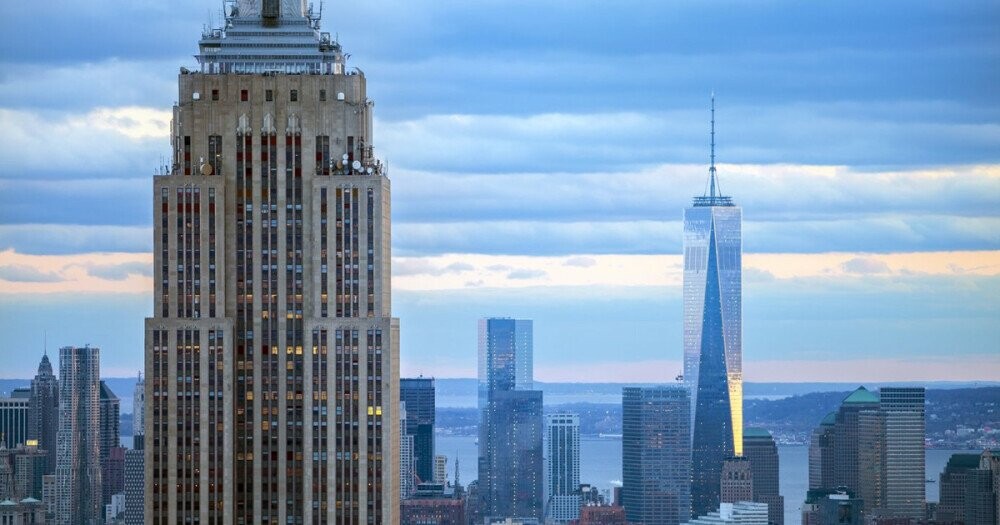
- The Empire State Building is a lightning magnet. Its antenna is struck by lightning about 25 times a year, which makes it less a skyscraper and more New York’s dramatic weather antenna.
- The Space Needle has a revolving glass floor. Seattle’s famous tower features The Loupe, billed as the world’s first and only revolving glass floor. It is perfect for people who enjoy views and mild emotional chaos.
- Central Park has an ancient Egyptian obelisk. Cleopatra’s Needle is about 3,500 years old, making it the oldest man-made object in the park. The squirrels may act unimpressed, but history is watching.
- Central Park lampposts can help you navigate. Many lampposts have number codes that indicate nearby streets and whether you are closer to the east or west side. It is a secret map hiding in plain sight.
- The Hollywood Sign began as an advertisement. It originally read “Hollywoodland” and promoted a real estate development in 1923. The world-famous symbol of cinema started as a hillside billboard with ambition.
Strange Facts About Famous Places Around the World
Global landmarks that are weirder than they look
- The Eiffel Tower grows in hot weather. Because metal expands with heat, the tower can become slightly taller in warm conditions. Paris gets romance; physics gets the credit.
- The Eiffel Tower can lean away from the sun. Sunlight heats one side more than the others, causing tiny shifts. It is not dramatic enough for tourists to notice, but it is enough for engineers to smile knowingly.
- The Eiffel Tower was built incredibly fast. Construction took 2 years, 2 months, and 5 days, an astonishing pace for a structure that became one of the world’s most recognizable landmarks.
- The Great Wall of China is not easily visible from space. The old claim that it can be seen from the Moon is a myth. NASA notes that the wall is difficult or impossible to see from Earth orbit without special lenses.
- The Great Pyramid of Giza was originally taller. It once stood about 481 feet high, but today it is lower because outer casing stones were removed over time.
- The Great Pyramid once shone in the sun. Its original smooth white limestone casing would have reflected sunlight, giving it a polished, glowing appearance rather than the rugged look visitors see today.
- The pyramid blocks were extremely heavy. Many blocks averaged more than two tons, with the largest weighing up to about fifteen tons. Ancient builders were not casually stacking patio stones.
- The Colosseum had an underground backstage. Beneath the arena was the hypogeum, a network of tunnels, cages, and mechanisms used to move fighters, scenery, and animals into the spectacle.
- Animals could appear in the Colosseum like magic. Ancient lifts and trapdoors helped create sudden dramatic entrances. Rome understood show business long before fog machines.
- The Mona Lisa was once stolen from the Louvre. In 1911, the painting disappeared, and the theft helped make it even more famous. Nothing boosts a painting’s brand like becoming the center of an international mystery.
- Pablo Picasso was questioned after the Mona Lisa theft. He was not the thief, but his name became part of the strange investigation surrounding the world’s most famous missing smile.
- The Taj Mahal is almost perfectly symmetrical. Its design balances domes, gardens, minarets, and gateways with extraordinary precision, making it both a love story and a geometry flex.
- One tomb disrupts the Taj Mahal’s symmetry. Mumtaz Mahal’s cenotaph sits at the center, while Shah Jahan’s was placed beside it later, creating a subtle but famous break in the balance.
- The Leaning Tower of Pisa started leaning early. The tilt became noticeable after only the first three stories were built, thanks to soft ground under the foundation.
- War accidentally helped the Leaning Tower survive. Construction paused for nearly a century because of regional conflict, giving the ground time to settle before more weight was added.
- Petra thrived because of water engineering. The desert city used channels, dams, cisterns, and reservoirs to capture and manage precious water.
- Petra’s water channels were remarkably precise. One irrigation channel along the Siq drops only about 12 feet over the course of a mile, showing careful ancient engineering.
- Stonehenge used stones from far away. Many bluestones came from Wales, meaning prehistoric builders moved heavy rocks across great distances without trucks, cranes, or complaining in online reviews.
- Stonehenge’s Altar Stone may have come from Scotland. Recent research indicates that the large central stone originated far north of the monument, adding another mystery to an already mysterious site.
- Machu Picchu was not truly “lost.” Hiram Bingham publicized it internationally in 1911, but local Indigenous people knew about the site before his arrival.
- Machu Picchu may have had deep ceremonial meaning. Scholars have debated whether it was a royal estate, pilgrimage center, sacred landscape, or some combination of these roles.
- Niagara Falls moves a staggering amount of water. About 3,160 tons of water flow over the falls every second, which is nature’s way of saying, “Turn the volume up.”
- Water at Niagara Falls drops fast. It plunges at about 32 feet per second, creating the thunderous force that makes visitors instinctively reach for rain ponchos.
- Easter Island’s moai may have “walked.” Researchers have tested the idea that teams used ropes to rock statues side to side, moving them upright across the island.
- Moai statues are heavier than they look. Many average around 13 feet tall and 14 tons, which makes the “walking statue” theory even more impressive.
- Angkor Wat began as a Hindu temple. The famous Cambodian site was originally dedicated to Vishnu before gradually becoming associated with Buddhism.
- Angkor Wat is one of the world’s largest religious complexes. Its scale, moat, galleries, towers, and bas-reliefs make it feel less like a building and more like a stone universe.
- The Louvre was not always just a museum. Before becoming one of the world’s most visited museums, the Louvre had a long life tied to royal power, palace culture, and France’s changing identity.
- Buckingham Palace has a hidden working side. Beyond balconies and royal ceremonies, it functions as an administrative headquarters, event venue, residence, and symbol of the British monarchy.
- Famous places often survive because people change their minds. The Eiffel Tower, Hollywood Sign, and many other icons were not always universally loved. Today’s treasure can be yesterday’s eyesore with better public relations.
Why Strange Landmark Facts Make Travel More Memorable
Strange facts about famous places do more than help you win trivia night. They change the way you see travel. A landmark becomes more interesting when it stops being a flat image and starts acting like a character with secrets. The Statue of Liberty is no longer just a symbol of freedom; she is a copper giant with a green patina, a long nose, and a staircase that punishes unprepared calves. The Eiffel Tower is not just romantic ironwork; it is a heat-sensitive structure that subtly changes size like it has seasonal moods.
This is why the best travel experiences often begin before the trip. A traveler who knows that Central Park lampposts contain navigation codes walks through the park differently. Suddenly, a simple light pole becomes a clue. Someone visiting the White House may look at the press briefing room and imagine the old swimming pool hidden beneath all those microphones. A person standing near the Golden Gate Bridge may appreciate that the color was not chosen by accident but because fog, landscape, and visibility all had a vote.
These details also make crowded destinations feel personal. Famous places can be overwhelming because everyone is trying to take the same photo from the same angle at the same time. But a strange fact gives you a private way in. At the Colosseum, instead of seeing only broken stone, you can imagine trapdoors, animal lifts, and ancient stagecraft. At Petra, the carved facades are stunning, but the hidden water system reveals something even deeper: survival in the desert required intelligence as much as beauty. At Niagara Falls, the view is impressive, but knowing the force and volume of the water turns the mist into a full-body science lesson.
Travelers often remember the odd detail more than the official description. Guidebooks may call the Taj Mahal a masterpiece of Mughal architecture, which is true, but many visitors are hooked by the tiny asymmetry created when Shah Jahan’s tomb was added beside Mumtaz Mahal’s. That small disruption makes the monument feel human. The Leaning Tower of Pisa is funny because it failed at standing straight, but it is fascinating because engineers, soil, time, and even a construction pause all helped it survive. The imperfection became the attraction.
For families, strange landmark facts are especially useful. Children may not care about dates at first, but tell them that Easter Island statues may have “walked,” or that the Empire State Building gets struck by lightning about 25 times a year, and suddenly history has a pulse. For writers, creators, teachers, and travel bloggers, these facts are storytelling gold. They provide hooks, humor, and emotional texture. A famous place becomes easier to explain when it contains one unforgettable surprise.
The best way to experience famous places is to look for the second story hiding behind the first. The first story is the obvious one: this is tall, old, beautiful, sacred, huge, or expensive. The second story is stranger: this was almost demolished, this changed color, this moved across a continent, this was built over a pool, this has a secret code, this survives because people refused to let it disappear. That second story is where wonder lives.
Conclusion
The world’s most famous places are famous for good reasons, but their strangest details are what make them unforgettable. A monument may begin as an engineering project, an advertisement, a tomb, a temple, or even a prison, then slowly become a symbol recognized across the planet. The odd facts remind us that history is not tidy. It is full of accidents, arguments, repairs, myths, experiments, and surprising decisions that somehow survive long enough to become culture.
So the next time you see a landmark on a postcard, travel blog, documentary, or bucket list, look closer. Ask what color it used to be. Ask what is underneath it. Ask who moved the stones, who paid for the sign, who thought the tower was ugly, who installed the secret code, and who decided not to tear the whole thing down. The answer is often stranger than the brochureand much more fun.