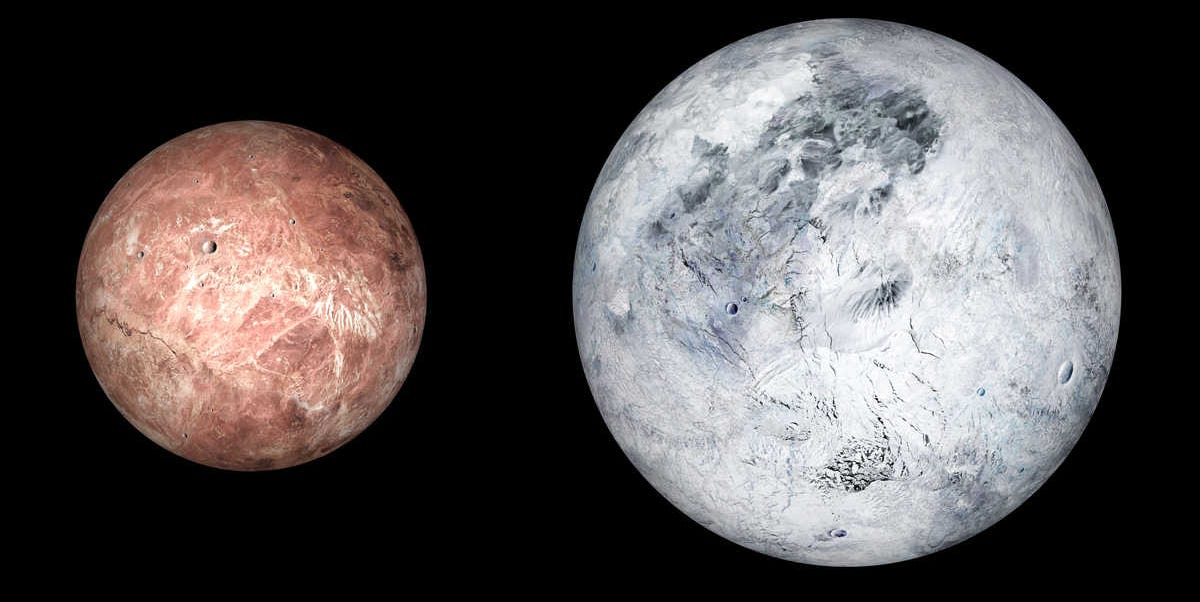
Far beyond Neptune, where sunlight is weak enough to feel like a rumor, two dwarf planets may be hiding a remarkably warm secret. Eris and Makemake look like frozen leftovers from the solar system’s construction phase: small, remote, methane-coated worlds orbiting in a celestial deep freezer. Yet observations from the James Webb Space Telescope suggest that their surfaces contain methane probably manufactured inside them under conditions far warmer than anyone expected.
That finding raises an even more exciting possibility. If these worlds developed enough internal heat to drive hydrothermal or metamorphic chemistry, they may once have contained subsurface oceans. Some models even allow liquid water to survive today beneath thick ice. Scientists have not directly detected those oceans, so nobody should start selling waterfront property on Makemake. Still, the chemical evidence is changing how researchers view dwarf planets beyond Pluto.
Meet Eris and Makemake, Two Distant Dwarf Planets
Eris and Makemake are trans-Neptunian objects, icy bodies that formed roughly 4.5 billion years ago beyond Neptune. Both are among the five dwarf planets formally recognized by the International Astronomical Union.
Eris: The World That Helped Demote Pluto
Eris is about 1,500 miles wide, close to Pluto in diameter but more massive. Its discovery intensified the debate over what counts as a planet and helped trigger the 2006 definition that reclassified Pluto. Eris arrived late to the family meeting and somehow got Pluto’s chair removed.
It orbits at an average distance of about 68 astronomical units, and one Eris year lasts roughly 557 Earth years. Its surface can fall below minus 400 degrees Fahrenheit. Eris also has a small moon, Dysnomia, whose orbit helps astronomers determine the dwarf planet’s mass.
Makemake: Bright, Reddish, and Mysterious
Makemake has a radius of about 444 miles and circles the Sun from an average distance of 45.8 astronomical units. One orbit takes approximately 305 Earth years. Its reddish-brown surface contains frozen methane and ethane, and NASA notes that some methane grains may be as large as half an inch. Makemake also has a tiny moon nicknamed MK 2.
How Webb Read the Methane Like a Chemical Diary
The breakthrough came from Webb’s Near-Infrared Spectrograph, or NIRSpec. The instrument separates reflected light into many wavelengths. Since different molecules absorb light in distinctive patterns, a spectrum acts like a chemical barcode. Webb can detect ordinary methane and rarer versions containing heavier isotopes.
Researchers focused on deuterium, a heavy form of hydrogen. The ratio of deuterium to ordinary hydrogen, written as D/H, can reveal where a substance originated and how it was processed. Webb measured D/H ratios of about 2.5 times 10-4 in methane ice on Eris and 2.9 times 10-4 on Makemake.
Those values are much lower than the ratio in methane believed to be primordial on comet 67P/Churyumov-Gerasimenko. Therefore, the methane on Eris and Makemake does not resemble untouched material inherited directly from the cold cloud that formed the solar system.
The Crucial Clue: This Methane Appears to Be “New”
If the dwarf planets had simply preserved their original methane for billions of years, scientists expected a stronger heavy-hydrogen signature. Instead, the ratios resemble hydrogen associated with water in many outer-solar-system bodies. That points toward methane created through interactions involving water, rock, carbon compounds, and internal heat.
Carbon-isotope measurements provide another clue. They do not show the strong enrichment expected if today’s methane were merely the final residue of a much larger supply that mostly escaped. A better explanation is that methane was produced inside the dwarf planets and later delivered to the surface, perhaps recently in geological terms.
Two Ways to Cook Methane Inside an Ice World
Geochemical models identify two main nonbiological pathways. Both require interiors far warmer than the frozen surfaces.
1. Thermogenic Methane From Heated Organic Material
In the thermogenic scenario, heat alters carbon-rich organic matter trapped in rock. At temperatures above roughly 300 degrees Fahrenheit, complex compounds can break apart, allowing carbon and hydrogen to form methane. This pathway does not necessarily require a liquid ocean, but it does require a rocky core heated substantially by radioactive decay.
Even a small world can retain part of that energy when a thick ice layer provides insulation. The surface may be colder than a landlord’s heart while the deeper interior remains chemically busy.
2. Abiotic Methane From Hot Water and Rock
The second route is more dramatic. If heat melted some internal ice, hot water could circulate through the rocky core. Reactions involving water, minerals, carbon monoxide, and carbon dioxide could then generate methane without biology. Similar water-rock chemistry occurs around hydrothermal systems on Earth, although conditions inside a dwarf planet would be very different.
This mechanism opens the door to hidden oceans. A buried sea could have formed between the core and outer ice shell, allowing warm water to exchange chemicals with the seafloor.
Could Eris and Makemake Still Have Liquid Oceans?
The honest answer is “possibly,” not “definitely.” Webb did not photograph an ocean, detect underground waves, or discover an Erisian submarine. It measured methane isotopes. Researchers then used geochemical and thermal models to identify processes capable of producing those signatures.
The results indicate that the rocky cores probably reached temperatures high enough for hydrothermal or metamorphic reactions. Such heat could also support subsurface water, especially if ammonia, salts, or other compounds lowered its freezing point. Miles of overlying ice would slow heat loss.
Eris may be the stronger candidate for long-lived activity because its greater mass helps it retain heat. Makemake may have cooled faster. Current observations cannot establish whether either world contains liquid water today, how deep an ocean might be, or whether internal activity continues.
How Could Interior Methane Reach the Surface?
Cryovolcanism is one possibility. Instead of molten rock, cryovolcanoes can release water, ammonia, methane, nitrogen, or slushy volatile mixtures. Gas pressure may push material through fractures until it erupts or leaks onto the surface. The methane would then freeze almost immediately.
Fresh deposits could help explain why Eris and Makemake are relatively bright compared with many smaller trans-Neptunian objects darkened by radiation. Brightness is not proof of active geology, but it fits a history of resurfacing. Seasonal cycles can also move volatile frost around, although they cannot explain the methane’s deep-geochemistry signature by themselves.
Why the Discovery Changes the Kuiper Belt Story
The outer solar system was once described as a museum of frozen leftovers. It does preserve ancient material, but ancient does not mean inactive. Pluto proved that when NASA’s New Horizons spacecraft revealed glaciers, mountains, convection, haze, and evidence consistent with a subsurface ocean.
Eris and Makemake extend that lesson. A world does not need strong sunlight to become geologically complex. Radioactive decay, leftover formation heat, insulating ice, and chemical reactions can keep an interior evolving long after the surface freezes.
The findings are also relevant to astrobiology. Liquid water, rock, organic compounds, and energy are important ingredients when researchers assess habitability. Their possible presence does not mean life exists on either dwarf planet. Methane is not proof of biology, and nonbiological chemistry explains the observations. Nevertheless, an ocean interacting with a warm rocky core would be a compelling environment to investigate.
What Scientists Need to Learn Next
Additional Webb observations could map methane and other ices across both rotating worlds. Changes over time might reveal seasonal deposits, fresh terrain, or active transport. Better measurements of nitrogen, carbon monoxide, ethane, and more isotopes could narrow the possible internal chemistry.
Stellar occultations can test for thin atmospheres and improve estimates of size and shape. Thermal models can explore whether an ocean could survive for billions of years. Ultimately, a spacecraft flyby could search for fractures, smooth plains, domes, plume deposits, or other signs of cryovolcanism. The trip would be difficult, but New Horizons already showed that distant dwarf planets reward patience.
Conclusion: Frozen Outside, Complicated Inside
Eris and Makemake were once easy to dismiss as remote ice balls circling in Pluto’s lonely neighborhood. Webb’s isotope measurements make that description look incomplete. Their methane appears to carry the signature of internal production, requiring warm or hot geochemistry in rocky cores. These dwarf planets experienced far more evolution than their silent surfaces suggest.
Hidden oceans remain a hypothesis rather than a confirmed discovery. Even so, the possibility is credible enough to reshape plans for studying the Kuiper Belt. The solar system’s frontier may not be a graveyard of inert debris. It may be a collection of insulated worlds with warm histories, active chemistry, and secrets sealed beneath ice.
A Space-Watcher’s Experience: Learning Not to Judge a World by Its Frost
Following discoveries in the outer solar system produces a particular kind of intellectual whiplash. First, a distant object appears as a point of light. Astronomers estimate its orbit, brightness, and color, and the public receives a tidy label: frozen dwarf planet. Years later, a better telescope arrives and the label falls apart. The dot becomes a chemically complex world, and the phrase “nothing happens there” quietly exits through the emergency door.
That pattern is one of the most useful experiences readers can take from the Eris and Makemake research. Scientific knowledge often advances not through one cinematic image but through indirect clues. No probe drilled through the ice. No camera photographed a glowing underground sea. Webb instead separated faint reflected sunlight into wavelengths and measured tiny differences among methane molecules. From those differences, researchers reconstructed a plausible history of hot rock, water, organic material, and gas moving through an unseen interior.
At first, isotope ratios can feel less exciting than a dramatic space photograph. They look like numbers invented to frighten anyone who skipped chemistry class. Yet those numbers are the adventure. A D/H ratio is a message from matter itself. It can show whether methane was inherited from the solar system’s birth cloud, altered by loss to space, or created later through internal reactions. Reading that message is like finding flour on a kitchen floor and deducing that someone baked bread at midnight. The loaf is gone, the baker is hiding, but the evidence has opinions.
The discovery also changes the emotional geography of the solar system. People naturally imagine warmth and activity near the Sun, then picture increasing emptiness and stillness with distance. Eris challenges that intuition. Its surface receives little solar energy, yet its interior may once have supported powerful chemical reactions. Makemake, though smaller, tells a similar story. The farther scientists look, the less useful “too cold to be interesting” becomes.
There is also a lesson in restraint. Headlines emphasize hidden oceans because oceans are irresistible. They suggest chemistry, exploration, and perhaps habitability. But the evidence supports a chain of inference: methane has unusual isotope ratios; those ratios favor internal production; that production requires substantial heat; and some plausible pathways involve liquid water. Every step matters, but the final ocean has not been directly observed.
That uncertainty does not weaken the discovery. It shows science working in real time. Future spectroscopy, occultations, thermal models, laboratory experiments, and spacecraft observations can test the idea. The answer might be a present-day ocean, an ancient ocean that froze, or a dry thermogenic pathway that required heat but little liquid water.
For anyone following planetary science, the best habit is to keep categories flexible. “Dwarf” does not mean simple. “Frozen” does not mean dead. “Remote” does not mean irrelevant. Eris and Makemake remind us that nature does not organize itself around our first impressions. Sometimes the most incredible worlds are the quiet ones orbiting in darkness, leaving only a few altered methane molecules as clues.
Note: The proposed subsurface oceans on Eris and Makemake have not been directly detected. The idea is based on Webb spectroscopy, isotope measurements, and geochemical models indicating warm or hot internal processes.