McDonald’s is one of those brands so familiar that it almost feels like public infrastructure: yellow arches, salty fries, a soda the size of a toddler’s backpack, and a drive-thru voice asking, “Anything else?” But behind the convenience, the nostalgia, and the suspiciously addictive fries sits a long menu of controversies. Some are old. Some are recent. Some involve courtrooms, regulators, workers, children, animals, franchisees, and customers who simply wanted lunch and got a corporate ethics seminar with dipping sauce.
Note: This article uses the word “evil” as a humorous editorial frame for documented controversies, lawsuits, public criticism, settlements, and regulatory actions. It is not a legal conclusion. Where claims were disputed, dismissed, settled, or alleged, the wording says so. Think of this as a fast-food scandal tour: less “Happy Meal,” more “uncomfortable combo.”
Below are 15 impressively questionable things connected to McDonald’s history, business practices, marketing, labor systems, and public image. Grab a napkin. Things may get greasy.
15 Impressively Evil Things McDonald’s Has Done
1. The Hot Coffee Case Was Much Worse Than the Joke
The infamous McDonald’s hot coffee lawsuit is often repeated as a punchline, usually by people who only know three words: “hot coffee lawsuit.” In reality, Stella Liebeck suffered severe burns after coffee spilled in her lap, and trial evidence focused on the company’s coffee temperature standards and prior burn complaints. The jury’s award was later reduced, and the case settled privately. The “evil” part, according to critics, was not that coffee was hot; it was that a real injury became a cultural joke while corporate safety questions got buried under late-night monologues.
2. Selling Fries With Beef Flavoring to People Who Avoid Beef
McDonald’s fries are practically a religion of their own, which made it especially awkward when vegetarians and Hindu customers challenged the company over beef flavoring used in its fries. The controversy centered on whether customers had been misled about what was in one of the chain’s most iconic products. McDonald’s later apologized and agreed to a settlement involving payments to vegetarian and religious groups. For a company selling food to millions, “surprise beef” is not exactly the seasoning people expect.
3. Dragging Its Feet on Trans Fat Transparency
In the early 2000s, McDonald’s announced plans to reduce trans fats in its cooking oil, then faced lawsuits accusing it of failing to clearly inform customers about delays. The company agreed to an $8.5 million settlement, including money for public education. The issue matters because trans fats were not a tiny footnote in nutrition science; they were tied to heart-health concerns. The villainous flavor here was not just the oil. It was the gap between “we are changing” and “customers clearly know what is happening.”
4. Marketing to Children Like Tiny Brand Ambassadors
The Happy Meal is brilliant business: food, toy, cartoon energy, and childhood memory packed in a box with handles. But critics have long argued that McDonald’s used toys, characters, playgrounds, and child-focused ads to build loyalty before kids could spell “brand loyalty.” Research on fast-food advertising has repeatedly examined how toy premiums and child-directed marketing influence children’s preferences. Parents call it “pester power.” Marketers call it engagement. Children call it “I want the toy.” Everyone else calls it Tuesday.
5. Turning Kids’ Meals Into Toy Commercials With a Side of Nuggets
One criticism goes beyond advertising to children generally: the toy often becomes the star, while the meal becomes the entry fee. Studies of child-directed fast-food ads have found that premiums can dominate the message. That raises a basic question: is McDonald’s selling lunch, or is it selling collectible plastic that happens to come with fries? The line gets blurry, and the blur is profitable. For families trying to encourage healthy eating, the Happy Meal can feel less like dinner and more like a tiny hostage negotiation.
6. Suing Activists in the McLibel Case
McDonald’s became internationally infamous for the McLibel case, a long-running British libel battle against activists who had distributed a critical leaflet. The case became a symbol of corporate power versus ordinary critics, especially because the activists defended themselves against a giant corporation. Later, the European Court of Human Rights found that the defendants’ trial rights had been violated by the United Kingdom’s legal aid rules. Even when a company technically wins parts of a legal battle, it can still lose the public-relations war so badly that the fries go cold.
7. Wage and Hour Controversies in the Franchise System
Many McDonald’s restaurants are franchise-owned, which allows the corporation to argue that local operators are responsible for employment practices. That structure has not stopped lawsuits and settlements over wage-and-hour claims, including allegations that workers were underpaid, forced to cover register shortages, or denied proper compensation. Critics say the franchise model can create a convenient fog machine: corporate standards when the brand wants control, franchise independence when labor problems arrive with a subpoena.
8. No-Poach Clauses That Allegedly Trapped Workers
McDonald’s has faced antitrust litigation over old franchise agreements that allegedly prevented one McDonald’s location from hiring workers away from another. The company has said it stopped requiring such clauses in 2017, but workers argued the practice limited job mobility and suppressed wages. In plain English, that means a worker flipping burgers at one location might have had fewer chances to move to another McDonald’s for better pay. That is not “career development.” That is a Monopoly board where every square says “Go back to the fryer.”
9. Child Labor Violations at Franchise Locations
Federal labor officials have found child labor violations involving McDonald’s franchisees, including cases where minors worked later or longer than allowed and, in some reports, children as young as 10 were found around fast-food kitchen operations. McDonald’s corporate leadership condemned such incidents, and the violations were attributed to franchise operators. Still, for the public, the logo on the building is the logo on the building. When children are found working near grills, fryers, and late-night shifts, the brand cannot simply hide behind the drive-thru menu.
10. Sexual Harassment Cases Involving Young Workers
McDonald’s franchisees have faced serious sexual harassment lawsuits and settlements, including cases involving teenage workers. The Equal Employment Opportunity Commission has pursued claims against operators accused of failing to protect employees from harassment by supervisors, managers, or coworkers. McDonald’s is hardly the only fast-food chain with this problem, but its scale makes the issue especially alarming. A first job should teach punctuality, teamwork, and how to survive rush hour. It should not teach a teenager that workplace safety is optional.
11. Racial Discrimination Allegations From Franchisees and Media Companies
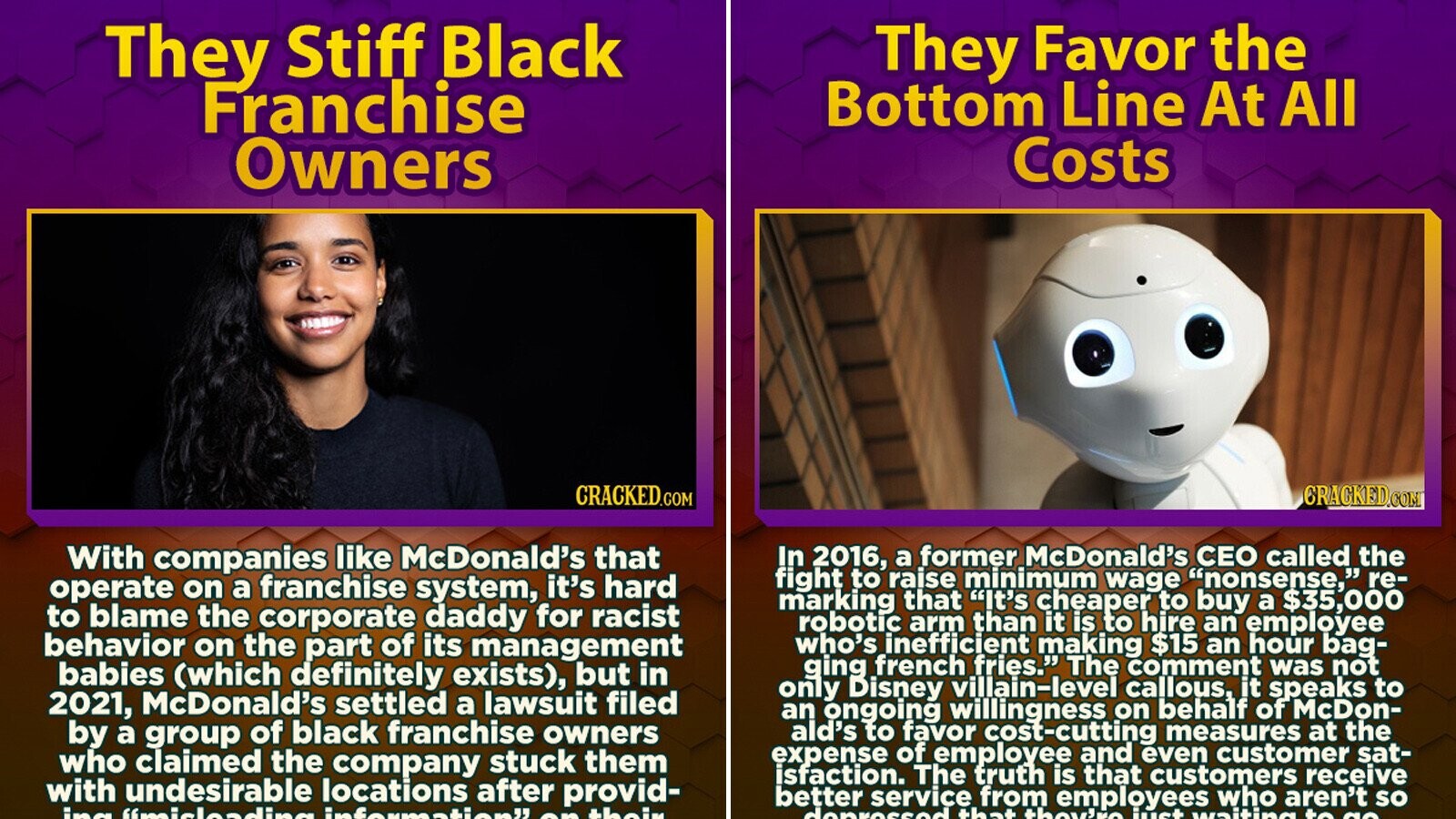
McDonald’s has faced multiple racial discrimination lawsuits and claims, including allegations by Black franchise owners that they were steered toward less profitable locations, as well as a major lawsuit from media entrepreneur Byron Allen over advertising with Black-owned media. Some claims have been dismissed, amended, or settled, and McDonald’s has denied wrongdoing in various cases. But the recurring nature of the allegations has kept attention on who gets opportunity, who gets advertising dollars, and who gets told to be patient while the golden arches shine elsewhere.
12. The CEO Text Message Backlash
McDonald’s CEO Chris Kempczinski faced backlash after a text exchange with Chicago’s mayor appeared to blame parents after the deaths of two children in separate tragedies. He later addressed the comments internally, but the controversy became part of a wider discussion about corporate leadership, race, empathy, and public accountability. A later lawsuit by a former executive referenced criticism of those texts. The “evil” angle here is not a burger. It is what happens when executive language sounds polished in the boardroom but cruel in the real world.
13. Broken Ice Cream Machines and Repair Restrictions
The McDonald’s ice cream machine has become a meme with its own emotional support group. But behind the joke sits a serious right-to-repair issue. Franchisees and repair advocates criticized restrictions that made machines difficult to diagnose and fix without authorized service. Federal agencies supported broader repair rights for commercial equipment, and copyright exemptions later made certain repairs easier. Customers experienced the problem as “Sorry, the machine is down.” Franchise owners experienced it as lost sales. The machine experienced it as a villain origin story.
14. The Monopoly Promotion Fraud Disaster
The McDonald’s Monopoly game was designed to make customers buy more food for a chance at prizes. Then the promotion became infamous after a security insider connected to the outsourced game operation stole winning pieces and helped rig the system for years. McDonald’s itself was portrayed as a victim of the fraud, but the scandal still exposed how a wildly profitable promotion could be vulnerable to weak controls. Customers were chasing rare pieces that, in many cases, had already been quietly diverted. That is not a game; that is capitalism wearing a top hat and laughing.
15. Packaging, Waste, and the Environmental Hangover
McDonald’s has made environmental commitments over the years, including changes to packaging, but the company has also been criticized for foam packaging, plastic waste, and the broader environmental footprint of fast food. The old polystyrene clamshell became a symbol of disposable convenience: eat in six minutes, let the packaging haunt the planet indefinitely. To its credit, McDonald’s has changed some practices. To its critics, the company helped normalize a disposable dining culture where the trash can became part of the business model.
Why These McDonald’s Controversies Still Matter
It is easy to dismiss McDonald’s scandals as ancient internet listicle material. But these controversies are not just random corporate bloopers. They reveal patterns that matter across the fast-food industry: aggressive child marketing, low-wage labor pressure, franchise accountability gaps, privacy trade-offs, repair restrictions, nutritional concerns, and public promises that can take years to become reality.
McDonald’s is powerful because it is ordinary. Nobody expects a philosophical crisis when ordering fries. That is precisely why the brand is worth examining. When a company becomes part of daily life, its decisions affect workers, children, suppliers, franchisees, neighborhoods, animals, public health, and the environment. The Big Mac is not just a sandwich. It is a tiny edible business model.
Experience Section: What It Feels Like to Live Under the Golden Arches
Most people do not experience McDonald’s as a legal case or a policy debate. They experience it as a craving at 11:47 p.m., a tired parent giving in after soccer practice, a teenager’s first paycheck, a broken McFlurry promise, or a guilty pleasure eaten in a parked car while pretending the bag is invisible. That everyday familiarity is exactly why the company’s controversies hit differently. McDonald’s is not a distant corporation selling industrial widgets. It is the place where your kid wants the toy, your app offers “free fries,” and your budget says, “Fine, just this once.”
Imagine being a young worker in a busy restaurant during dinner rush. The headset is beeping, fries are screaming from the fryer, someone in the drive-thru is furious about sauce, and a manager is telling everyone to move faster. In that environment, labor rights can feel theoretical. Breaks, scheduling, harassment reporting, and wage accuracy become real only when something goes wrong. That is why wage, child labor, and harassment controversies are not abstract. They describe what can happen when speed and profit sit above people in the priority line.
Customers have their own strange relationship with the brand. Many know the food is not exactly a spa retreat for the bloodstream, but the convenience is powerful. The menu is engineered for comfort: salty, sweet, fast, predictable. The app adds another layer. Deals feel like savings, rewards feel like winning, and location-based convenience feels magical until you remember that convenience often arrives with data collection. Suddenly, your lunch has a privacy policy. Nothing improves digestion like realizing your fries may be part of a marketing profile.
Parents experience a different battle. A child does not ask for “a balanced meal with a modest sodium profile.” A child asks for the box, the toy, the character, the bright colors, and the emotional satisfaction of winning a plastic object that will disappear under the car seat by Thursday. McDonald’s did not invent children’s advertising, but it mastered the art of making kids feel like the restaurant was built for them. For parents, that can turn dinner into a tiny courtroom where the prosecution is six years old and holding a toy catalog.
Then there is the weird loyalty many people still feel. Even critics often admit the fries are good. Former workers may complain about the job while remembering coworkers fondly. Customers may mock the ice cream machine and still check if it is working. That contradiction is the McDonald’s experience in a nutshell: affection mixed with suspicion, convenience mixed with consequences. The golden arches are both comfort food and corporate case study. You can enjoy a cheeseburger and still ask hard questions about how it got so cheap, so fast, and so deeply embedded in American life.
Conclusion: The Real Lesson Behind These McDonald’s Scandals
McDonald’s is not a mustache-twirling villain operating from a secret lair beneath a PlayPlace. It is something more complicated and more important: a massive corporation whose decisions ripple through food culture, labor markets, advertising, technology, animal agriculture, and environmental habits. Some controversies involved direct corporate choices. Others involved franchisees, suppliers, partners, or lawsuits that McDonald’s disputed. But all of them orbit the same giant brand.
The lesson is not “never eat McDonald’s again,” although your cardiologist may be quietly nodding. The lesson is to notice how normal corporate power can look when it is wrapped in nostalgia, convenience, and a perfectly salted fry. Fast food is cheap because someone, somewhere, is paying part of the cost: workers, animals, franchisees, public health systems, customers’ data, or the environment.
So the next time someone says McDonald’s is just burgers and fries, remember the bigger combo: legal battles, marketing genius, labor disputes, privacy questions, repair fights, and decades of public criticism. The golden arches are not just a restaurant sign. They are a reminder that even the most familiar brands deserve scrutiny.