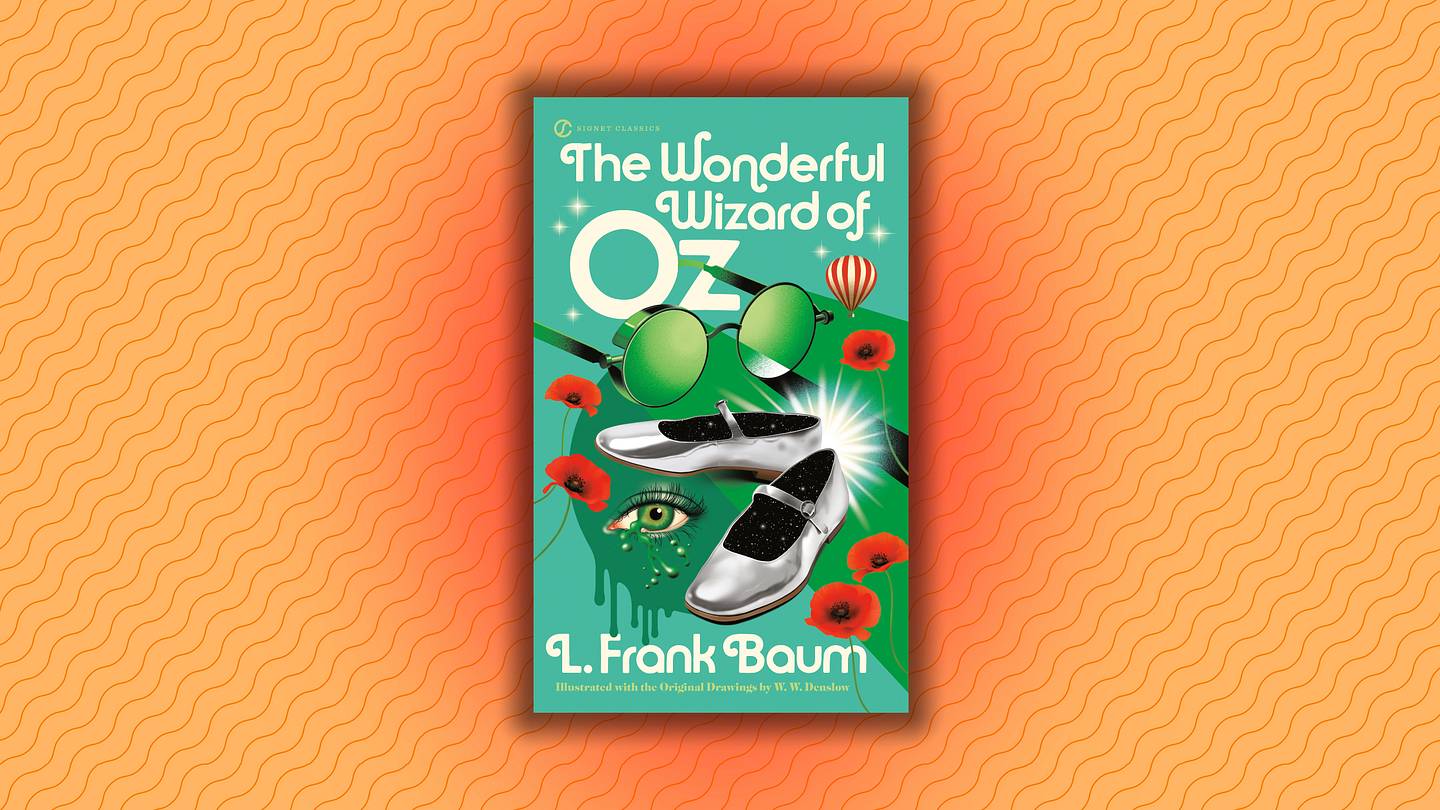
Note: This copy-ready HTML body is written for web publishing and intentionally omits visible source links inside the article. The historical details have been researched and rewritten in original wording for a natural reading experience.
Few children’s books have traveled as far as The Wonderful Wizard of Oz. It began as a 1900 American fantasy novel by L. Frank Baum, illustrated by W. W. Denslow, and somehow grew into a cultural tornado: books, stage musicals, silent films, the 1939 movie, Broadway spin-offs, academic arguments, Halloween costumes, collectible shoes, and probably at least one family dog named Toto.
But behind the yellow brick road is a story even more interesting than the journey to the Emerald City. Baum was not a mysterious old wizard hiding behind a curtain. He was a restless writer, businessman, newspaperman, theater lover, family man, dreamer, promoter, and occasional failure collector. In other words, he was very American: optimistic, inventive, practical, and not above trying another idea when the previous one landed in a ditch.
This article explores 13 fascinating facts about L. Frank Baum’s Wonderful Wizard of Oz, from its first publication and original silver shoes to the book’s deeper themes, artistic design, adaptations, and long-lasting magic. No broomstick license required.
Why The Wonderful Wizard of Oz Still Matters
The Wonderful Wizard of Oz is more than a famous children’s book. It helped define what an American fairy tale could be. Instead of castles, dragon-slaying princes, and gloomy European forests, Baum gave readers Kansas fields, a cyclone, a girl who wants to go home, and a magical country that feels both strange and oddly familiar. Oz is full of witches, winged monkeys, talking animals, enchanted shoes, and a ruler who turns out to be much less powerful than advertised. In short, it has everything a child needs, including a reminder that adults sometimes bluff their way through life with smoke, noise, and excellent branding.
The novel’s appeal comes from its balance. It is whimsical but not empty, simple but not shallow, funny but not careless. Dorothy’s companionsthe Scarecrow, Tin Woodman, and Cowardly Lionare not just sidekicks. They represent questions readers still ask: Am I smart enough? Do I have enough heart? Can I be brave when I feel terrified? Baum’s answer is comforting without being sugary: the qualities we chase may already be inside us, but we often need a journey, a few weird friends, and one very inconvenient witch to notice them.
13 Facts About L. Frank Baum’s Wonderful Wizard of Oz
1. The book was first published in 1900
The Wonderful Wizard of Oz was published in 1900 by the George M. Hill Company in Chicago. It quickly became a success, helping Baum move from hopeful children’s author to one of the most recognizable names in American fantasy. At the time, the book stood out because it felt fresh, colorful, and proudly homegrown. It did not need medieval Europe to feel magical. A farmhouse in Kansas and a cyclone did the job nicely.
2. Baum wanted to create a “modernized fairy tale”
Baum explained in the book’s introduction that he wanted a fairy tale suited for modern children. Traditional fairy tales often included frightening punishments, dark moral lessons, and enough gloom to make bedtime feel like a legal warning. Baum preferred wonder, joy, and adventure. He did not remove danger entirelyDorothy still faces witches, strange creatures, and uncertaintybut he softened the atmosphere so the story felt inviting rather than grim.
3. Dorothy’s shoes were originally silver, not ruby
One of the most famous differences between Baum’s novel and the 1939 MGM film is Dorothy’s footwear. In the book, the magic shoes are silver. The ruby slippers became famous later because bright red looked spectacular in Technicolor. This change was so successful that many people now remember the movie version first. The book, however, remains clear: Dorothy’s original magical fashion statement was silver. Practical? Maybe. Iconic? Absolutely.
4. W. W. Denslow’s illustrations helped make the book a sensation
W. W. Denslow did not merely decorate Baum’s story; he helped define how Oz looked. His illustrations gave readers memorable versions of Dorothy, Toto, the Scarecrow, the Tin Woodman, and the Cowardly Lion. The first edition was visually ambitious for its time, with colorful artwork and playful design choices that made the book feel like an object of wonder. In modern terms, Denslow gave Oz its first visual brand identitybefore anyone was making mood boards.
5. Baum had many careers before Oz
Before becoming the author of Oz, Baum tried several paths. He worked in journalism, theater, retail, and publishing. He also edited a trade journal about window displays, a detail that sounds oddly specific until you remember how theatrical Oz feels. Baum understood presentation. He knew how to catch the eye, stage a scene, and make ordinary objects feel dramatic. The Emerald City, with its glittering illusion of grandeur, makes more sense when you know its creator understood showmanship.
6. Baum’s family life influenced the story
Baum was married to Maud Gage, the daughter of women’s rights activist Matilda Joslyn Gage. His household included strong, intelligent women, and his fiction often reflects that influence. Dorothy is not a passive princess waiting in a tower. She is practical, loyal, direct, and brave. She solves problems by moving forward, making friends, asking questions, and refusing to be impressed by fake authority. For a children’s heroine in 1900, that was quietly powerful.
7. Oz became a series because readers wanted more
Baum originally created a magical world that could stand on its own, but readers were not ready to leave. The success of The Wonderful Wizard of Oz led Baum to write many more Oz books. He eventually became known as the “Royal Historian of Oz,” a charming title that treated the imaginary land as if it were a real place sending him official updates. It was playful marketing, but it also captured why fans loved Oz: it felt like somewhere that continued existing after the last page.
8. The story was adapted for the stage very early
Long before the 1939 movie became a classic, The Wonderful Wizard of Oz was adapted for the stage. A musical version opened in the early 1900s and became a major success. The stage adaptation changed parts of the story and leaned into spectacle, comedy, and performance. That history matters because Oz was never only a book locked on a shelf. Almost from the beginning, it was a performance machine, ready to sing, dance, sparkle, and reinvent itself.
9. The “Oz” name may have come from a filing cabinet
One famous story says Baum found the name “Oz” by noticing the letters O-Z on a filing cabinet drawer. Like many great literary origin stories, it is tidy, memorable, and almost suspiciously perfect. Whether one treats it as fact, family legend, or authorial showmanship, the tale fits Baum beautifully. He had a gift for turning everyday objects into portals. A filing label becomes a fairyland. That is basically the entire Oz method in miniature.
10. The book has often been read as political allegory
For decades, scholars and readers have debated whether The Wonderful Wizard of Oz is a hidden political allegory about Populism, monetary policy, and late nineteenth-century America. The silver shoes, yellow brick road, Emerald City, and powerless Wizard have all been interpreted through that lens. However, many experts caution that there is no clear evidence Baum intentionally built the story as a coded political argument. The safest conclusion is this: Oz is rich enough to invite political readings, even if it was written first as a children’s fantasy.
11. The Wizard is one of literature’s great “fake it till you make it” figures
The Wizard of Oz appears mighty because he controls appearances. He uses spectacle, fear, mystery, and distance to make people believe he is greater than he is. When the curtain is pulled back, he is revealed as an ordinary man with an extraordinary talent for presentation. That twist remains sharp because it speaks to a timeless truth: authority can look impressive while being mostly smoke, mirrors, and a very loud microphone.
12. The book helped shape American fantasy for children
Before Baum, many English-language fairy tales leaned heavily on European traditions. The Wonderful Wizard of Oz helped prove that American settings, speech, humor, and optimism could support a major fantasy world. Kansas was not a decorative detail; it was the emotional anchor. Dorothy’s desire to return home gives the wildness of Oz its shape. Without Kansas, Oz would just be colorful chaos. With Kansas, it becomes a journey with a heartbeat.
13. Oz keeps changing because its core idea is flexible
From Baum’s sequels to the 1939 film, from The Wiz to Wicked, Oz has been reimagined again and again. Each version highlights something different: childhood courage, theatrical spectacle, racial and cultural reinterpretation, misunderstood villains, political power, friendship, identity, or the longing for home. The reason Oz survives is not because it stays frozen. It survives because its foundation is strong enough to handle reinvention. The road may stay yellow, but every generation walks it in different shoes.
What Makes These Oz Facts So Fascinating?
The best facts about The Wonderful Wizard of Oz are not just trivia snacks for literature fans. They reveal how stories become cultural landmarks. A book does not remain famous for more than a century only because it has witches and talking scarecrows. It lasts because it speaks to readers in more than one way.
Children can enjoy the adventure at face value: a girl is swept away to a magical land and must find her way home. Adults can notice the satire of false authority, the emotional wisdom of the companions, and the strange modernity of Baum’s world. Collectors can admire the first edition. Film fans can compare silver shoes to ruby slippers. Scholars can argue about allegory until the Cowardly Lion needs a nap. Everyone gets something.
Baum’s genius was not that he made Oz complicated. His genius was that he made it open. The story is simple enough to enter quickly and rich enough to revisit. That is why the book works for bedtime reading, classroom discussion, theater adaptation, film analysis, and nostalgic rereading. Oz is a place, a metaphor, a brand, a memory, and a mirrorsometimes all before lunch.
Experience Section: Reading The Wonderful Wizard of Oz Today
Reading The Wonderful Wizard of Oz today feels a little like opening a trapdoor under American pop culture. You may think you already know the story because you have seen the movie, heard about the ruby slippers, or watched a modern Oz-inspired musical. Then you read Baum’s book and realize the original has its own rhythm, humor, and personality. It is familiar, but not identical. It is like meeting someone after only seeing their extremely famous cousin on television.
One of the most enjoyable experiences is noticing how direct the book feels. Baum does not bury readers under heavy description or complicated mythology. Dorothy lands in Oz, receives help, starts walking, and meets people who need something. The structure is clean and satisfying. Each new friend adds emotional flavor: the Scarecrow wants brains, the Tin Woodman wants a heart, and the Cowardly Lion wants courage. Children understand those desires instantly, while adults may quietly admit they are still shopping for the same items.
The book also rewards readers who enjoy contrasts. Kansas is gray, plain, and difficult, while Oz is bright, strange, and unpredictable. Yet Dorothy still wants Kansas. That detail is powerful. Baum does not say home is perfect. He says home matters because it is yours. In an age of constant movement, digital distraction, and curated fantasy worlds, that message still lands. Oz may be magical, but belonging is stronger than spectacle.
Another modern reading pleasure is comparing the book with later adaptations. The silver shoes surprise many readers. So does the difference in tone between the novel and the film. The book has its own odd little moments, including unusual creatures and episodes that later versions trimmed or transformed. This makes the reading experience feel like literary archaeology. You are not just reading a famous story; you are uncovering the source material beneath a century of cultural glitter.
For writers, Baum’s work is also a lesson in clarity. He builds a world without making the reader memorize a rulebook. He gives characters simple goals but lets those goals carry emotional meaning. He creates danger without making the story miserable. Most importantly, he trusts wonder. That may sound easy, but it is not. Many fantasy stories confuse complexity with depth. Baum understood that a road, a wish, and a few unforgettable companions can be enough.
The experience of reading Oz today is therefore both cozy and revealing. It reminds us that classic stories do not survive by accident. They survive because each generation finds a new doorway into them. For one reader, Oz is about courage. For another, it is about friendship. For another, it is about seeing through fraud. For many, it is simply about the deep comfort of wanting to go home and discovering that the journey has changed you.
Conclusion
L. Frank Baum’s The Wonderful Wizard of Oz remains one of the great American fantasy stories because it combines simplicity with staying power. Its facts are fun: the book appeared in 1900, Dorothy’s shoes were silver, W. W. Denslow’s illustrations shaped the first look of Oz, and the story became a springboard for stage, film, scholarship, and reinvention. But the deeper reason Oz endures is emotional. It gives readers a journey where intelligence, compassion, bravery, and home are not distant treasures. They are already present, waiting to be recognized.
More than a century later, the yellow brick road still works because it is not only a path through a fantasy land. It is a path through self-doubt, illusion, friendship, and discovery. Baum may have wanted to please children, but he accidentally gave adults plenty to think about too. Not bad for a story that begins with bad weather and ends with one of the most satisfying homecomings in American literature.