Archaeology has a flair for drama. Just when we assume the past is politely waiting in museums, tombs, and carefully marked excavation sites, it pops up under a parking lot, inside a peat bog, beneath a farmer’s field, or in a cave entered by curious teenagers and one very history-making dog. Apparently, ancient history enjoys hide-and-seek more than we give it credit for.
The best archaeological discoveries are not always found where experts expect them. Some are uncovered by farmers digging wells, hikers crossing glaciers, divers exploring shipwrecks, or workers cutting peat. These strange archaeological discoveries remind us that the ancient world is not buried only in remote deserts or royal pyramids. Sometimes, it is hiding under ordinary life, waiting for someone to notice that the “weird rock” is actually a 2,000-year-old artifact.
Below are 10 archaeological discoveries found in strange places, each one real, fascinating, and slightly rude for making historians rewrite textbooks.
1. The Antikythera Mechanism Found in a Shipwreck
The Antikythera Mechanism is often called the world’s first known analog computer, which sounds like something invented by a time traveler with excellent bronze-working skills. Discovered in 1901 among wreckage from an ancient ship near the Greek island of Antikythera, this corroded device turned out to contain a complex system of gears used to predict astronomical events, including eclipses and planetary cycles.
The strange part is not only that it was found underwater, but that such a sophisticated machine existed more than 2,000 years ago. At first, it looked like a lump of bronze that had lost an argument with the ocean. Later X-ray imaging revealed its internal gears, inscriptions, and astronomical functions. The discovery changed how researchers understood ancient Greek technology. Clearly, the Greeks were not just writing philosophy and looking dramatic in marble; they were also building pocket-sized sky calculators.
2. The Dead Sea Scrolls Found in Desert Caves
In 1947, Bedouin shepherds searching near Qumran in the Judean Desert entered a cave and found clay jars containing ancient scrolls. That is already an excellent opening scene for an adventure movie. The scrolls, later known as the Dead Sea Scrolls, included biblical texts, religious writings, community rules, and thousands of fragments dating from roughly the third century BCE to the first century CE.
The strange location helped preserve them. Hidden in dry desert caves, sealed in jars, and protected from heavy moisture, the scrolls survived for nearly two millennia. Their discovery gave scholars a rare view into Jewish religious life, scribal traditions, and textual history during the Second Temple period. For something found while looking for livestock, the Dead Sea Scrolls delivered an academic shockwave. Moral of the story: never underestimate a shepherd with curiosity.
3. The Terracotta Army Found While Digging a Well
In 1974, farmers near Xi’an, China, were digging a well when they struck fragments of pottery. Instead of water, they uncovered the first hints of an underground army created for Qin Shi Huang, the first emperor of China. Not exactly the refreshment they were hoping for, but historically speaking, not bad.
The Terracotta Army consists of thousands of life-sized clay soldiers, horses, chariots, and officials buried near the emperor’s mausoleum. Each warrior has distinct facial features, hairstyles, armor, and posture. The find revealed the scale of imperial power in the Qin dynasty and the emperor’s belief that even in the afterlife, one should travel with a full military staff. Some people pack snacks for a journey; Qin Shi Huang packed an army.
4. Ötzi the Iceman Found in a Melting Glacier
In 1991, hikers in the Ötztal Alps near the Austria-Italy border noticed what they thought was the body of a modern mountaineer frozen in ice. It turned out to be Ötzi, a naturally mummified man who lived more than 5,000 years ago during the Copper Age. Awkward for the rescue team, thrilling for archaeology.
Ötzi was found with clothing, tools, a copper axe, arrows, and personal items that offered an extraordinary snapshot of prehistoric life. Later analysis revealed he had been shot with an arrow and likely died violently. His body remained preserved because the glacier created a natural freezer. As climate change melts ancient ice, more artifacts are emerging from alpine regions, but Ötzi remains one of the most famous examples of archaeology found in the coldest possible filing cabinet.
5. Lascaux Cave Paintings Found After a Dog Investigated a Hole
In 1940, teenagers near Montignac, France, discovered the entrance to Lascaux Cave after a dog named Robot investigated a hole. Inside, the boys found walls covered with Paleolithic paintings of bulls, horses, deer, and other animals. It was one of the most important prehistoric art discoveries ever made, and yes, a dog deserves at least partial credit.
The paintings are more than 17,000 years old and show remarkable skill, movement, and symbolic imagination. Lascaux helped reshape ideas about Ice Age humans, proving that prehistoric people were not merely surviving; they were observing, imagining, and creating art with confidence. The cave’s strange rediscovery also shows how major archaeological finds can begin with the least scholarly phrase imaginable: “Where did the dog go?”
6. King Richard III Found Under a Parking Lot
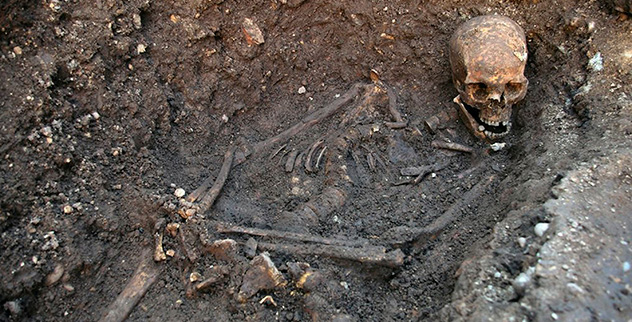
Few strange archaeological discoveries are as delightfully modern as finding a medieval king beneath a parking lot. In 2012, archaeologists in Leicester, England, excavated the site of the former Greyfriars Friary and found human remains later identified through DNA, injuries, and historical evidence as King Richard III.
Richard III died at the Battle of Bosworth Field in 1485, ending the Plantagenet line and helping launch the Tudor dynasty. His grave was lost after the friary was dissolved, and for centuries stories about his remains circulated without certainty. Then, under asphalt and painted parking spaces, the last English king to die in battle was found. It is hard to imagine a more British archaeological sentence than “Your Majesty was under the car park.”
7. Tollund Man Found in a Peat Bog
In 1950, two brothers cutting peat in Denmark discovered a human body so well preserved that police initially thought it might be a recent murder victim. Instead, the man had lived during the Iron Age more than 2,000 years earlier. Known as Tollund Man, he was found in a peat bog with a leather noose around his neck.
Peat bogs are strange but powerful preservers. Their acidic, low-oxygen, waterlogged conditions can slow decay and preserve skin, hair, organs, clothing, and even facial expressions. Tollund Man’s peaceful-looking face became famous worldwide, although his death was anything but peaceful. His discovery gave researchers insight into Iron Age ritual, violence, diet, and burial practices. It also proved that bogs are not just dramatic landscapes for moody literature; they are natural archives.
8. Sutton Hoo Found Beneath Quiet English Mounds
At Sutton Hoo in Suffolk, England, grassy mounds on a private estate looked ordinary enough. But in 1939, self-taught archaeologist Basil Brown excavated one of them at the request of landowner Edith Pretty and uncovered an Anglo-Saxon ship burial. Beneath the soil lay the imprint of a massive wooden ship and a burial chamber filled with treasures.
The find included a helmet, weapons, gold fittings, silver objects, and luxury goods that revealed the wealth and international connections of early medieval England. Sutton Hoo challenged the old idea that the so-called Dark Ages were culturally dim. In reality, they were glittering quite nicely under a mound in Suffolk. The discovery is strange because a royal-scale burial had been hiding in plain sight, tucked under a grassy rise that could easily have been mistaken for landscape decoration.
9. Göbekli Tepe Found Beneath a Hill in Turkey
Göbekli Tepe in southeastern Turkey is one of the most important Neolithic archaeological sites ever discovered. Its massive T-shaped limestone pillars, carved with animals and abstract symbols, date back more than 11,000 years. That makes the site older than Stonehenge and the Egyptian pyramids by thousands of years.
What makes Göbekli Tepe strange is that it was hidden beneath a hill and long misunderstood. Early surveys recognized the area as archaeological, but its full significance became clearer in the 1990s through excavations led by Klaus Schmidt. The site forced scholars to reconsider how hunter-gatherers organized labor, ritual, architecture, and community life before full-scale farming. In other words, before humans had cities, pottery, or office coffee, they were already carving monumental stone pillars.
10. The Gjellestad Viking Ship Found Under a Farm Field
In 2018, ground-penetrating radar detected the outline of a Viking ship burial beneath a farm field in Norway. Known as the Gjellestad ship, the vessel was buried just below the surface, along with traces of burial mounds and longhouses. The idea that a Viking ship was lying under farmland is the kind of discovery that makes archaeologists look at every field with suspicious excitement.
Viking ship burials were reserved for high-status individuals and reflected the importance of ships in Norse identity, travel, trade, warfare, and mythology. The Gjellestad discovery showed how modern technology can reveal buried structures without immediately digging them up. Radar did what the naked eye could not: it turned an ordinary field into a map of a vanished Viking landscape.
Why Strange Archaeological Discoveries Matter
Strange archaeological discoveries are more than entertaining historical trivia. They matter because they reveal how unpredictable the archaeological record can be. A farmer’s well, a parking lot, a peat bog, or a glacier may preserve evidence just as powerfully as a royal tomb. These discoveries also remind us that human history is not neatly stored in places labeled “important.” It is scattered across landscapes, sealed in mud, frozen in ice, buried under cities, and sometimes sitting inconveniently beneath modern infrastructure.
They also show the value of accidental discovery. Professional archaeology depends on careful research, survey methods, excavation techniques, conservation science, radiocarbon dating, DNA analysis, and ethical preservation. But many famous finds began with non-experts: hikers, farmers, shepherds, workers, teenagers, and landowners. Curiosity often opens the door; science explains what is on the other side.
For readers interested in ancient artifacts, lost civilizations, historic treasures, and unusual archaeological finds, these stories offer a powerful lesson: the past is not gone. It is layered beneath us. Every city, road, field, cave, mountain pass, and shoreline may contain traces of earlier lives. Archaeology helps us read those traces carefully, without turning every backyard pebble into “proof of Atlantis.” Enthusiasm is good; evidence is better.
Experiences and Lessons Inspired by Strange Archaeological Discoveries
One of the most exciting experiences related to strange archaeological discoveries is the simple act of looking at ordinary places differently. After reading about discoveries like Richard III under a parking lot or the Terracotta Army beneath farmland, it becomes almost impossible to walk through a city, cross a field, or visit an old building without wondering what stories are hiding below the surface. No, this does not mean everyone should grab a shovel and start digging behind the grocery store. Archaeology is not a pirate hobby. But it does mean we can develop a deeper awareness of place.
Visiting archaeological museums after learning the discovery stories also becomes much more meaningful. A bronze fragment in a glass case is interesting; a bronze fragment pulled from a shipwreck and later revealed to be part of an ancient astronomical computer is unforgettable. Context turns objects into stories. When museum labels explain where something was found, who discovered it, and why the location mattered, the artifact becomes more than old material. It becomes a conversation across time.
Travelers can also build richer experiences by exploring the landscapes around famous discoveries. At Sutton Hoo, for example, the quiet mounds and open fields are part of the emotional power of the site. At Lascaux, even though the original cave is protected, replicas help visitors understand the atmosphere of prehistoric art without damaging the fragile paintings. In places like the Alps, Ötzi’s story encourages people to think about how climate, geography, and preservation shape what survives from the past.
Another experience worth considering is how accidental discoveries teach humility. Modern people often assume that ancient societies were simple because they lacked our technology. Then the Antikythera Mechanism appears from a shipwreck and politely embarrasses that assumption. Göbekli Tepe does something similar by showing that hunter-gatherer communities could organize monumental building projects long before traditional markers of civilization appeared. These finds remind us that intelligence, creativity, and ambition are not modern inventions.
For students, writers, bloggers, and history lovers, strange archaeological discoveries are excellent storytelling tools. They combine mystery, science, location, and human drama. A farmer striking pottery while digging a well is immediately more engaging than a dry sentence about imperial funerary art. A bog body mistaken for a modern murder victim invites curiosity before introducing Iron Age ritual. These stories help make archaeology accessible without reducing it to fantasy.
The most responsible experience, however, is respect. If someone finds a potential artifact, bone, structure, coin hoard, or unusual object, the right step is to report it to local heritage authorities, not clean it aggressively, sell it online, or announce oneself as Emperor of the Backyard. Context is everything in archaeology. An artifact removed carelessly loses much of its scientific value. The exact location, soil layer, surrounding materials, and relationship to other objects help researchers understand its meaning.
Ultimately, these discoveries make the world feel deeper. A road is not just a road; it may cross an ancient settlement. A field is not just a field; it may cover a ship burial. A cave is not just a cave; it may hold art older than agriculture. Strange archaeological discoveries invite us to move through the modern world with curiosity, patience, and a little wonder. The past is not always locked away. Sometimes, it is waiting quietly under our feet, hoping we notice before someone builds another parking lot.
Conclusion
The story of archaeology is not only the story of experts with brushes and notebooks. It is also the story of accidents, odd locations, lucky timing, and ordinary people stumbling into extraordinary history. From the Dead Sea Scrolls hidden in desert caves to a Viking ship under a farm field, these archaeological discoveries found in strange places prove that the ancient world has a mischievous sense of timing.
What makes these finds so powerful is not just their age or beauty, but the way they challenge assumptions. They show that ancient people were more skilled, connected, artistic, and complex than many once believed. They also remind us that history is not finished. New discoveries will continue to emerge from glaciers, wetlands, construction sites, coastlines, and places no one has thought to examine yet.
Note: This article is original web content based on widely documented archaeological records, museum research, academic reporting, and historical publications. It is written for publication without embedded source-link clutter.