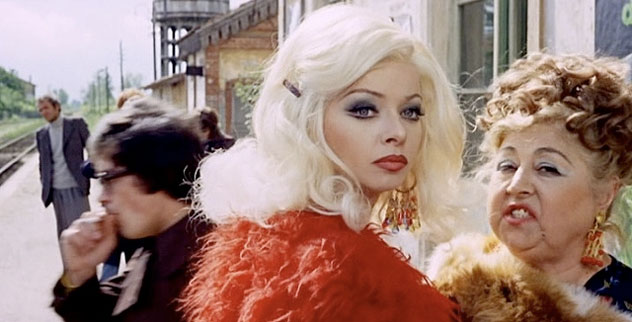
Black leather gloves. Gleaming knives. Impossible architecture. Gorgeous people making catastrophically poor decisions. Welcome to Italian giallo, the cinematic neighborhood where every apartment has designer furniture, every stranger is suspicious, and the local police appear to have misplaced both the evidence and the instruction manual.
The word giallo means “yellow” in Italian, referring to the yellow covers used for popular mystery novels published by Mondadori. Italian filmmakers transformed those literary whodunits into a highly visual mixture of murder mystery, psychological thriller, horror, eroticism, and extravagant style. Although there is no rigid checklist, classic giallo movies often feature amateur investigators, masked killers, subjective camerawork, red herrings, elaborate murder sequences, modern urban settings, and music that sounds as though a jazz group has discovered a haunted nursery.
The genre flourished during the 1960s and 1970s, with Mario Bava establishing much of its visual language and Dario Argento pushing that language into operatic territory. The following ten brilliant Italian giallo films offer an ideal journey from the form’s early experiments to its most stylish, disturbing, and self-aware achievements.
What Makes a Great Italian Giallo Film?
A great giallo does more than identify a murderer. It turns the act of looking into a trap. Witnesses misremember crucial details, cameras spy through windows, mirrors conceal information, and viewers become uneasy participants in the investigation. Plot logic may occasionally wander off for an espresso, but visual logic remains ruthlessly precise.
The best examples combine suspense with expressive color, architecture, editing, costume design, and sound. They can be lurid, elegant, ridiculous, frightening, or all four before breakfast. Many also contain dated sexual politics and exploitative violence, so modern audiences should approach them critically rather than treating every genre convention as untouchable sacred art.
1. The Girl Who Knew Too Much (1963)
Director: Mario Bava
Often described as the first recognizable giallo film, Mario Bava’s The Girl Who Knew Too Much follows American tourist Nora Davis after she witnesses what appears to be a murder on Rome’s Spanish Steps. The problem is simple: no body can be found, nobody believes her, and her vacation has become considerably less relaxing than the brochure promised.
Shot in atmospheric black and white, the film is less bloody than later gialli but establishes several essential ingredients: a foreign protagonist, an amateur investigation, unreliable perception, a mysterious killer, and a city transformed into a maze of danger. Its title knowingly echoes Alfred Hitchcock’s The Man Who Knew Too Much, while Bava’s tilted compositions and nocturnal lighting give the story a personality of its own.
This is the ideal starting point for viewers who prefer mystery and suspense over explicit gore. It feels like the genre clearing its throat before delivering a very stylish scream.
2. Blood and Black Lace (1964)
Director: Mario Bava
If The Girl Who Knew Too Much drew the blueprint, Blood and Black Lace switched on the colored lights and redecorated the entire building. The story centers on a Roman fashion house whose models are targeted by a faceless killer wearing a fedora, dark coat, and black gloves.
Bava treats the fashion house as a poisoned jewel box. Red, purple, blue, and green lighting pours across mannequins, curtains, mirrors, and staircases. Each room appears too beautiful to be safe, which is precisely the point. The film helped codify the image of the anonymous black-gloved murderer and demonstrated that a killing sequence could function as a disturbing piece of visual choreography.
The mystery is packed with greed, blackmail, secret relationships, and suspects who seem to have graduated with honors from the Academy of Suspicious Behavior. More importantly, the film reveals how giallo can manipulate conventional whodunit expectations, including assumptions about the killer’s identity and motives. Blood and Black Lace remains one of the genre’s most influential and visually intoxicating works.
3. The Bird with the Crystal Plumage (1970)
Director: Dario Argento
Dario Argento’s feature debut begins with one of the genre’s defining situations. American writer Sam Dalmas sees a woman being attacked inside a modern art gallery. Trapped behind glass, he can only watch. He later becomes convinced that something about the scene was wrong, although he cannot identify what his eyes failed to understand.
That gap between seeing and comprehending drives the entire film. Argento fills the investigation with distorted memories, eccentric suspects, empty streets, and threatening works of art. The gallery itself becomes a perfect giallo image: a crime displayed like an exhibit while the witness remains physically separated from it.
Ennio Morricone’s score moves between delicate, lullaby-like passages and harsh experimental sounds, making even quiet moments feel unstable. The film’s international success helped ignite the major giallo boom of the 1970s and established Argento as a director capable of combining art-house precision with pulp excitement. It is sophisticated, playful, and suspenseful enough to make birdwatching feel medically inadvisable.
4. A Lizard in a Woman’s Skin (1971)
Director: Lucio Fulci
Before Lucio Fulci became famous for apocalyptic zombies and ocular trauma that could make an optometrist resign, he directed several fascinating gialli. A Lizard in a Woman’s Skin may be the most feverishly psychological of them.
Florinda Bolkan plays Carol Hammond, a wealthy woman troubled by erotic and violent dreams involving her glamorous neighbor. When that neighbor is murdered in a manner resembling Carol’s nightmare, fantasy and evidence begin bleeding into one another. Fulci stages dream sequences full of corridors, disorienting spaces, sudden movement, and surreal imagery, creating the sensation that the movie itself may be undergoing psychoanalysis.
The film is colder and grittier than Bava’s jeweled nightmares, yet it still delivers stylish compositions and a memorable Ennio Morricone score. Its central mystery is effective, but its greatest strength is uncertainty: Are the images clues, hallucinations, repressed desires, or some inconvenient combination of all three?
5. The Strange Vice of Mrs. Wardh (1971)
Director: Sergio Martino
Sergio Martino became one of the most reliable directors of the giallo boom, and The Strange Vice of Mrs. Wardh is a sleek introduction to his work. Edwige Fenech stars as Julie Wardh, a diplomat’s wife whose return to Vienna brings her into contact with a sadistic former lover, an attractive new admirer, and a razor-wielding murderer targeting women across the city.
The movie layers romantic betrayal, sexual obsession, blackmail, and murder until practically every meaningful glance requires its own evidence bag. Fenech gives Julie vulnerability and intelligence, allowing the film to work as more than a parade of glamorous costumes and ominous phone calls.
Martino and screenwriter Ernesto Gastaldi keep rearranging the audience’s assumptions, delivering multiple reversals without completely losing control of the story. Meanwhile, Nora Orlandi’s haunting music gives the film a melancholy quality beneath its lurid surface. It is sensual, nasty, elegant, and enthusiastically committed to the theory that trusting anyone is how you end up in the third act of a giallo.
6. What Have You Done to Solange? (1972)
Director: Massimo Dallamano
What Have You Done to Solange? begins as a familiar murder mystery involving students at a Catholic girls’ school, but it gradually becomes something sadder and more disturbing. Fabio Testi plays Enrico Rosseni, a married teacher whose affair with a student draws him into the investigation of several brutal killings.
The film contains recognizable giallo ingredients, including hidden relationships, questionable witnesses, institutional secrecy, and a killer whose attacks are staged with unnerving intensity. Yet director Massimo Dallamano gives the victims more emotional weight than the genre often allows. As the truth emerges, the film shifts from sensational mystery toward an indictment of hypocrisy, exploitation, and adults who protect reputations rather than vulnerable young people.
Ennio Morricone’s score is mournful rather than merely suspenseful, reinforcing the tragedy underneath the puzzle. The result is one of the most emotionally resonant Italian giallo filmsa movie that leaves behind more than a clever final revelation.
7. Your Vice Is a Locked Room and Only I Have the Key (1972)
Director: Sergio Martino
First, yes, that is the real title. Second, it may still be shorter than the explanation required to describe the plot.
Loosely inspired by Edgar Allan Poe’s “The Black Cat,” the film revolves around Oliviero, an alcoholic writer living in a decaying villa with his abused wife, Irina. Their poisonous marriage becomes even more complicated when Oliviero’s niece Floriana arrives and local women begin turning up dead.
Rather than focusing exclusively on an outside killer, Martino builds suspense from the household’s shifting alliances. Desire, resentment, money, humiliation, and possible murder circulate through the villa like guests at the worst dinner party in Italy. Anita Strindberg, Luigi Pistilli, and Edwige Fenech play characters who are manipulative enough to make the audience repeatedly revise its loyalties.
The movie is Gothic, cynical, and morally grubby, with an unforgettable black cat wandering through the intrigue like the only creature smart enough to understand the screenplay. It also demonstrates how flexible giallo could be, blending Poe-inspired Gothic horror with psychological cruelty and twist-heavy crime fiction.
8. Torso (1973)
Director: Sergio Martino
In Torso, university students are stalked by a masked murderer identified partly through a distinctive scarf. A group of women retreats to an isolated countryside villa, reasonably assuming that distance from the city will provide safety. Horror cinema has filed considerable evidence against this assumption.
The film’s first portion operates as a lurid campus mystery, but its final act becomes a remarkably tense exercise in concealment and survival. Martino slows the pace, restricts the protagonist’s movements, and turns the villa into a space where every floorboard, doorway, and poorly timed breath matters.
Torso is frequently discussed as a bridge between classic giallo and the emerging slasher formula. Its masked killer, group of young targets, isolated setting, and sustained final confrontation anticipate later stalk-and-slash movies while retaining the visual style and mystery structure of Italian thrillers. Some elements have aged badly, particularly the objectification of women, but its suspense craftsmanship remains formidable.
9. Deep Red (1975)
Director: Dario Argento
For many viewers, Deep Red is the supreme Italian giallo. David Hemmings plays Marcus Daly, a jazz pianist who witnesses the murder of a psychic and becomes obsessed with an apparently missing detail at the crime scene. With reporter Gianna Brezzi, played by Daria Nicolodi, he follows clues involving a child’s drawing, an abandoned house, a disturbing song, and memories buried beneath domestic respectability.
Argento refines his fascination with perception into an elaborate cinematic game. The answer is visible, yet viewers may fail to register it for the same reason Marcus does: looking is not the same as understanding. The murder set pieces are intense, but the film also makes room for humor, especially in the competitive relationship between Marcus and Gianna.
Goblin’s pounding progressive-rock score gives the movie a nervous pulse, while Argento’s camera glides through rooms as though the architecture itself were investigating the crime. Stylish without becoming empty and complicated without becoming inert, Deep Red is both an excellent mystery and a master class in controlled visual misdirection.
10. Tenebrae (1982)
Director: Dario Argento
After exploring supernatural horror in Suspiria and Inferno, Argento returned to giallo with Tenebrae, a bright, modern, and unusually self-aware murder mystery. Anthony Franciosa plays Peter Neal, an American crime novelist visiting Rome to promote his latest book. Soon, someone begins murdering people while claiming inspiration from Neal’s fiction.
The film examines the uneasy relationship between violent art, artists, critics, and audiences. Is a writer responsible for what readers take from a book? Can moral condemnation conceal private obsession? Does discussing these questions become slightly harder when a razor-wielding killer keeps interrupting the book tour?
Argento fills the film with white walls, hard sunlight, reflective surfaces, and daring camera movements. Instead of hiding evil in Gothic darkness, he places it inside an apparently clean, futuristic city. A famous tracking shot travels over and around a house, transforming surveillance into a display of pure directorial confidence.
Tenebrae is a meta-giallo about creating and consuming giallo stories, yet it never forgets to function as a savage, twist-filled thriller. It is clever, excessive, and grimly funnythe work of a filmmaker examining his own reputation while sharpening the knives.
How to Watch Italian Giallo Films
Italian gialli reward a slightly different viewing style from conventional detective movies. Do not become so focused on identifying the killer that you overlook the filmmaking. Notice repeated colors, paintings, mirrors, gloves, photographs, music cues, architectural details, and objects positioned at the edge of the frame. A decorative item may be more trustworthy than the police inspector.
It also helps to expect multiple versions. Many Italian productions were shot with international casts whose dialogue was dubbed for different markets. Alternate cuts may contain different scenes, running times, or English titles. The same movie can therefore appear under several names, as though the film itself has entered witness protection.
Finally, remember that style is not merely packaging in giallo. Color, sound, editing, costume, and camera movement often communicate emotional or psychological information that the dialogue does not. Apparent narrative irrationality can sometimes be a weakness, but it can also create the dreamlike instability that gives the genre its peculiar power.
A Personal Viewing Experience: Entering the Giallo Labyrinth
Watching these ten Italian giallo films in chronological order feels like entering a museum after closing time and slowly realizing the mannequins have changed positions. The early rooms are comparatively calm. The Girl Who Knew Too Much offers moonlit streets, nervous humor, and a mystery that still behaves like a mystery. Then Blood and Black Lace arrives, turns every lamp red, locks the doors, and informs you that the guided tour has been canceled.
The most enjoyable part of a giallo marathon is noticing how quickly ordinary objects become threatening. A scarf is not simply a scarf. A child’s drawing is certainly not going on the refrigerator. A modern sculpture may be evidence, a warning, or merely proof that someone spent too much money decorating the murder gallery. After several films, even picking up a telephone begins to feel like irresponsible behavior.
Sound is equally important. These movies should be watched with the volume high enough to appreciate their unusual scores and aggressive sound design. Morricone’s whispered vocals and experimental arrangements can make an empty hallway feel psychologically crowded. Goblin’s music in Deep Red does not politely accompany the action; it kicks down the door, plugs in an amplifier, and becomes another suspect.
A group viewing can be especially entertaining because giallo mysteries encourage confident theories that collapse within minutes. Someone will announce that the killer is obviously the jealous husband. Another viewer will suspect the photographer, the doctor, the cousin, or the suspiciously attentive neighbor. By the final revelation, everyone has accused half the cast and at least one piece of furniture.
At the same time, these films are not all carefree midnight entertainment. Their treatment of gender, sexuality, trauma, and violence can be troubling. Some movies criticize repression and hypocrisy; others reproduce the exploitation they appear to examine. A thoughtful viewing experience means appreciating the craft while remaining alert to those contradictions. Loving a genre does not require defending every decision made within it.
The most memorable discovery is how different the directors feel despite sharing recognizable conventions. Bava creates richly colored spaces where beauty itself seems dangerous. Fulci often brings a harsher, more feverish texture. Martino emphasizes poisoned relationships, sensuality, and efficient suspense. Argento turns perception into architecture, constructing elaborate traps for both his characters and the audience.
After the final credits of Tenebrae, the genre’s influence becomes difficult to miss. Elements of giallo appear throughout American slashers, psychological thrillers, fashion-driven horror, music videos, and modern films obsessed with voyeurism and stylized violence. Yet the originals still feel strange because they do not reduce easily to a formula. They are murder mysteries that sometimes value mood over deduction, horror movies that admire interior design, and works of visual art with an alarming interest in straight razors.
For a first marathon, spread the ten films across several evenings rather than consuming them in one blood-red blur. Begin with Bava, watch the genre expand through Fulci and Martino, and finish with Argento’s Deep Red and Tenebrae. Keep the room dark, the subtitles on, and your theories flexible. Most importantly, never trust a black-gloved stranger standing beside an unusually decorative staircase.
Conclusion
The finest Italian giallo films turn murder mysteries into sensory experiences. Their plots offer hidden identities and elaborate motives, but their deeper pleasures come from color, rhythm, music, movement, and the constant uncertainty of perception.
The Girl Who Knew Too Much establishes the basic structure, while Blood and Black Lace defines the genre’s visual iconography. The Bird with the Crystal Plumage launches Argento’s influential style, and films such as A Lizard in a Woman’s Skin, The Strange Vice of Mrs. Wardh, and What Have You Done to Solange? show how widely the form could vary. Your Vice Is a Locked Room and Only I Have the Key brings Gothic poison, Torso anticipates the slasher, and Deep Red and Tenebrae push the genre toward visual perfection and self-analysis.
These movies are glamorous, unsettling, occasionally absurd, and rarely boring. Once you enter their maze of mirrors and misleading memories, ordinary thrillers may start looking suspiciously underdressed.