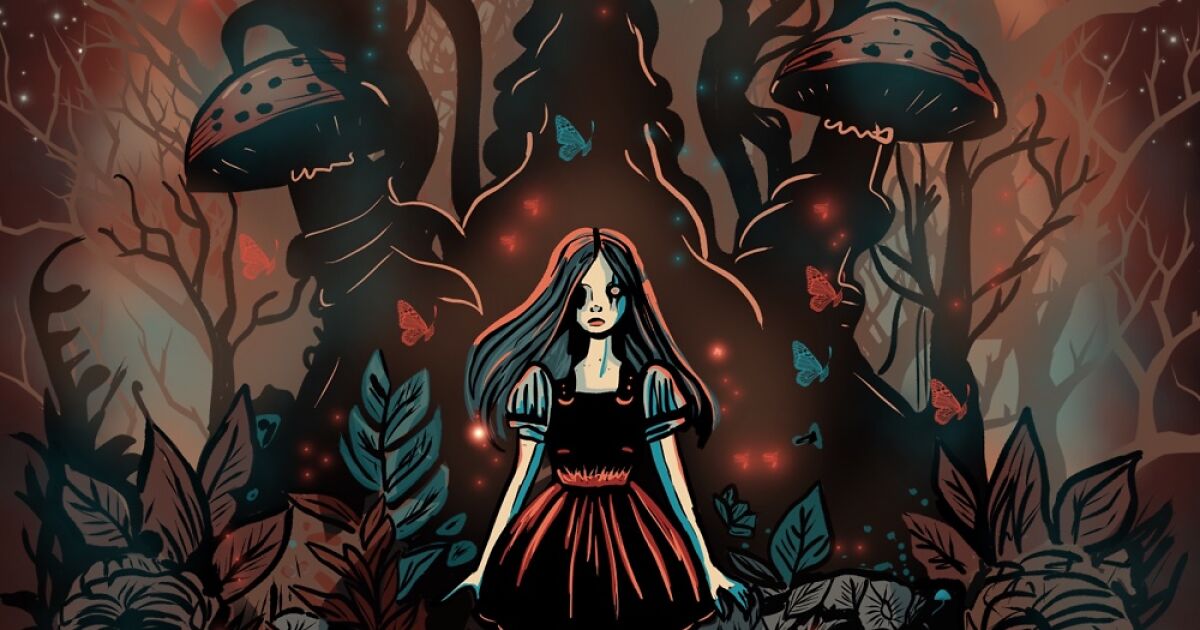
What happens when a story everyone thinks they know gets tossed into a new visual universe? In my art series re-imagining characters from Alice in Wonderland, I decided that Wonderland did not need another polite tea party, another perfectly striped Cheshire Cat, or another Queen of Hearts yelling at innocent shrubbery. It needed a makeover with a little mystery, a little mischief, and enough visual chaos to make a clock-checking rabbit reconsider his life choices.
This collection takes familiar Wonderland characters and gives them new personalities, settings, textures, and symbols. Instead of copying the versions already carved into pop-culture memory, I approached each character as though they had wandered out of the original story and into a strange, modern dream. The result is an Alice in Wonderland art series built around imagination, visual storytelling, surreal character design, and the delightful possibility that nothing in Wonderland has to stay the same for very long.
Why Alice in Wonderland Still Inspires Artists
Few stories give artists as much creative room to play as Alice’s Adventures in Wonderland. The world is packed with talking animals, impossible rooms, odd rules, shifting proportions, card soldiers, strange food, riddles, and characters who behave as though common sense is a suspicious-looking vegetable.
The original tale became visually unforgettable in part because of John Tenniel’s illustrations, which helped shape how generations pictured Alice, the White Rabbit, the Mad Hatter, the Queen of Hearts, and the Cheshire Cat. But the same story has also encouraged artists, costume designers, illustrators, theater makers, filmmakers, and sculptors to interpret Wonderland in wildly different ways.
That is what makes an Alice in Wonderland character art series so exciting. You are not simply drawing a rabbit with a watch. You are deciding what anxiety looks like when it grows fur. You are not just painting a queen in red. You are asking what power looks like when it wears a crown that is two sizes too large and has absolutely no interest in listening to feedback.
For me, Wonderland is not only a fantasy setting. It is a place where identity changes constantly, logic bends in half, and characters reveal themselves through strange behavior instead of neat explanations. That makes it ideal for surreal art, fantasy portraits, dark whimsy illustrations, digital paintings, mixed-media work, or even sculptural character design.
The Big Idea Behind My Wonderland Character Series
My goal was not to recreate a Victorian illustration or imitate a familiar movie adaptation. I wanted to imagine what would happen if Wonderland existed in a different emotional climate: part dreamscape, part abandoned carnival, part botanical laboratory, and part late-night thought spiral.
Each artwork begins with a question rather than a costume. What does Alice look like when she becomes the explorer instead of the confused visitor? What would the White Rabbit carry if his watch measured memory instead of time? Could the Mad Hatter become less of a party host and more of a maker of impossible machines?
The answers shaped the series. Some characters became more elegant. Others became stranger. A few became slightly unsettling, which feels fair because Wonderland has never exactly been a calm wellness retreat.
A Visual Language of Dream Logic
The art series uses oversized objects, floating furniture, distorted architecture, symbolic plants, checkerboard shadows, glowing clocks, and impossible scale. These visual details are inspired by the central feeling of Wonderland: the sense that you are awake, but your surroundings have decided to stop cooperating.
I also used color to separate each character’s emotional world. Cold blues, smoky violets, and dim golds belong to the more secretive figures. Rich reds, harsh whites, and sharp blacks dominate the characters who crave control. Soft greens, luminous mushrooms, and hazy pinks appear in scenes where transformation matters more than certainty.
Re-Imagining the Most Iconic Alice in Wonderland Characters
Alice: The Cartographer of Impossible Places
In my version, Alice is not simply falling through a rabbit hole. She is mapping it. I imagined her as a determined young explorer carrying a lantern, a sketchbook, and a folded map that keeps changing whenever she looks away.
Her dress is less about nostalgia and more about movement. The fabric is layered with tiny handwritten notes, route markings, and symbols that resemble stars, keys, doors, and arrows. She becomes the person who documents Wonderland rather than merely surviving it.
This interpretation gives Alice more agency. She is curious, observant, and brave enough to keep walking even when the hallway has suddenly turned upside down. Frankly, that is more than most of us can say after opening a confusing email before breakfast.
The White Rabbit: Keeper of Lost Time
The White Rabbit is often remembered as nervous, hurried, and perpetually late. In this series, he becomes a guardian of broken time. Instead of carrying one pocket watch, he wears a coat lined with dozens of tiny clocks, each stopped at a different moment.
His eyes are tired but alert, as though he has spent centuries trying to repair every missed opportunity in Wonderland. Behind him, a tunnel of clocks melts into roots and branches. The rabbit hole becomes less of a hole and more of a time portal disguised as an anxiety attack.
This piece explores the pressure to keep moving. The White Rabbit is funny on the surface, but he also represents the feeling that life is always one minute ahead of you.
The Cheshire Cat: A Smile in the Static
My Cheshire Cat does not vanish into the air. He dissolves into fragments of glowing color, drifting letters, and glitch-like streaks of light. Sometimes only his grin appears. Sometimes his eyes float in the branches. Sometimes he becomes part of the sky itself.
I wanted this character to feel playful but slightly unpredictable. The Cheshire Cat gives advice, but never the kind that fits neatly inside a planner. He is the friend who says something cryptic, disappears for three days, and somehow turns out to have been correct.
In the artwork, his stripes are replaced by shifting patterns that resemble galaxies, television static, and old wallpaper. He becomes a symbol of identity in motion: visible, invisible, and impossible to pin down.
The Mad Hatter: Engineer of the Endless Tea Party
The Mad Hatter became one of the most mechanical figures in the series. Rather than hosting a traditional tea party, he operates a vast tea-making machine powered by spinning cups, brass pipes, leaking clocks, and steam that forms tiny question marks.
His hat is not merely a hat. It is a portable workshop. It holds measuring tools, miniature spoons, folded blueprints, and one extremely offended bird. His coat pockets are stuffed with gears and tea leaves, because apparently nobody in Wonderland has ever heard of practical storage.
This version of the Hatter is less about madness and more about obsession. He creates elaborate systems for rituals that never end. The tea party is not a meal; it is a machine that keeps time from moving forward.
The Queen of Hearts: Monarch of the Red Garden
The Queen of Hearts is one of the most fun characters to redesign because she enters every scene as though she has already fired half the room. In my series, she rules a garden where roses grow from playing cards and the hedges are trimmed into enormous crowns.
Her gown looks almost architectural, built from layered crimson fabric, sharp collars, embroidered thorns, and heart-shaped armor. She is beautiful, theatrical, and intimidating enough to make a tulip apologize for leaning the wrong way.
Beneath the dramatic costume, though, the Queen represents fragile authority. Her rage is so loud because the world around her refuses to stay organized. Wonderland cannot be controlled, no matter how many orders she shouts.
The Caterpillar: Archivist of Transformation
The Caterpillar appears in the series as a calm, otherworldly librarian surrounded by giant mushrooms and shelves filled with labeled glass jars. Inside the jars are memories, discarded names, old dreams, and tiny versions of people before they changed.
His smoke curls into diagrams of moons, ladders, and butterflies. He is not in a hurry because transformation does not respond well to being rushed. That is a useful reminder for anyone who has tried to reinvent their entire life before Monday morning.
This character became the emotional center of the series. He asks questions without supplying easy answers. His presence suggests that becoming someone new is not a single event. It is a strange, slow process with many uncomfortable stages and probably at least one mushroom involved.
How I Built the Mood of a Modern Wonderland
Texture Matters as Much as Character Design
A surreal art series needs more than recognizable characters. It needs atmosphere. I built mine through layers of texture: weathered paper, ink stains, velvet shadows, chipped paint, luminous mist, scratched gold leaf, and soft botanical forms.
These materials help Wonderland feel old and new at the same time. The viewer can sense the story’s Victorian roots without feeling trapped inside a museum display. The art is meant to look as though it has been discovered in a forgotten room, but somehow also posted from a future that has very strong opinions about decorative mushrooms.
Scale Is One of Wonderland’s Best Tricks
Scale changes everything in this series. Alice may appear tiny beneath a giant keyhole. The White Rabbit may become enormous beside a miniature city. A teacup can turn into a room. A chessboard can stretch into a landscape.
This visual shift is important because Wonderland is built on instability. A character’s size changes, a room changes, the rules change, and the reader or viewer is forced to see familiar objects differently. In art, exaggerated scale can create humor, tension, wonder, or all three at once.
Symbols Give Each Piece a Second Story
I added visual symbols throughout the collection so each image could be read more than one way. Keys represent access and choice. Clocks represent pressure and lost time. Roses represent beauty controlled too tightly. Mirrors suggest self-questioning. Mushrooms symbolize transformation, uncertainty, and the fact that nature is sometimes much stranger than fantasy.
The goal is to reward slow looking. A viewer may first notice the character, then the environment, then the strange little details hiding around the edges. Ideally, every piece feels like a rabbit hole of its own.
What Makes a Re-Imagined Character Series Feel Original
When working with famous literary characters, the challenge is not recognition. People already know the names. The challenge is surprise.
Originality comes from asking better questions. Instead of asking, “What color is the Mad Hatter’s coat?” ask, “What is he trying to build, and why has he been building it for one hundred years?” Instead of asking, “Should the Queen wear a crown?” ask, “What happens when the crown begins growing roots into the garden?”
A strong character reinterpretation keeps the emotional core while changing the visual language. The White Rabbit should still feel rushed. The Cheshire Cat should still feel elusive. The Queen should still feel dangerous. But the artist can move them into a different era, medium, emotional register, or symbolic setting.
That freedom is especially important when using public-domain literary inspiration. The classic source material can offer a rich starting point, but an artist’s own composition, mood, symbolism, styling, and visual narrative are what make the final work feel personal.
How I Would Display This Alice in Wonderland Art Collection
If this series were shown in a gallery, I would avoid hanging the pieces in a simple row. Wonderland deserves a little theater. The entrance would begin with a narrow hall of framed doors, each lit from behind. Visitors would have to choose a path before seeing the first artwork.
The White Rabbit would appear near a wall of moving projections, with clocks drifting across the room. The Mad Hatter would sit near a sculptural tea table covered in strange objects. The Cheshire Cat would be placed in a darker corner, where fragments of its face could appear in reflective surfaces.
The Queen of Hearts would command the final room, surrounded by oversized painted roses and card-shaped shadows. At the exit, viewers would find Alice’s unfinished map, inviting them to add their own imagined route through Wonderland.
Art should not always behave like a quiet object on a white wall. Sometimes it should invite people to wander, wonder, and briefly question whether that wallpaper is watching them.
Conclusion: Wonderland Is Never Finished
This Alice in Wonderland art series is my way of exploring characters that have lived in imaginations for generations while giving them a new visual language. The series is not about replacing classic interpretations. It is about joining the conversation with fresh questions, unusual textures, bold symbolism, and a healthy respect for the strange.
Alice, the White Rabbit, the Cheshire Cat, the Mad Hatter, the Queen of Hearts, and the Caterpillar are still recognizable, but they are no longer frozen in familiar poses. They become explorers, inventors, guardians, rulers, archivists, and living symbols of curiosity, chaos, identity, power, and transformation.
That is the magic of re-imagining literary characters. A story can be more than a story. It can become a mirror, a maze, a map, or a doorway. And sometimes, if you are lucky, it can become all four before tea.
Studio Notes: My Experience Creating a Wonderland-Inspired Art Series
The first thing I learned while creating this Alice in Wonderland-inspired art series was that familiar characters are harder to draw than unfamiliar ones. When nobody knows a character, you can give them three eyes, a paper boat for a hat, and a lighthouse for a left hand without much resistance. But when you touch Alice, the White Rabbit, or the Queen of Hearts, people arrive with memories already packed in their suitcases.
Some viewers remember illustrated books. Others remember animated films, costumes, school plays, old tea sets, Halloween parties, or the first time they read about a girl stepping into a world where every rule had been rearranged. I knew I had to respect that history while still making room for my own ideas.
My sketchbook quickly became a maze of experiments. I drew Alice with maps in her hair. I made the White Rabbit too serious, then too funny, then so tired that he looked like he had been answering customer-service emails since 1865. I painted the Queen of Hearts with a dozen different crowns before realizing that the best version was the one that looked slightly uncomfortable, as though it had been assembled from roses, armor, and sheer impatience.
The Cheshire Cat was the most difficult character. A cat that disappears is already visually interesting, but I did not want to rely on a simple floating grin. I tried turning him into smoke, stars, thorny vines, neon stripes, and pieces of broken glass. Eventually, I found the right feeling by making him look as though he belonged to the environment more than he belonged to his own body. He became part of the trees, the shadows, and the corners of the frame.
The Mad Hatter surprised me most. At first, I imagined a loud, chaotic character surrounded by cups and hats. But the more I worked on him, the more I saw him as someone trapped inside a ritual. His tea machine became larger with every sketch. By the end, it looked like a tiny factory for brewing memories, regret, and very questionable herbal blends.
Creating this series also reminded me that art does not need to explain every symbol immediately. A clock can be a clock, but it can also be pressure. A mushroom can be a mushroom, but it can also be change. A door can be a door, but it can also be a decision you are terrified to make because there is a decent chance a talking rabbit is waiting on the other side.
My favorite part of the process was allowing the images to become stranger than I planned. Every time I tried to make Wonderland too orderly, the artwork lost energy. The strongest pieces appeared when I stopped controlling every detail and let the composition wander a little. That felt appropriate. Wonderland has always rewarded curiosity more than certainty.
In the end, this art series became less about illustrating a famous story and more about revisiting the feeling of being curious, confused, brave, and slightly overdressed for a surreal adventure. That is why these characters still matter. They remind us that imagination does not need a perfect map. Sometimes it only needs a door, a question, and the courage to follow a rabbit who clearly has no idea where he is going.