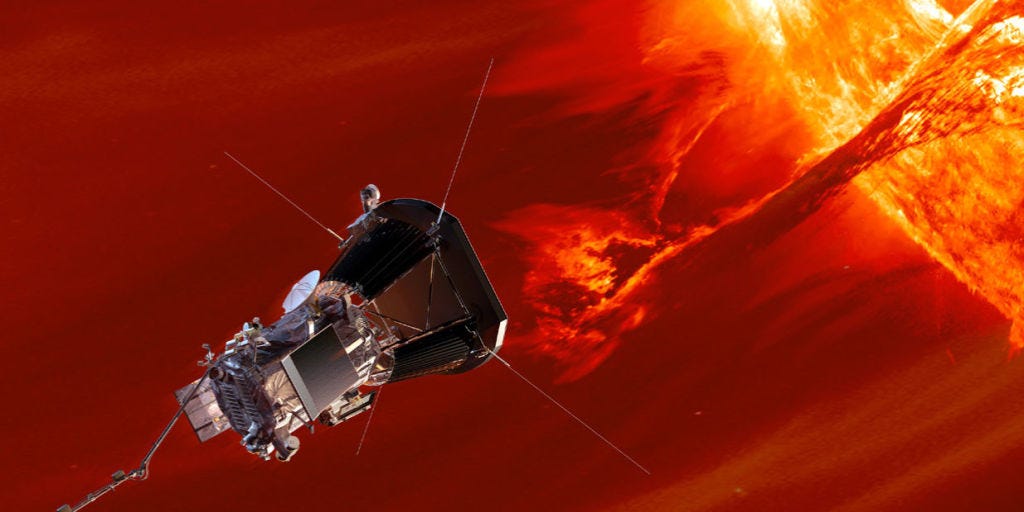
Most of us treat the Sun the way you treat a hot pan: admire from a safe distance, pretend you meant to do that,
and quietly move on. NASA, however, looked at the brightest, most overachieving ball of plasma in our sky and said,
“What if we sent a spacecraft into its atmosphere?”
That isn’t a movie pitch. It’s real heliophysicsled by NASA’s Parker Solar Probe, a mission built to repeatedly skim
through the Sun’s outer atmosphere (the solar corona), where temperatures soar and the solar wind is born.
If you’ve ever wondered why space agencies don’t just “turn down the Sun a little,” this story is for you.
In this deep dive, we’ll unpack what it means to “fly into the Sun’s atmosphere,” how NASA engineers designed a
Sun-diving spacecraft that doesn’t melt into a philosophical lesson, and what we’re learning that matters
for everything from satellite safety to your GPS behaving itself.
Why Fly Into the Sun’s Atmosphere at All?
From Earth, the Sun looks like a steady, glowing diskreliable, comforting, and only mildly judgmental when you forget
sunscreen. Up close, it’s an active star with magnetic tantrums, plasma outflows, and eruptions that can ripple across
the solar system.
The puzzle scientists have wrestled with for decades is a classic “wait, that’s backwards” problem: the Sun’s visible
surface (the photosphere) is hot, but the corona above it is ridiculously hotter. The corona is also where the
solar winda stream of charged particlesescapes and races outward, shaping a protective bubble called the
heliosphere and sometimes smacking into Earth’s magnetic field.
Understanding the corona isn’t academic trivia. It’s the upstream source of space weather, which can
disrupt communications, stress power grids, and scramble satellites. The better we understand how the solar wind forms
and how energetic particles accelerate, the better we can forecast the Sun’s “moods” before they punch our technology
in the face.
The corona is hot, but it’s also thin
Here’s the weird part that makes this mission possible: even though the corona can reach temperatures of over a million
degrees, it’s extremely low density. Heat, in the practical sense of “how fast does it cook my spacecraft,” depends on
energy transfer, not just temperature on a brochure. Parker Solar Probe still faces brutal sunlight and radiation, but
the thinness of the corona is the only reason a spacecraft can survive there at all.
Meet the Spacecraft: Parker Solar Probe, NASA’s Sun-Skimming Specialist
The headline says “NASA is building a spacecraft,” and that’s emotionally truebecause missions like this are never
just one moment. They’re decades of concepts, years of engineering, and then ongoing operations, upgrades to ground
systems, and extended science campaigns that keep evolving as the Sun throws new surprises.
The flagship example is NASA’s Parker Solar Probe, launched in 2018 and designed to repeatedly dive
closer to the Sun than any spacecraft before it, eventually operating inside the solar coronaliterally flying into
the Sun’s atmosphere.
The mission is named after physicist Eugene Parker, whose theory of the solar wind helped explain why the Sun’s
influence doesn’t stop at the planetsit floods the solar system with charged particles and magnetic fields.
What “flying into the Sun’s atmosphere” actually means
The Sun doesn’t have an atmosphere like Earth’s with a neat edge and a polite sign that says “Now entering corona.”
Scientists use physical boundaries insteadregions defined by magnetic and plasma behavior. One of the biggest is the
Alfvén surface, a kind of “point of no return” where the solar wind breaks free and can no longer send
information back to the Sun via magnetic waves.
When Parker crosses that boundary, it’s sampling the birthplace of the solar wind and measuring the magnetic and
particle conditions that shape space weather downstream. It’s less “swoop into a cloud” and more “plunge into a
chaotic magnetic frontier with instruments on.”
How NASA Builds a Spacecraft That Doesn’t Instantly Become a Legend (and a Puddle)
If you’re imagining NASA engineers standing around a whiteboard writing “Step 1: Don’t melt,” congratulationsyou’ve
basically earned an honorary systems engineering badge.
Parker Solar Probe’s survival strategy is beautifully simple in concept and maddeningly difficult in execution:
stay in the shadow of a heat shield while operating instruments that still need to taste the solar wind.
The thermal protection system: a giant “space umbrella”
The spacecraft’s signature feature is its Thermal Protection System, a heat shield roughly 8 feet
across and about 4.5 inches thick, built from carbon-composite materials with a lightweight carbon-foam core and a
bright outer coating that reflects sunlight. In plain English: it’s a high-tech pancake that blocks the Sun from
roasting the spacecraft.
The numbers are wild. The shield is designed to face temperatures hot enough to melt steel, while keeping the
instruments and electronics behind it at roughly room-temperature conditions. The mission lives and dies by that
temperature gradient.
Pointing matters: the spacecraft must “hold its shield up” at all times
A heat shield only works if it’s between you and the thing trying to turn you into charcoal. Parker relies on precise
attitude control and autonomous fault protection, because near the Sun the spacecraft can’t always chat with Earth in
real time. If something goes off-nominal, it must protect itself fastno waiting for a conference call.
Solar panels with an actual cooling system
Power is another engineering headache. Solar arrays love sunlight… until they hate it. Parker uses a
water-cooled solar array system: water flows through tiny channels in the panels to absorb heat, then dumps that heat
through radiators into space. It’s the closest thing to giving your spacecraft a hydration plan.
Instruments that can handle the environment
Even with the shield, some components must poke into harsher conditions to do real science. That means careful
material choices, robust electronics, and designs that treat radiation and thermal cycling like daily weather, not a
rare event.
The Trick Flight Plan: Using Venus as a Cosmic Brake Pedal
Here’s the counterintuitive part: getting to the Sun is not like falling down a hill. You’re already orbiting the Sun
at high speed because Earth is. To dive inward, you must shed orbital energy. Parker does that using a series of
Venus gravity assistsflybys that steal a bit of orbital momentum and tighten the spacecraft’s loop
around the Sun.
Over multiple flybys, Parker’s orbit shrinks until its closest approaches become record-breaking. NASA confirmed a key
milestone in late 2024, when the mission used its final Venus gravity assist to queue up its closest-ever passes.
Record-setting close approaches and speeds
During its closest approaches, Parker has flown only about 3.8 million miles above the Sun’s surface
while traveling around 430,000 miles per hourfaster than any human-made object. Communication can drop
out during these passes, so teams wait for a post-encounter beacon signal like it’s a text from a friend who promised
they’d be home safely after a sketchy shortcut.
The payoff is that Parker doesn’t just look at the corona; it samples itmeasuring particles and magnetic fields
in situ, where the solar wind is being formed and shaped.
What Parker Measures Inside the Corona
Parker’s instrument suite is designed to answer a few big questions: How is the corona heated? How is the solar wind
accelerated? And how do energetic particles get boosted to extreme speeds?
The four core instrument suites
-
FIELDS: measures electric and magnetic fields, waves, and turbulencebasically the electromagnetic
“texture” of the corona and solar wind. -
SWEAP (Solar Wind Electrons Alphas and Protons): counts and characterizes key solar wind particles to
understand flow speed, density, and temperature. -
ISʘIS (Integrated Science Investigation of the Sun): measures energetic particleshigh-speed
radiation hazards and vital clues about acceleration mechanisms. -
WISPR (Wide-Field Imager for Parker Solar Probe): the camera that images coronal structures, solar
wind patterns, and events like coronal mass ejections before the spacecraft flies through their aftermath.
Think of it as a coordinated team: WISPR watches the big structures; the other instruments measure what it feels like
to be inside them. That combination is how you go from “pretty pictures” to “physics you can model and forecast.”
What We’ve Learned So Far: Solar Weirdness, Confirmed
The Sun is not a calm, uniform sphere. It’s more like a magnetic engine with a plasma exhaustexcept the exhaust
sometimes loops, twists, and flings charged particles like confetti at the solar system.
Magnetic “switchbacks”: the solar wind’s sudden U-turns
One of Parker’s early headline discoveries was the prevalence of magnetic switchbackssharp kinks in
the solar wind’s magnetic field where the field flips direction. Instead of being rare oddities, they showed up as a
common feature closer to the Sun.
Why does that matter? Switchbacks may be tied to how the solar wind is accelerated and how energy moves through the
corona. They’re also a reminder that the solar wind isn’t a smooth riverit’s a turbulent flow with structure.
Crossing the Alfvén surface: entering the “point of no return” region
In 2021, NASA announced that Parker had flown through the solar corona and sampled it directlycrossing into regions
where the magnetic and particle conditions define the Sun’s atmosphere. That’s a milestone because it turns the corona
from a remote-sensing target into a measurable environment.
More recently, scientists have used Parker’s data to help map the Alfvén surface in greater detail, showing how this
boundary can be irregular and dynamicespecially during more active periods of the solar cycle.
The dust-free zone: the Sun’s “no crumbs allowed” region
The inner solar system isn’t emptyit’s dusty. But closer to the Sun, dust grains can get blasted, vaporized, or
pushed around by heat and radiation pressure. Parker observations helped illuminate how dust thins as you approach the
Sun, strengthening evidence for a long-theorized dust-free zone nearer in.
That matters because dust affects how light scatters in the inner solar system and can influence the environment that
newborn solar wind flows through.
Closest-ever images and better space-weather intuition
As Parker has reached its tightest orbit, the mission has delivered its closest-ever views of coronal structures and
solar wind patterns. These observations help scientists connect what we see leaving the Sun (like coronal mass
ejections and streamer structures) to what we later measure near Earth.
That connection is the heart of practical heliophysics: if we can understand how solar eruptions evolve and merge as
they travel outward, we can improve forecasts for geomagnetic storms that affect satellites, aviation, and
communications.
Why This Mission Matters to People Who Don’t Own a Solar Observatory
Space weather is not sci-fi. It’s infrastructure. Modern life depends on satellites for navigation, timing, weather,
communication, and Earth observation. Solar activity can disturb satellite electronics, increase atmospheric drag in
low Earth orbit, and create radiation environments that are hazardous for astronauts.
The better Parker helps us understand solar wind formation and energetic particle acceleration, the more we can
upgrade models that feed space-weather forecasting. That means earlier warnings, smarter satellite operations, and
fewer surprisesbecause “surprises” are fun for birthdays, not for power grids.
So… Is NASA Still “Building” Sun-Diving Spacecraft?
In one sense, Parker Solar Probe is already builtand it’s actively doing the work it was engineered for. But the
broader truth is that NASA is always “building” missions like this in three ongoing ways:
-
Building operations: refining autonomous behaviors, updating analysis pipelines, and planning new
observation campaigns based on what the Sun is doing right now. -
Building knowledge: each discovery changes what we ask nextabout turbulence, magnetic reconnection,
and how the corona funnels energy into the solar wind. -
Building the next generation: new instruments, new mission concepts, and new partnerships that take
lessons learned from Parker and apply them to future heliophysics missions.
NASA has noted that after the baseline mission plan milestones (including repeated close approaches), the spacecraft
remains in orbit and continued observations will be evaluated in formal mission reviewsbecause as long as the
spacecraft is healthy, the Sun is offering fresh data every single pass.
Conclusion
A spacecraft flying into the Sun’s atmosphere sounds like a dare. Parker Solar Probe turned it into a disciplined,
data-driven science missionone that pairs bold engineering with a simple goal: understand the environment that
literally shapes our solar system.
By hiding behind a heat shield, cooling its solar arrays like a marathon runner, and using Venus as a gravitational
brake, Parker can sample the corona where the solar wind is born. The result is a clearer picture of the Sun’s
magnetic complexity, better insight into space weather, and a roadmap for future missions that will keep pushing
closer to the source.
Bonus: of “Experience” You Can Actually Have With a Sun-Diving Spacecraft
You may not be able to hitch a ride on a solar probe (NASA tends to frown on “open seating” near the corona), but you
can still have surprisingly real, hands-on experiences that connect you to the mission. Here are a few ways people
make a Sun-diving spacecraft feel less like distant science and more like something you’re participating in.
1) Follow the mission like a sports season
Parker’s close approaches happen on a schedule, and each one is an “event” with its own story: a tight perihelion,
a temporary communications blackout, then that reassuring beacon that says the spacecraft is fine. Watching those
milestones unfold is a genuine emotional experiencepart curiosity, part suspense, part “please don’t let the Sun
win today.” If you enjoy launches, this is the long-form version: a season of close passes, science releases, and
fresh imagery that rewards your attention over months and years.
2) Use space-weather alerts the way you use weather apps
The Sun’s activity shows up in real-world ways: auroras, satellite drag, radio blackouts, and geomagnetic storms.
When you start following space-weather updates, Parker’s purpose becomes instantly relatable. People often describe a
shift in how they look at the sky: the Sun stops being a static background object and starts feeling like an active
driver of conditions around Earth. It’s the difference between “nice daylight” and “oh, that daylight has a magnetic
personality.”
3) Re-create the core engineering idea at home (safely)
Parker’s survival strategystay in the shadecan be demonstrated with simple experiments: use a heat lamp and compare
temperatures behind reflective vs. dark surfaces, or explore how insulation plus reflection changes heating rates.
Teachers and science communicators do versions of this all the time because it maps cleanly to the probe: you’re not
defeating heat with magic; you’re managing energy flow with materials, geometry, and shadow.
4) Pair Parker with solar viewing habits that don’t destroy your eyeballs
Following a solar mission often inspires people to observe the Sun more intentionally. The key “experience” here is
learning the discipline: never look directly at the Sun without proper solar filters, and treat safe eclipse viewing
as non-negotiable. When you connect Parker’s extreme engineering with your own safe observation practices, you build
a practical appreciation for scale: if NASA needs carbon-composite shielding and autonomous safing, you probably need
certified solar glasses.
5) Let the mission change how you read headlines
Once you understand the corona and solar wind even a little, news about geomagnetic storms, aurora forecasts, and
satellite anomalies becomes more meaningful. People who follow Parker often describe a “context upgrade”: instead of
seeing solar storms as random chaos, they start seeing them as physics with causesmagnetic fields reconnecting,
plasma accelerating, and structures propagating outward. That’s a real experience too: the world feels more legible
when you can connect the dots between a star’s behavior and the technology you rely on.
In other words, Parker Solar Probe doesn’t just fly into the Sun’s atmosphereit pulls you into the story of how our
star works. And that story is one of the few science narratives where “getting closer” actually makes everything
safer for the rest of us.