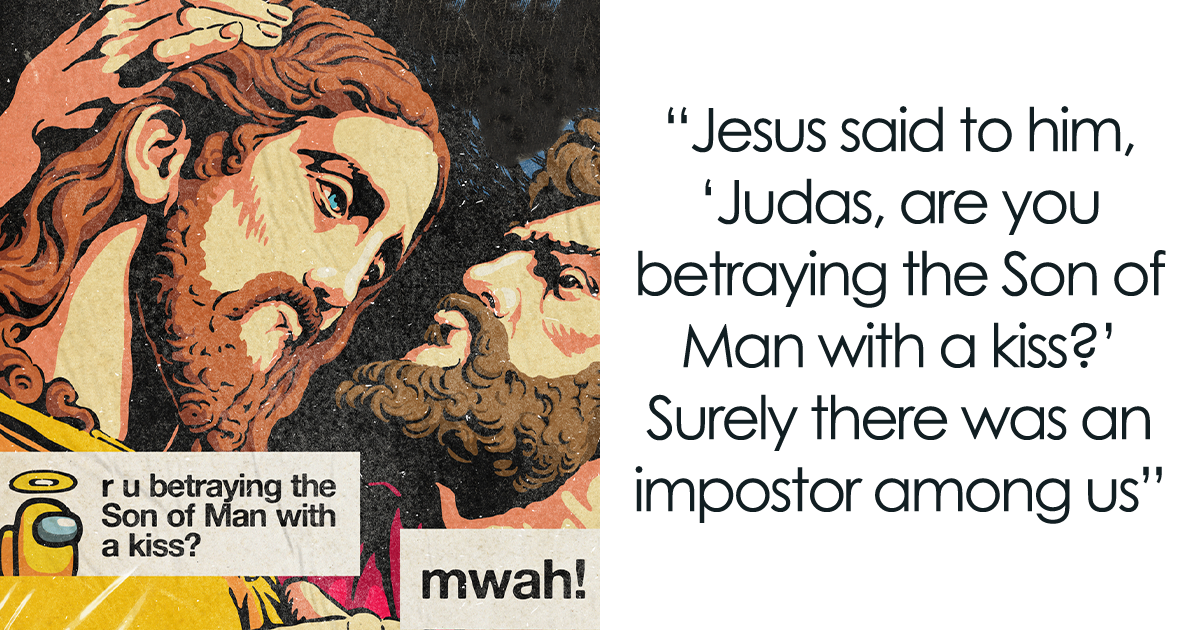
The Bible contains miracles, poetry, wisdom, betrayal, plagues, monsters, wars, resurrections, and enough family drama to make a soap-opera writer request a vacation. Put those elements inside the visual language of an old horror comic, and Scripture suddenly resembles something discovered behind a loose brick in a haunted bookstore.
That deliciously strange collision inspired Brazilian graphic artist Butcher Billy to reinterpret biblical episodes as vintage comic book covers. Known for mixing famous people, music, movies, politics, and retro illustration, the artist reverses a familiar cultural process. Instead of borrowing biblical imagery for modern entertainment, he inserts modern pop culture into Bible stories.
The title’s promise that these comics are “for kids” is intentionally mischievous. The collection includes mass destruction, demons, beheading, betrayal, and one extremely unfortunate encounter with a giant fish. Parents should therefore consider a child’s age and sensitivity before sharing the images. “Sunday school with pulp-horror lighting” is not a universally soothing bedtime category.
Why Bible Stories Work So Well as Vintage Comics
Biblical narratives have inspired visual art for centuries, appearing in paintings, stained glass, sculpture, tapestries, and illuminated manuscripts. Museums continue to interpret these works partly through their visual storytelling, symbolism, and dramatic human gestures. Comic art uses many of the same tools: recognizable characters, compressed action, heightened expressions, and a single image capable of suggesting an entire narrative.
Butcher Billy adds the vocabulary of twentieth-century comic coversbold colors, distressed printing, theatrical captions, looming faces, and promises of danger. His style recalls an era when covers practically grabbed readers by the collar and shouted, “Buy this issue or remain tragically uninformed about the space monster!”
The approach also carries historical irony. American horror comics once caused such public anxiety that publishers created the Comics Code Authority in 1954. Its rules heavily restricted gruesome imagery, walking corpses, and horror-themed language. This collection playfully imagines what might have happened if biblical stories had strolled into that nervous era wearing trench coats and carrying suspiciously dramatic lightning.
The 18 Creepy Bible Comic Covers
1. Judas and the Betrayal With a Kiss
The first cover draws from Luke 22, where Judas identifies Jesus to an approaching crowd with a kiss. The artist connects that act of concealed betrayal with modern stories about impostors and hidden enemies. It is a natural horror premise: the apparent friend standing beside you is secretly working for the other side. No monster costume is requiredjust terrible loyalty and highly uncomfortable timing.
2. The Number of the Beast
Revelation 13 supplies one of popular culture’s favorite ominous numbers: 666. The comic treatment combines apocalyptic symbolism with heavy-metal theatrics, particularly the cultural association created by Iron Maiden. A mysterious beast, coded identity, and end-times imagery already sound like a vintage supernatural series. The amplifier simply needed to be turned up.
3. Moses Downloads From the Cloud
Exodus 31 describes Moses receiving two tablets inscribed by God. Butcher Billy translates “tablets” and “the cloud” into technological language, imagining Moses with devices worthy of a product launch. The joke works because ancient and modern meanings overlap so neatly. Suddenly, the covenant resembles the most consequential software update in historywith terms and conditions that people actually read.
4. Jonah Meets the Ultimate Sea Monster
In Jonah 2, the prophet is expelled onto dry land after surviving inside a great fish. The cover reframes the episode as a creature feature, complete with a nod to Jaws. The biblical text does not identify the animal as a whale, despite generations of children’s illustrations. Whatever swallowed Jonah, it certainly provided the worst three-night accommodations imaginable.
5. Zechariah’s Terrifying Plague
Zechariah 14 contains a graphic description of a plague affecting flesh, eyes, and tongues. The artist connects the imagery to George A. Romero’s living-dead movies. The result resembles a forbidden zombie-comic cover from the pre-Code era. It also demonstrates that ancient prophetic literature could produce visual horror without makeup artists, latex, or a single Hollywood effects budget.
6. Lot’s Wife Becomes a Pillar of Salt
Genesis 19 tells of Sodom and Gomorrah’s destruction and Lot’s wife looking back despite a warning not to do so. She becomes a pillar of salt, an unforgettable transformation that has inspired centuries of interpretation. The comic adds musical humor while hinting that the family’s later cave episode is even more disturbing. That is an impressive achievement considering the city has just rained fire.
7. Job Enters a Cosmic Test
The Book of Job begins with a heavenly discussion about Job’s faithfulness, followed by catastrophic losses and intense suffering. Butcher Billy presents the premise as a sinister contest between God and Satan, pairing it with an ABBA-inspired winner-and-loser joke. The satire deliberately simplifies a complex theological book, emphasizing the unsettling question at its center: Why can a good person suffer so profoundly?
8. Solomon Calls for a Sword
In 1 Kings 3, two women claim the same baby. Solomon proposes dividing the child, prompting the true mother to surrender her claim rather than allow the baby to be harmed. The child is never actually cut; the threat exposes genuine maternal love. A vintage cover can freeze the scene at its most alarming second, however, making Solomon’s wisdom look suspiciously like the beginning of a slasher film.
9. Jesus and the Demon-Possessed Pigs
Matthew 8 recounts an exorcism in which demons enter a herd of pigs that then rush into the water. The comic turns the bizarre episode into the origin story of a rock band. This mashup works because the narrative already has tombs, supernatural confrontation, panicked animals, and shocked townspeople. All it lacks is a tour bus with regrettable upholstery.
10. Noah’s Ark and the End of the World
Children’s books often emphasize paired animals, a large wooden boat, and a rainbow. Genesis 6–9 also describes a flood that destroys nearly all land-based life. Butcher Billy restores that apocalyptic scale while adding commentary about wealth and privilege. The cheerful nursery image becomes a disaster comic in which seating on the rescue vessel is the most exclusive reservation on Earth.
11. Lazarus Walks Out of His Tomb
John 11 presents the raising of Lazarus as a sign of Jesus’ power over death. Through the visual grammar of horror comics, however, a dead man emerging from a tomb can resemble the opening panel of a zombie apocalypse. The humorous reinterpretation depends on genre rather than theology: change the caption and lighting, and a miracle can briefly wear the costume of a monster story.
12. David Faces Goliath
First Samuel 17 tells how David defeats the heavily armed Goliath with a sling and stone. Later, David uses Goliath’s sword to complete the victory. The cover blends the biblical hero with pop-cultural identities associated with the name David, producing a pun that works visually. It is an underdog story with enormous stakesand possibly the Bible’s least relaxing lesson in projectile accuracy.
13. Eve Takes the Forbidden Fruit
Genesis 3 describes the serpent’s temptation, the forbidden fruit, and humanity’s expulsion from Eden. The fruit is never specifically called an apple in the biblical text, although Western art made that image famous. Butcher Billy recasts Eve as a rebellious figure resisting authority, using pop-music energy to complicate the familiar portrayal of her as merely the person who ruined an otherwise lovely afternoon.
14. The Head of John the Baptist
Matthew 14 recounts how Herod, trapped by a public promise, orders John the Baptist’s beheading after Herodias’s daughter requests his head. The comic pairs the scene with the Yeah Yeah Yeahs song “Heads Will Roll.” It is one of the collection’s darkest combinations because the joke and the violence arrive simultaneouslyand the platter is unfortunately not carrying appetizers.
15. The Fallen Morning Star
Isaiah 14 contains a poetic taunt against the king of Babylon. The King James tradition rendered its “morning star” language with the name Lucifer, which later Christian interpretation strongly associated with Satan. The comic embraces that familiar devil imagery and mixes it with lyrics and attitudes from alternative music. The result is less quiet Bible study and more infernal album-release party.
16. Ezekiel Goes to the Movies
This cover invokes Ezekiel 25:17 through the famous speech delivered by Jules Winnfield in Pulp Fiction. Importantly, most of that movie monologue is not a direct quotation of the biblical verse; it is a cinematic expansion. Butcher Billy plays with the mistaken cultural memory, turning Scripture, film dialogue, and comic-book vengeance into one gloriously tangled reference.
17. Ecclesiastes Discovers Social Media
Ecclesiastes opens with a meditation on vanity, repetition, and the apparent absence of anything truly new under the sun. The artist updates that existential weariness for the social-media age, where every new platform arrives dressed as a revolution. The Preacher has seen empires rise and fall; another short-video app is unlikely to knock him off his chair.
18. Isaiah Joins a Cheerful Cartoon Gang
Isaiah 1 contrasts scarlet sins with cleansing that makes them white as snow. Butcher Billy pairs this message of restoration with the sugary optimism of The Get Along Gang, an animated property associated with cooperation and friendship. The tonal collision closes the collection on a deceptively bright note: cosmic moral reckoning presented with the enthusiasm of Saturday-morning television.
More Than Shock Value
The collection succeeds because it does not merely place blood-red letters over religious scenes. Each cover connects a biblical passage with a recognizable cultural reference, allowing the two sources to comment on each other. Heavy metal amplifies Revelation; zombie cinema reframes Lazarus and Zechariah; social media makes Ecclesiastes feel unexpectedly current.
The comics can also encourage readers to check the original passages. Some jokes depend on popular assumptions rather than precise textual details. Jonah’s creature is described as a great fish, Eve’s fruit is not named as an apple, and the speech associated with Ezekiel in Pulp Fiction is largely a movie invention. Satire becomes a doorway to closer readingadmittedly, a doorway decorated with skulls and dramatic exclamation points.
Religious viewers may interpret the project differently. Some will enjoy its irreverent creativity, while others may find the treatment of sacred narratives uncomfortable. Both reactions are understandable. Satire works by creating friction, and Butcher Billy’s pop-art method rarely enters a room on tiptoe.
The Creative Experience Behind a Collection Like This
Finding the Right Story Is Harder Than Finding Horror
Developing a series like this begins with a surprising realization: there is no shortage of visually intense Bible stories. The challenge is choosing episodes that remain recognizable when compressed into one cover. A good selection needs a strong central imagea towering warrior, a mysterious number, a tomb opening, a burning city, or a prophet inside a sea creature. If the concept requires three paragraphs before the sketch makes sense, it probably belongs in a graphic novel rather than on a pretend newsstand.
Research Changes the Joke
Close reading quickly reveals how much popular memory differs from the source material. Details added through paintings, sermons, movies, and children’s books can become more familiar than the actual text. That discovery creates better humor because the artist can play with both versions. The work becomes an archaeological dig through cultural memoryexcept the archaeologist keeps finding movie posters, song lyrics, and suspiciously modern apples.
Designing “Old” Art Requires New Decisions
A convincing vintage comic cover is not created simply by applying a yellow filter. The experience involves balancing limited colors, halftone textures, aged paper, dramatic typography, imperfect registration, and boldly simplified figures. Every element must feel slightly theatrical. Faces need to communicate danger from across a room, titles need the confidence of emergency broadcasts, and empty space must be treated as though it owes the publisher money.
The most satisfying stage is often combining references that should not logically coexist but instantly make sense together. Moses and digital tablets are separated by thousands of years, yet the wordplay connects them in a second. Lazarus and zombie cinema occupy very different spiritual worlds, but the shared image of a man leaving a tomb supplies a visual bridge.
Humor Needs Boundaries
The darker the source material, the more carefully the tone must be handled. Some episodes concern suffering, death, coercion, or destruction and cannot be treated like harmless slapstick. A successful parody directs its energy toward cultural associations, genre conventions, or modern behavior rather than reducing victims to punch lines. That boundary is not always perfectly clear, which is why revisionand occasionally deleting the cleverest but cruelest ideais part of the creative experience.
Audience Reactions Become Part of the Artwork
Once the images appear online, viewers begin identifying references, debating interpretations, correcting details, and sharing their own memories of the stories. One person sees theology, another sees horror history, and a third is simply delighted that Ecclesiastes seems aware of TikTok. That range of responses demonstrates why mashup art is so engaging: the audience completes the circuit by bringing its own cultural knowledge.
The experience ultimately shows that ancient narratives are not culturally dormant. They continue to influence movies, music, advertising, superhero stories, and everyday expressions. Presenting them as vintage Bible comics does not create their drama; it reveals drama that was already there, then gives it distressed paper, explosive lettering, and the confidence to demand ten cents at the newsstand.
Conclusion
Butcher Billy’s creepy Bible stories transform familiar Scripture into a lively gallery of retro horror, pop music, cinematic jokes, and vintage comic book design. The 18 covers are funny because their connections feel absurd and strangely logical at the same time. They also remind us that biblical literature contains far more narrative variety than the gentlest children’s editions suggest.
Whether viewers consider the collection witty, provocative, unsettling, or all three before breakfast, it encourages a fresh look at stories that have shaped Western art and popular culture for centuries. Ancient prophets and pulp-comic artists may not seem like natural neighbors, but give them a dramatic title font and they get along alarmingly well.