There was a time when asking me how I felt was a little like asking a goldfish to explain taxes. I had feelings, obviously. They were simply living in a messy little apartment in my chest, refusing to answer the door.
Words felt too neat for what was happening inside me. “Sad” was too small. “Lonely” was true, but incomplete. “Fine” was the word I used most often, mostly because it required zero emotional assembly instructions.
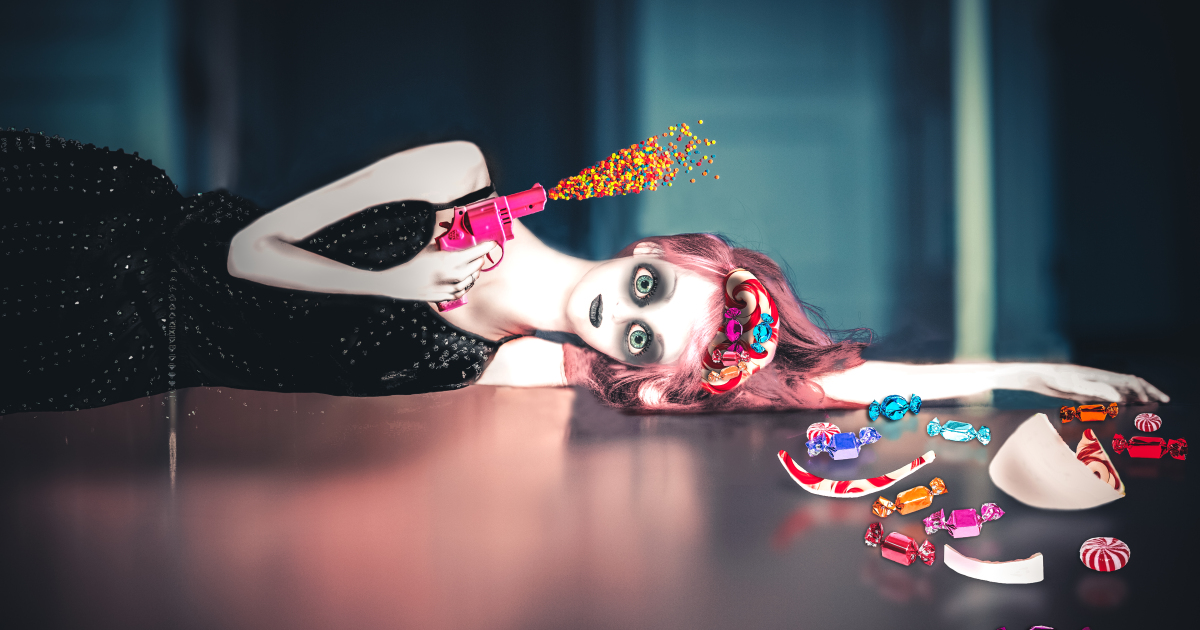
So I started making surreal sad art pictures instead.
I did not sit down with a dramatic artist scarf, a candlelit studio, and a mysterious European accent. I usually sat at a desk with cold coffee, a tired brain, and the kind of music playlist that made every song sound like it had recently lost custody of the moon.
These pictures became my diary. Not a diary filled with dates and sentences, but one made of floating houses, cracked mirrors, birds with suitcases, and oceans hiding inside bedrooms. Each surreal image said something I was unable to say out loud at the time.
Here are ten surreal sad art pictures I created when my emotions were too complicated for ordinary language.
1. The Girl Who Carried a House on Her Back
A picture about emotional weight
In the first image, a girl walks across an empty field while carrying a tiny old house on her back. The house has crooked windows, a chimney that leaks black smoke, and a front door that is slightly open.
I created this picture during a period when I felt like I was carrying every memory I had ever tried to ignore. Old conversations. Regrets. Things I wished I had said. Things I absolutely wished I had not said.
The house represented the past. It was not huge enough to crush her, but it was heavy enough to change the way she walked.
That was the strange thing about sadness. It did not always knock me down. Sometimes it simply made everything feel heavier. Getting out of bed was heavier. Replying to messages was heavier. Choosing what to eat felt like a project requiring a board meeting.
The open door in the picture mattered most. It suggested that the girl could still go inside, face what she had been carrying, and eventually decide what should stay and what could be left behind.
2. The Moon That Slept in My Bedroom
A picture about insomnia and quiet loneliness
This image showed a bedroom at night, except the moon was lying on the bed under a blanket. It looked exhausted. The stars outside the window were watching it like concerned neighbors.
I made this picture after many sleepless nights. Not the glamorous kind of insomnia where someone writes a bestselling novel at 3 a.m. More like the kind where you stare at the ceiling and suddenly remember something embarrassing you said in 2014.
The moon became a stand-in for my tired mind. It was supposed to shine. It was supposed to be high in the sky, doing moon things. Instead, it had curled up under a blanket and quietly given up for the night.
There is something deeply lonely about being awake when the rest of the world seems asleep. The room becomes larger. The silence becomes louder. Even the refrigerator starts sounding emotionally judgmental.
This surreal sad art picture reminded me that exhaustion can make ordinary sadness feel enormous. Sometimes the mind does not need a brilliant solution. Sometimes it needs rest, water, a softer morning, and permission to stop pretending it is made of steel.
3. The Fish Bowl With No Water
A picture about feeling emotionally empty
In this picture, a goldfish floated inside an empty glass bowl. There was no water, but the fish was still suspended in midair, as if sadness had changed the rules of physics.
I was not trying to make a scientific statement. Goldfish are not known for their emotional restraint, but they are also not magical. The image was about that strange feeling of functioning without feeling fully alive.
I could go to work. I could smile at people. I could make jokes. I could even answer, “How are you?” with a convincing “Good!”
But inside, I felt like something important had evaporated.
The empty bowl represented emotional numbness. It was a way of showing what happens when you have spent too long trying not to feel anything. Eventually, your feelings do not disappear. They simply hide behind glass and become difficult to reach.
Creating this picture helped me realize that emptiness is not always the absence of emotion. Sometimes it is emotion that has become too tired to introduce itself.
4. The Forest That Grew Inside My Chest
A picture about thoughts that would not stop growing
This image showed a person standing in profile while an entire dark forest grew from inside their chest. Branches curled out through their ribs. Small birds nested in the shadows. A foggy path disappeared somewhere near the heart.
This was one of the most personal pieces in the collection because it captured what overthinking felt like.
My thoughts did not arrive politely. They multiplied. One small worry could become a forest by lunchtime. One awkward memory could become a tree. One fear about the future could become a whole forest ranger station with maps, emergency supplies, and several bears.
The forest was beautiful, but it was also difficult to walk through. That was the point.
Sadness is not always gray. Sometimes it is green, crowded, alive, and full of paths you cannot stop exploring. I wanted the image to show that even painful thoughts can contain beauty. The goal was not to burn down the forest. The goal was to find a way through it.
5. The Mirror That Refused to Show My Face
A picture about losing a sense of self
In this picture, I stood in front of a mirror, but the reflection showed a hallway instead of my face. At the end of the hallway was a small closed door.
There were days when I looked in the mirror and recognized my features but not myself. I knew my name. I knew what I liked to eat. I knew which bills needed paying. But I did not always know who I was beneath the routines.
The hallway represented distance from myself. The closed door represented the part of me I had stopped visiting.
It sounds dramatic, but sadness can be dramatic. It has the emotional subtlety of a raccoon in a kitchen cupboard at midnight.
This picture was about identity, especially the way difficult seasons can make you feel disconnected from the person you used to be. It was also about curiosity. Even though the door was closed, it was still there. That meant there was still a way back.
6. The Boat Made of Letters I Never Sent
A picture about regret and unfinished conversations
This surreal artwork showed a small paper boat floating on a black ocean. The boat was folded from handwritten letters, and the words slowly dissolved into the water.
I had many things I wanted to say to people. Apologies. Explanations. Questions. Confessions. A few extremely petty speeches I wisely decided not to deliver because jail seemed inconvenient.
The letters in the boat represented all the words I had kept inside.
Some messages never get sent because the timing is wrong. Some because the relationship is over. Some because you realize the person receiving the message may not understand it anyway.
The boat was fragile, but it was moving. That mattered. Even unspoken emotions can travel somewhere. They can become art. They can become a lesson. They can become a private goodbye.
This image taught me that closure does not always arrive through another person. Sometimes closure begins when you finally admit what you wanted to say.
7. The Giant Hand Holding a Tiny Storm
A picture about trying to control grief
In this picture, a giant hand holds a tiny glass jar. Inside the jar is a thunderstorm with lightning, rain, clouds, and one very confused-looking bird.
I made this after trying to control every difficult emotion I had. I treated sadness like a spill on the carpet. Something to clean up quickly before anyone noticed.
But grief, disappointment, fear, and loneliness do not enjoy being trapped in jars. They rattle. They flash. They make noise. They want to be acknowledged.
The hand was not cruel. It was frightened. It wanted to keep the storm from damaging everything else.
That is how I felt. I wanted to contain the sadness so I could keep functioning. I wanted to keep it small enough to carry around without anyone asking questions.
But the lightning in the jar reminded me that emotions do not become less real because we hide them. Sometimes the healthier choice is to open the lid a little and let the weather exist.
8. The Bird With a Suitcase Full of Stones
A picture about leaving without feeling free
This picture showed a bird flying through a pale sky while dragging a suitcase behind it. The suitcase was open, and it was filled with heavy gray stones.
I created it during a time when I knew I needed to move forward, but emotionally, I was still standing in the doorway.
Leaving something behind does not automatically make you feel free. You can leave a place, a job, a friendship, or a version of yourself and still carry parts of it with you.
The bird could fly, but not easily. The suitcase represented emotional baggage, which is a phrase people use so often that it has almost lost its power. But sometimes emotional baggage is exactly what it feels like: a clunky, overstuffed suitcase that somehow gets heavier every time you pretend it is not there.
The bird was sad, but it was moving. That was the hopeful part.
Healing is not always a graceful flight through a golden sky. Sometimes it is a bird hauling a suitcase of rocks and muttering, “This is fine,” while the wind slaps it in the face.
9. The City Where Everyone Wore Paper Masks
A picture about hiding behind a cheerful version of yourself
This image showed a crowded city street filled with people wearing white paper masks. Every mask had the same smile. Behind the masks, shadows spilled from their eyes.
I made this picture because I became very skilled at looking okay.
I could laugh at the right moment. I could say “No worries.” I could post something cheerful online. I could be the person who reassured everyone else while quietly feeling like I was made of wet cardboard.
The masks represented the performance of being fine.
There is nothing wrong with privacy. Not every emotion needs an audience, a speech, and a slideshow. But there is a difference between privacy and disappearing.
This surreal sad art picture reminded me that people often carry invisible struggles. The person who seems calm may be overwhelmed. The person who makes everyone laugh may be tired of holding everything together.
Sometimes the bravest thing is not removing the mask in front of the whole world. Sometimes it is taking it off in front of one safe person.
10. The Sunken Room Full of Floating Chairs
A picture about sadness after everyone has left
The final picture showed an old living room underwater. Chairs floated near the ceiling. A lamp glowed beneath the waves. A small table held one untouched cup of tea.
This was about absence.
Not necessarily death. Not necessarily a breakup. Sometimes absence is simply the feeling that life has changed and nobody told you how to rearrange the furniture afterward.
The floating chairs represented conversations that had ended. The cup of tea represented waiting. The underwater room represented how sadness can make familiar places feel strange.
I wanted the picture to feel quiet rather than dramatic. No crashing waves. No sharks wearing tiny business suits. No giant squid delivering motivational speeches.
Just silence.
Because some of the hardest emotions are not loud. They sit beside you. They make a home in the room. They wait until you are alone enough to notice them.
But even underwater, the lamp was still glowing. I included that small light because sadness does not erase every source of hope. Sometimes hope is not a sunrise. Sometimes it is a lamp that refuses to go out.
What These Surreal Sad Art Pictures Taught Me
Looking back, these pictures were never really about being sad in a permanent way. They were about trying to understand what sadness looked like before I had the words for it.
Surreal art gave me permission to be strange, emotional, dramatic, quiet, confused, and visually unreasonable. A floating house made sense when a sentence did not. A storm inside a jar explained something that “I feel overwhelmed” could not fully hold.
That is the beauty of visual storytelling. It does not demand that every feeling be logical. It lets a fish float in an empty bowl. It lets the moon sleep in your bed. It lets grief become a room underwater.
And somehow, once the feeling was outside of me, I could look at it with more kindness.
My Experience Making a Surreal Art Diary
Making these surreal sad art pictures became a strange kind of ritual. I did not always begin with an idea. Most of the time, I began with a feeling I could not explain.
Sometimes I would sit in front of a blank canvas and think, “Well, today I feel like a dusty lampshade in a haunted motel.” That was not exactly a useful sentence for everyday conversation, but it was a perfectly reasonable beginning for an artwork.
Then I would ask myself a simple question: If this feeling had a body, what would it look like?
Would it be a cracked egg floating over a city? Would it be a child holding a balloon shaped like a thundercloud? Would it be a hallway with no doors, no windows, and one suspiciously judgmental houseplant?
The answer usually came in images rather than words.
At first, I felt embarrassed by how sad the pictures were. I worried they would make me look overly dramatic. I worried people would think I was trying too hard to be mysterious. Nobody wants to become the person who posts a black-and-white photo of a spoon and captions it, “The silence remembers.”
But eventually, I realized that sadness does not become less real just because it looks unusual in art.
Creating the images helped me stop judging my emotions. I did not have to solve every feeling immediately. I did not have to explain every strange symbol. I only had to make something honest enough to recognize later.
Some days, the art felt heavy. Other days, it felt funny. I started noticing that even in my saddest work, humor kept sneaking in. A floating chair might wear socks. A giant cloud might look annoyed. A bird might carry a suitcase that was clearly too large for its life choices.
That humor mattered. It reminded me that sadness and laughter can exist in the same room. Sometimes they are practically roommates.
Over time, the surreal diary became less about documenting pain and more about noticing change. The colors slowly became warmer. The skies became less empty. The people in the pictures started opening doors, carrying lights, planting tiny gardens, or walking toward something instead of away from it.
I did not wake up one day magically healed, glowing, and able to communicate feelings with the elegance of a movie character. Real life is not like that. I still had difficult days. I still had moments when I wanted to avoid every question beginning with “How are you?”
But the art gave me a language.
It taught me that I did not need perfect words to begin expressing myself. I only needed a place to put the feeling. Sometimes that place was a sketchbook. Sometimes it was a digital collage. Sometimes it was a strange picture of the moon hiding under a blanket.
And sometimes that was enough to help me feel a little less alone.
Conclusion: Sadness Can Become Something You Understand
These ten surreal sad art pictures began as a diary because I did not know how to express myself any other way. They gave shape to loneliness, exhaustion, regret, uncertainty, and emotional heaviness without forcing those feelings into neat little boxes.
Surreal art does not need to make perfect sense. That is part of its power. It can turn a difficult memory into a floating house, an empty feeling into a fish bowl, or sleeplessness into a moon resting in a bedroom.
For anyone who struggles to explain what they feel, creativity can be a gentle starting point. You do not need to be a professional artist. You do not need expensive materials. You do not even need to know what you are making at first.
Start with one question: “What would this feeling look like?”
You may be surprised by what answers back.
Note: This article is a creative first-person narrative inspired by surreal visual journaling and emotional self-expression. It is not a substitute for professional mental health support when someone is struggling or feels unsafe.