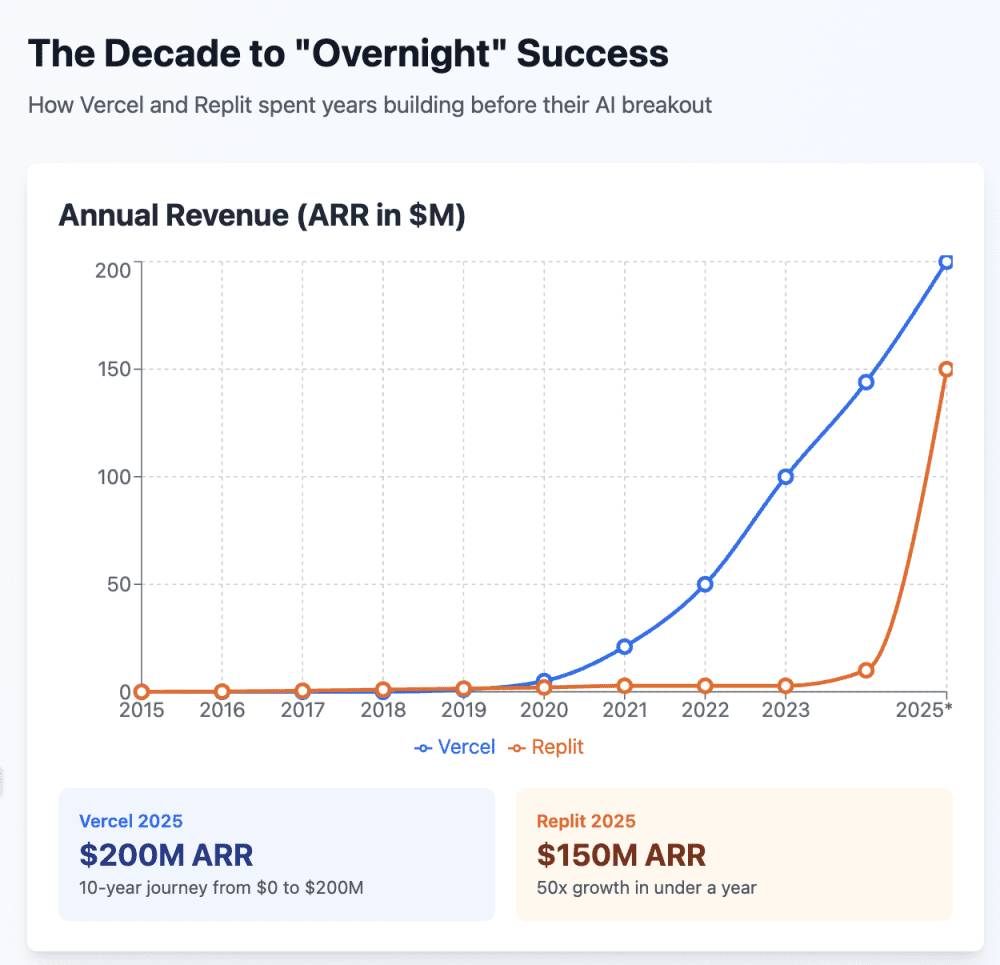
“Overnight success” is one of startup land’s favorite fairy tales. It sounds tidy, dramatic, and conveniently short enough for a LinkedIn post. But when Vercel hit a $9.3 billion valuation in 2025 and Replit reached $3 billion the same year, neither company had just wandered into the AI boom like two lucky tourists who found money on the sidewalk. They had spent years building the rails before the train showed up.
That is the real story here. AI may have poured gasoline on growth, but it did not invent the engine. Vercel spent a decade making the web faster, smoother, and less annoying for developers. Replit spent even longer chasing a bigger idea: making software creation accessible to more people, including people who do not speak fluent engineer. In both cases, the valuations looked sudden only if you ignored the long, unglamorous setup.
So no, this was not “poof, AI, billions.” It was more like “years of infrastructure, open-source trust, product iteration, painful pivots, and then one very big moment when the market suddenly cared.” There is a difference. A huge one.
The Myth of AI Overnight Success
AI has a weird effect on business storytelling. It makes people forget history. The minute a company launches a flashy AI feature, raises a big round, or gets a valuation spicy enough to make venture capitalists smile into their oat milk lattes, the public narrative turns into: Wow, that came fast.
But Vercel and Replit are strong reminders that “fast” is often just what ten years of preparation looks like from the outside. Vercel was founded in 2015, back when it was still called ZEIT. Replit was founded in 2016, but CEO Amjad Masad had been chasing the idea of browser-based programming since 2009. In startup years, that is not a sprint. That is cardio.
Both companies also lived in categories that usually take time to mature. Developer tools are not impulse buys. Infrastructure is not built on vibes alone. Teams adopt these products slowly, test them thoroughly, and only then make them part of production workflows. If you are trying to become foundational, not merely trendy, growth can look frustratingly patient right up until it looks obvious.
That is why the AI era rewarded these companies so sharply. They were not building isolated gadgets. They were building platforms that already sat close to the act of creating software.
Vercel’s Long Climb: From Frontend Friction to AI Cloud
First, it made the modern web easier to ship
Vercel’s story starts before the $9.3 billion headline. The company was built around a deceptively simple promise: help developers ship fast, performant web applications without wrestling every cloud knob by hand. That matters more than it sounds. Plenty of teams can write code. Fewer teams enjoy wrangling deployment, performance, preview environments, scaling, and the thousand tiny paper cuts that turn “we built it” into “why is production on fire?”
Vercel earned trust by making those headaches smaller. Its stewardship of Next.js helped it become deeply embedded in modern web development. That gave Vercel more than brand recognition. It gave the company distribution, developer affection, and the right to be taken seriously when it expanded beyond hosting into a broader cloud platform.
Then, it turned distribution into a business
By May 2024, Vercel had raised a Series E round at a $3.25 billion valuation, surpassed $100 million in annual revenue, and said more than 1 million developers were using Next.js every month. That was already a major company, not a scrappy side quest. It also had enterprise customers such as Under Armour, OpenAI, and Perplexity. In other words, the company had done the hard part: it had become part of how real businesses shipped real products.
Then AI arrived not as a side feature, but as a force multiplier. Vercel’s v0 product made it easier to generate interfaces from prompts, and the company pushed deeper into what it calls the AI Cloud. By September 2025, Vercel announced a $300 million Series F round at a $9.3 billion valuation. It also said revenue had risen 82% over the previous year, its user base had doubled, and v0 had more than 3.5 million users.
That jump was dramatic, but it was not magic. Vercel already owned a powerful position at the intersection of frontend development, deployment, and developer workflow. AI simply made that position more valuable. When more people want to build apps faster, the platform that already helps them ship becomes a much more strategic asset.
Why Vercel was well positioned for the AI moment
Vercel did not win because it shouted “AI” louder than everyone else. It won because its existing product stack was unusually close to where AI creates value. Developers using natural-language tools still need deployment, security, performance, previews, observability, and production readiness. Fancy prompt-to-code demos are cute. Running the result at scale is the grown-up problem.
That is where Vercel looked smart. The company was not just selling code generation. It was selling the path from idea to shipped experience. In the AI era, that is a much bigger prize.
Replit’s Longer, Messier Path: From Browser IDE to AI Builder Platform
The mission came first, long before the valuation
Replit’s public breakout may feel new, but the mission is old. Amjad Masad has talked about wanting to make programming accessible since 2009. Replit the company was founded in 2016, but the underlying obsession predates that. This matters because it explains why Replit feels different from some of the newer AI coding startups. It was not invented to chase an LLM trend. It was built around a belief that software creation should be easier, more collaborative, and more available to people outside traditional developer circles.
For years, that vision translated into a browser-based coding environment with a large community but an uneven business story. Millions used the product. Monetization was harder. That tension is common in developer tools: users love the product, accountants ask harder questions.
The hard years were not optional; they were formative
Replit’s climb to $3 billion was not smooth. By TechCrunch’s telling, the company endured years stuck around the same revenue level, multiple failed business models, and a painful internal reset that included major staff cuts. That part rarely gets glamorized in startup mythology, probably because “we spent years being early and occasionally confused” looks terrible on a T-shirt.
Yet those hard years taught Replit something crucial: broad adoption does not automatically become a great business unless the product, buyer, and workflow all line up. Once AI coding agents became good enough to move from novelty toward usefulness, Replit finally had a better answer to that problem.
AI changed the slope of the curve
In 2023, Replit raised $97.4 million at a $1.16 billion valuation. Good milestone. Serious company. Not exactly “the whole market is losing its mind” territory. Then came the sharper turn. In September 2025, Replit raised $250 million at a $3 billion valuation. The eye-popping number was the revenue jump: the company said annualized revenue had surged from $2.8 million to $150 million in less than a year.
That kind of acceleration usually means one thing: the product stopped being merely admired and started being purchased with urgency. Replit’s agentic tools pushed it closer to a broader market, including nontraditional builders and enterprise teams that wanted faster software creation. The company also highlighted customers such as Duolingo and Zillow, which helped signal that this was not just hobbyist momentum dressed up in a blazer.
Replit’s official messaging also makes its ambition clear: it wants to be the platform where anyone can build applications using natural language. That is not a tiny feature. That is a category claim.
Why AI Supercharged These Two Companies Specifically
1. They already had distribution
AI features are easier to monetize when you already have users. Vercel had deep adoption through Next.js and enterprise deployment workflows. Replit had millions of users and a long-standing identity as a place to create software in the browser. When the AI boom hit, neither company had to start from zero. They had an installed base.
2. They were building platforms, not party tricks
There is a huge difference between an AI demo and an AI platform. A demo says, “Look, it wrote some code.” A platform says, “Look, it wrote some code, tested it, deployed it, collaborated with your team, and now it fits into how your company actually works.” Investors pay more for the second one because customers do, too.
Vercel and Replit both live closer to the full software lifecycle than many AI wrappers. That is why their valuations expanded so fast once demand surged.
3. They solved boring problems, which is often where the money lives
Performance. Deployment. Collaboration. Workflow. Security. Environment setup. Testing. These are not the sexiest words in tech. They are, however, the words that stand between a cool prototype and a useful business. Vercel and Replit both spent years in those trenches. AI did not erase the boring parts. It made them more important.
4. They matched a broader market shift
The AI era is pushing software creation outward. More designers want to build. More product managers want to prototype. More founders want to launch without a full engineering team on day one. Vercel and Replit were unusually well placed for that shift because both companies had long believed that software creation should become more accessible and less infrastructure-heavy.
What Founders, Operators, and Marketers Should Learn
First: do not confuse acceleration with invention. AI accelerated these companies. It did not invent their credibility.
Second: community and distribution matter more than almost any hot feature. When a new platform shift arrives, the winners are often the companies that already have trust, usage, and a reason to exist.
Third: the market rewards infrastructure later than people expect, then all at once. That can be emotionally inconvenient. It is still true.
Fourth: painful pivots are sometimes part of the winning formula. Replit’s later surge makes more sense when you see the years of misfires that came before it. Vercel’s breakout looks cleaner, but it also reflects years of patient category building.
Finally: if you want to benefit from the next big technology wave, start by building something that remains useful even before the wave arrives. Otherwise you are not building a company. You are renting a trend.
Experience: What the Long Road to “Overnight Success” Actually Feels Like
If you have ever worked near a product team, startup, or growth-stage company chasing a big platform shift, the Vercel and Replit stories probably feel familiar in a painfully human way. The outside world sees the valuation headline. Inside the company, the experience is usually less “champagne and confetti” and more “why is the build failing again, and who moved the roadmap?”
The long road often starts with a mission that sounds a little too ambitious for the current market. Make the web dramatically easier to ship. Make software creation accessible to everyone. Those ideas sound bold, even noble, but in the early years they usually collide with reality: customers are not quite ready, the product is still rough in the corners, and monetization is a stubborn little gremlin that refuses to cooperate.
Then come the middle years, which are rarely romantic. Teams are shipping constantly, but growth is uneven. Some launches work, others land with the emotional force of a sock on carpet. You collect users faster than revenue, attention faster than budget, and expectations faster than sleep. There are meetings about focus, meetings about headcount, meetings about whether the company should go upmarket, downmarket, sideways-market, or simply hide under the desk for a while.
What makes companies like Vercel and Replit interesting is that they appear to have survived that awkward middle phase without losing the thread of what they were building. That is hard. Really hard. Startups do not usually fail because they lack ideas. They fail because time is expensive, markets move, and conviction gets brittle when the scoreboard stays unimpressed for too long.
There is also a strange psychological shift when the market finally catches up. Suddenly, the thing you have been explaining for years no longer needs a fifteen-slide deck and a heroic amount of hand waving. People just get it. Investors get it. Customers get it. Journalists definitely get it. The same product logic that once sounded early or niche now sounds inevitable. That change can feel thrilling, but it can also be disorienting. The company is still made of humans who remember the slower years, the misfires, and the months when “breakout growth” seemed like a phrase meant for somebody else.
That is why the best lesson from these stories is not simply “AI is big.” Everyone knows that. The deeper lesson is that readiness compounds quietly. It looks like infrastructure work, community building, product discipline, trust, and patience. None of that makes for a flashy headline in year three. But in year ten, it can make the headline possible.
So when people call Vercel and Replit overnight successes, it is worth smiling politely and translating the phrase into plain English. What they usually mean is this: these companies spent years doing the kind of work most people ignore, and then a major technology shift finally turned that invisible work into visible value. That is not overnight success. That is delayed recognition with better PR.
Conclusion
Vercel and Replit did not become valuable because AI sprinkled valuation glitter on two random developer tools. They became valuable because they spent years building infrastructure, community, and product trust in places where AI could later create explosive leverage. Vercel turned frontend and deployment expertise into a broader AI cloud story. Replit turned a long-running mission to democratize software creation into a timely agentic platform story.
The market noticed the valuations in 2025. The work began long before that. And that is the real takeaway for anyone building in tech: the biggest “overnight” wins are usually the ones that took the longest to prepare for.