The Panama Canal is one of those places that sounds simple until you try to explain it at dinner. “It connects two oceans,” someone says confidently. Truebut that is only the appetizer. The full story includes mountains, mosquitoes, treaty drama, giant ships, freshwater lakes, tolls, engineering nerve, and a route that refuses to behave the way a map in your head says it should.
Opened in 1914, the Panama Canal changed global shipping by giving vessels a shortcut between the Atlantic and Pacific Oceans. Instead of making the long, stormy journey around Cape Horn at the southern tip of South America, ships could cross the Isthmus of Panama in hours. That shortcut reshaped trade, naval strategy, port cities, supply chains, and even the size of ships themselves.
But the canal is not just a trench filled with seawater. It is a carefully managed waterway powered by gravity, freshwater, locks, workers, weather, and constant planning. Here are 10 surprising Panama Canal facts that make this engineering landmark even more fascinating than the postcard version.
1. The Canal Does Not Run Straight From East to West
Most people picture the Panama Canal as a horizontal slice across Panama, with the Atlantic Ocean on the east and the Pacific Ocean on the west. Geography, however, enjoys messing with our confidence. The canal actually follows a winding route that trends generally south and southeast from the Caribbean side toward the Pacific.
Even stranger, the Pacific entrance near Balboa is east of the Atlantic entrance near Colón. Yes, a ship can travel from the Atlantic to the Pacific and end up farther east than where it started. It sounds like a geography prank, but it is simply the result of Panama’s curved shape and the canal’s practical route through the narrow isthmus.
This is one reason the Panama Canal remains such a fun topic for map lovers. It proves that “Atlantic side” and “Pacific side” do not always match the neat left-right arrangement we carry around in our brains.
2. It Is Not a Sea-Level Canal
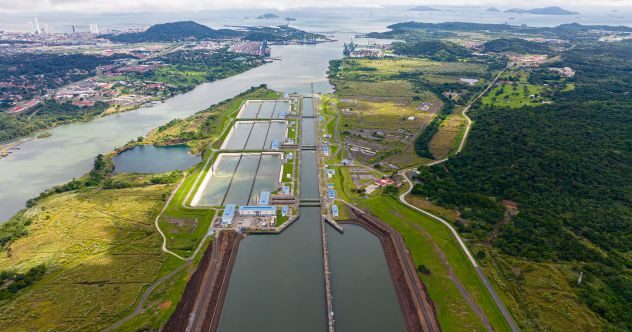
If you imagine ships floating smoothly through a flat ditch from one ocean to the other, the real canal has a surprise for you: ships climb. Not with engines roaring uphill, of course, but through a lock system that raises vessels from sea level to Gatun Lake, about 26 meters above sea level, and then lowers them back down on the other side.
The original locksGatun, Pedro Miguel, and Mirafloreswork like massive water elevators. A ship enters a chamber, gates close behind it, water flows in or out, and the vessel rises or descends step by step. It is elegant, slow-motion engineering. Think of it as an elevator for ships, except the passengers are container vessels, cruise ships, tankers, and the occasional yacht with a very good story to tell.
The system allows the canal to cross the Continental Divide without cutting a sea-level trench through the entire landscape. That decision made the project more achievable, although “more achievable” is doing a lot of work here. This was still one of the most difficult engineering projects ever completed.
3. Fresh Water Is the Canal’s Real Fuel
The Panama Canal runs on water, but not in the way people often assume. The locks use fresh water from Gatun Lake, and gravity does much of the work. When a lock chamber fills, water flows from the lake into the chamber. When it empties, water flows out. No giant pump is doing all the heavy lifting behind the curtain.
That makes Gatun Lake both a transportation tool and a precious resource. Every transit requires water, and the same watershed also supports communities, ecosystems, and Panama’s broader economy. In other words, the canal is not only an engineering system; it is a water management system wearing a captain’s hat.
This became especially important during the severe drought of 2023–2024, when lower water levels forced the Panama Canal Authority to limit daily transits and ship drafts. By 2026, the authority was allowing 38 daily ship passages and said it was not planning restrictions for the rest of the year, but the episode made one point very clear: even world-famous shortcuts depend on rain.
4. The French Tried Firstand the Jungle Won
Before the United States completed the Panama Canal, a French effort led by Ferdinand de Lesseps began in the late 19th century. De Lesseps was famous for the Suez Canal, so confidence was not in short supply. Unfortunately, Panama was not Egypt, and optimism does not drain swamps, stop landslides, or politely ask mosquitoes to leave.
The French attempted a sea-level canal, but the project ran into crushing problems: disease, difficult terrain, financial scandal, engineering miscalculation, and the brutal challenge of digging through tropical mountains and unstable soil. The effort collapsed before completion.
The French failure did not mean the dream was impossible. It meant the design, health measures, financing, and management had to change dramatically. When the United States later purchased the remaining French assets, it inherited both useful excavation work and a giant warning label: Panama was not going to be conquered by enthusiasm alone.
5. Mosquito Control Was as Important as Machinery
The story of the Panama Canal is often told with steam shovels, dynamite, railroads, concrete, and big men in hats pointing at maps. But public health was just as important as engineering. Yellow fever and malaria had devastated earlier workers, and controlling mosquito-borne disease became essential to finishing the canal.
Under the leadership of William Crawford Gorgas and other health officials, sanitation campaigns targeted mosquito breeding grounds. Workers drained standing water, fumigated buildings, screened living quarters, and improved public health systems in the Canal Zone. These efforts did not remove every danger, but they helped transform Panama from a construction nightmare into a place where the project could continue.
It is one of the canal’s most important lessons: infrastructure is never only concrete and steel. Sometimes the difference between failure and success has wings, bites ankles, and needs a puddle to reproduce.
6. The Human Cost Was Enormous
The Panama Canal is rightly admired as an engineering triumph, but that admiration should not erase the workers who paid for it with their health, safety, and lives. More than 40,000 laborers worked on the U.S. construction project, many of them from Barbados, Martinique, Guadeloupe, and other Caribbean communities.
The official U.S. construction death toll was 5,609 workers, though many historians believe the true human cost was higher. Disease, accidents, landslides, explosions, harsh labor conditions, and racial discrimination all shaped the workforce experience. The canal was not built by machines alone; it was built by people whose names are far less famous than the waterway they created.
That is why modern discussions of Panama Canal history increasingly include not just presidents, engineers, and treaty negotiators, but also the Afro-Caribbean laborers, nurses, doctors, cooks, clerks, railroad workers, and families who made the project possible.
7. Culebra Cut Was One of the Toughest Sections
The Culebra Cut, later also known as the Gaillard Cut, was the narrowest and most difficult part of the canal route. Workers had to carve through the Cordillera Central, a mountainous spine of rock, clay, and limestone. The goal was not just to dig a channel; it was to keep that channel from sliding back into itself like a stubborn cake batter.
Landslides were a constant problem. Rain softened slopes, blasting shook the terrain, and excavated material had to be hauled away continuously. The cut became a symbol of the entire project’s difficulty: humans versus geology, with geology putting up a very respectable fight.
Today, ships pass through this section as part of a normal transit, but the calm surface hides decades of struggle. When you see a vessel moving through the canal, remember that part of the route was not simply dug. It was argued out of the mountain, shovel by shovel and slide by slide.
8. The Canal Changed Who Controlled Panama’s Future
The Panama Canal was never just an engineering project. It was also a geopolitical story involving Colombia, Panama, France, and the United States. In 1903, after Panama declared independence from Colombia, the Hay-Bunau-Varilla Treaty gave the United States rights to build and control a canal zone across the isthmus. The agreement included a $10 million payment to Panama and an annual annuity.
For much of the 20th century, the United States controlled the canal and the surrounding Canal Zone. That arrangement became increasingly controversial in Panama, where many viewed it as a limit on national sovereignty. The Torrijos-Carter Treaties of 1977 created a path for gradually transferring control.
At noon on December 31, 1999, Panama took full control of the canal through the Panama Canal Authority. That moment was more than an administrative handover. It marked a major chapter in Panama’s national identity and economic future.
9. The Canal Had to Expand Because Ships Got Too Big
For decades, ship design was influenced by the canal’s original lock dimensions. The term “Panamax” came to describe vessels built to fit through the old locks. It was the maritime version of buying furniture based on the size of your apartment door.
But global trade kept growing, and container ships got larger. The canal needed more capacity and a way to handle bigger vessels, so Panama launched a major expansion project. The expanded canal opened to commercial traffic in 2016 with a new lane and larger locks capable of serving Neopanamax ships.
The expansion was not just about bragging rights for bigger boats. It changed shipping economics by allowing more cargo per transit, improving options for routes between Asia, the U.S. East Coast, Europe, and Latin America. It also helped Panama strengthen its role as a global logistics hub.
10. The Panama Canal Is Still Evolving
Some landmarks feel frozen in history. The Panama Canal is not one of them. It operates 24 hours a day, 365 days a year, serving thousands of ships annually across more than 180 maritime routes. It connects ports, supply chains, energy markets, agricultural exports, manufactured goods, and consumer products that eventually show up in stores, warehouses, factories, and homes.
Recent years have shown how sensitive the canal is to global events. Drought can limit water supply. Conflicts and disruptions in other shipping corridors can increase demand. Larger vessels require careful scheduling. Tolls, auctions, reservations, and draft limits all influence how companies plan their routes.
In fiscal year 2025, the canal reported revenue of about $5.7 billion and more than 13,000 vessel transits. That is a reminder that the Panama Canal is not merely a monument to the past. It is a living piece of world trade infrastructure, constantly adjusting to weather, markets, technology, and politics.
Why the Panama Canal Still Matters Today
The Panama Canal matters because distance matters. Cutting thousands of nautical miles from a voyage can save time, fuel, labor, insurance costs, and emissions. For companies, that can affect delivery schedules and prices. For countries, it can influence trade competitiveness. For consumers, it can quietly shape the availability and cost of goods.
The canal also matters because it shows how infrastructure creates ripple effects far beyond its physical location. A waterway in Central America can affect ports in the United States, exporters in South America, manufacturers in Asia, energy markets in Europe, and shipping schedules across the globe.
It is also a case study in the limits of human control. Engineers can design locks. Governments can sign treaties. Operators can schedule ships with impressive precision. But rainfall, watersheds, disease, geology, labor, and politics still shape the story. The Panama Canal is a reminder that great infrastructure is never finished once the ribbon is cut. It must be maintained, adapted, and respected.
Travel and Real-Life Experiences Around the Panama Canal
For travelers, the Panama Canal is one of those attractions that sounds educational and then unexpectedly becomes exciting. Watching a ship pass through the locks is oddly addictive. At first, it seems like nothing is happening. Then the water level shifts, gates open, tugboats move, locomotives guide, and a vessel the size of a floating neighborhood slides forward with the calm confidence of a shopping cart that somehow weighs 100,000 tons.
The Miraflores Visitor Center near Panama City is one of the most popular places to experience the canal. It offers observation decks where visitors can watch ships rise and fall through the locks. The best part is the scale. You can read measurements all day, but standing near a massive container ship makes the numbers feel real. The ship’s wall of steel passes so close that it feels less like transportation and more like a skyscraper politely drifting by.
A partial canal transit is another memorable experience. Instead of watching from the side, passengers ride through part of the waterway and feel the lock process from inside the chamber. The pace is slow, but that is the charm. The canal teaches patience. It is not a roller coaster. It is a giant mechanical ballet, and the choreography involves water, gravity, gates, pilots, tugboats, and a remarkable amount of coordination.
Travelers often combine a canal visit with nearby historical and natural sites. Panama City offers Casco Viejo, a colorful historic district with plazas, churches, restaurants, and restored colonial architecture. The Amador Causeway provides views of the skyline, the Pacific entrance, and ships waiting their turn. Soberanía National Park and the Pipeline Road area are excellent for birdwatching, proving that the canal region is not only about commerce but also biodiversity.
One practical tip: check ship schedules before visiting if possible. The locks are most interesting when vessels are moving through them. Without ships, the canal still has educational value, but the atmosphere becomes more “impressive concrete” than “global trade in action.” Comfortable shoes, sun protection, water, and a little patience will also help, because Panama’s heat can be enthusiastic.
Another useful experience is simply looking at the canal on a map before you go. Once you understand that the route is not a straight east-west cut, the geography becomes more interesting. You start to see Panama as a land bridge, a crossroads, and a place where oceans, continents, forests, cities, and ships all meet in a remarkably small space.
The Panama Canal also makes you think differently about everyday objects. A phone charger, a bag of coffee, a car part, a refrigerator, or a box of sneakers may have traveled through a system like this before reaching a shelf. The canal turns global trade from an abstract phrase into something visible. You watch one ship pass through and suddenly understand that supply chains are not invisible magic. They are routes, schedules, weather reports, workers, fuel, water, and decisions stacked on top of one another.
For families, students, history fans, engineering nerds, and casual travelers who just like big things doing big things, the Panama Canal delivers. It is educational without feeling like homework and impressive without needing special effects. The canal’s best trick is that it makes complex systems understandable. Water rises, gates open, ships move, and the world becomes a little more connected.
Conclusion
The Panama Canal is much more than a shortcut between oceans. It is a story of ambition, failure, adaptation, labor, science, sovereignty, and constant reinvention. From the French attempt and the deadly construction years to the U.S. era, the 1999 transfer to Panama, the 2016 expansion, and today’s water management challenges, the canal continues to shape how the world moves goods.
Its most surprising lesson may be that great engineering is never only about machines. The Panama Canal depends on people, politics, public health, rainfall, geography, and careful daily operation. That is what makes it not just one of the world’s most famous waterways, but one of its most fascinating.