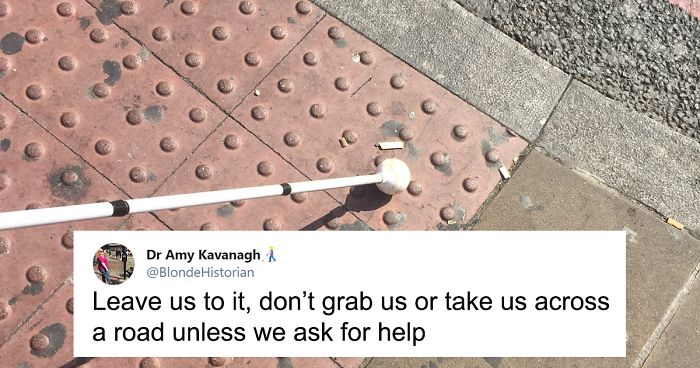
Most people have walked across tactile paving without giving it a second thought. You know the little bumpy panels at curb ramps, train platforms, and crosswalks? To many pedestrians, they are just “those sidewalk dots.” To blind and low-vision people, however, those dots can be the difference between confidently crossing a street and accidentally stepping into traffic. Tiny bumps, big job. Very underrated supporting character.
The viral conversation around a woman explaining tactile paving opened many people’s eyes to something blind pedestrians have known for years: public spaces are full of hidden barriers. A sidewalk may look “finished” to a sighted person, but if tactile paving is missing, blocked, worn down, installed incorrectly, or treated like decorative pavement confetti, it can become a navigation problem. Tactile paving is not a cute urban design flourish. It is safety information underfoot.
This article explains what tactile paving is, why it matters, what barriers blind individuals experience when it is ignored, and how better design can make streets safer for everyone. Because accessibility is not about special treatment. It is about giving people the information they need to move through the world without having to perform Olympic-level guesswork at every corner.
What Is Tactile Paving?
Tactile paving, also called detectable warning surfaces, tactile walking surface indicators, truncated domes, or tactile ground surface indicators, is a textured surface built into sidewalks, transit platforms, curb ramps, and other pedestrian areas. Its purpose is simple: communicate information through touch and visual contrast.
For blind pedestrians, tactile paving can be detected with a long white cane, underfoot, or sometimes by a guide dog’s trained response. For people with low vision, color contrast also matters. A bright yellow panel against dark pavement, for example, is easier to spot than gray bumps blending into gray concrete like a very unhelpful camouflage jacket.
In the United States, the most familiar type is the truncated dome surface. These are small, flat-topped bumps arranged in a grid pattern. They are commonly placed at curb ramps and blended transitions where the sidewalk meets a street. The message is not “walk this way.” The message is closer to “pay attention; you are approaching a hazard or vehicle area.”
Why Tactile Paving Matters For Blind And Low-Vision Pedestrians
Imagine walking through a busy city without relying primarily on sight. You are listening for traffic flow, detecting surface changes through a cane, remembering landmarks, avoiding outdoor dining furniture, dodging scooters, tracking curb lines, and trying to figure out whether that rumbling sound is a bus, a truck, or someone’s suitcase wheels having a dramatic moment.
Now remove the curb. Many modern curb ramps are built flush with the street so wheelchair users, stroller users, and people with mobility aids can cross more easily. That smooth transition is essential. But it also removes a major tactile cue that blind pedestrians historically used to know where the sidewalk ended and the roadway began. Tactile paving restores that missing warning cue.
That is the beauty of good inclusive design: one accessibility improvement should not erase another. A ramp helps people using wheels; detectable warnings help people who cannot visually detect the edge. Together, they create a crossing that works for more bodies, more abilities, and more real-life situations.
The Woman Who Made The Sidewalk Make Sense
The story that inspired this topic centered on a visually impaired woman sharing practical information about tactile paving and the barriers blind people experience in public spaces. Her explanation resonated because it translated a familiar street feature into everyday human terms. Instead of presenting tactile paving as a technical object, she described it as a clue system.
That framing matters. Many sighted pedestrians assume accessibility features are obvious, standardized, and always helpful. Blind and low-vision people know the reality is messier. A tactile panel can signal a crossing, a platform edge, a hazard, or a route change. But when panels are misplaced, inconsistent, too worn to feel, or blocked by parked scooters and sandwich boards, the “clue” turns into a prank. And not the fun kind where everyone laughs afterward.
Her educational approach also highlighted a bigger truth: blind people are constantly doing environmental analysis. They are not simply “walking.” They are reading the ground, sound, air movement, building lines, traffic patterns, and memory. Tactile paving is one part of that literacy system.
How Blind Individuals Use Tactile Paving In Real Life
1. Detecting Curb Ramps And Street Edges
At intersections, truncated domes warn pedestrians that they are leaving the sidewalk and entering an area where vehicles may move. This is especially important at curb ramps, where the pavement may slope gently and the traditional curb edge may disappear.
2. Identifying Transit Platform Edges
On train and subway platforms, tactile warning strips help alert blind and low-vision passengers that they are near the platform edge. That warning is not decorative. It is a vital safety feature in an environment full of noise, crowds, announcements, and moving trains.
3. Understanding Shared Streets And Complex Crossings
Shared streets, plazas, and curb-free designs can look sleek in architectural renderings. In real life, they can remove important cues. Without curbs, clear boundaries, detectable warnings, and audible traffic patterns, blind pedestrians may struggle to know where pedestrian space ends and vehicle space begins.
4. Supporting Orientation And Confidence
Tactile paving gives pedestrians information before they are forced to make a risky decision. It can help a cane user slow down, locate a crossing zone, or confirm that they are approaching a known hazard. Confidence is not a luxury in mobility. It is part of safety.
Common Barriers Blind People Experience With Tactile Paving
Blocked Tactile Paving
One of the most common problems is obstruction. Delivery bikes, scooters, trash bins, signs, restaurant tables, construction cones, and parked vehicles often block tactile surfaces. To a sighted person, this may look like minor clutter. To a blind pedestrian, it can erase the only reliable clue at that spot.
Worn Or Damaged Surfaces
Tactile paving must be detectable. If the domes are worn flat, cracked, loose, icy, or covered in debris, they lose their purpose. A detectable warning that cannot be detected is basically a sidewalk shrug.
Poor Color Contrast
Many people with vision impairment have some usable vision. High contrast helps them detect warning surfaces visually. When cities choose low-contrast materials for aesthetic reasons, the paving may look “tasteful” while becoming less useful. Accessibility should not lose a fight against beige.
Incorrect Placement
Tactile paving needs to be placed where it communicates accurate information. If it is too far from the hazard, angled strangely, placed only on part of a crossing, or installed where no crossing exists, it can confuse rather than help.
Inconsistent Patterns
Consistency matters. If one city uses tactile paving one way and another city uses it differently, blind travelers must constantly relearn the sidewalk. That creates stress, slows movement, and increases dependence on strangers or apps.
Construction Zones Without Safe Alternatives
Construction can temporarily destroy accessible routes. When crews block tactile paving without providing a safe, detectable alternate path, blind pedestrians may be forced into traffic, uneven ground, or confusing detours.
Why “Just Ask For Help” Is Not A Real Accessibility Plan
People often say, “Well, someone can help.” Sometimes, yes. Many people are kind. But independence should not depend on whether a helpful stranger happens to be nearby, not in a hurry, and not weirdly determined to grab someone’s arm without asking.
The better approach is to design spaces so blind people can navigate independently first. Help should be available when requested, not required because the built environment failed. A city that forces disabled people to rely on random acts of rescue is not accessible. It is just outsourcing design problems to whoever is standing near the crosswalk.
How To Interact Respectfully With A Blind Pedestrian
If you see a blind or low-vision person near tactile paving, do not assume they are lost. They may be pausing to read the environment. They may be listening for traffic. They may be waiting for the right moment to cross. Or they may simply be existing in public, a shocking concept.
If you think someone may need help, ask first. Try: “Would you like assistance?” If they say no, believe them. If they say yes, ask how they would like to be guided. Never grab a cane, harness, backpack, sleeve, or arm without permission. Surprise-grabbing a blind person is not helpful; it is how you become the villain in their afternoon.
What Cities And Property Owners Should Do Better
Install Detectable Warnings Correctly
Tactile paving should follow recognized accessibility standards for placement, dimensions, texture, and contrast. It should be installed across the full crossing area where appropriate, not sprinkled randomly like safety-themed confetti.
Maintain It Like Safety Infrastructure
Detectable warnings should be inspected, cleaned, repaired, and replaced when damaged. Cities maintain traffic lights because they matter. Tactile paving matters too.
Keep It Clear
Businesses, contractors, and residents should never place objects on tactile paving. Sidewalk clutter is not harmless when it blocks accessible information. A sandwich board advertising half-price tacos may be delicious, but it should not turn a curb ramp into an obstacle course.
Use Strong Visual Contrast
Contrast helps low-vision pedestrians identify tactile surfaces faster. Designers should prioritize function over a perfectly matched streetscape palette. Accessibility is not ugly. Bad design is ugly.
Consult Blind And Low-Vision People
No spreadsheet can replace lived experience. Cities should include blind pedestrians, orientation and mobility specialists, disability advocates, and access consultants in planning and review processes.
Why Tactile Paving Helps More Than One Group
Although tactile paving is designed primarily for blind and low-vision pedestrians, it can help many others. Distracted pedestrians may notice the change underfoot. Tourists may recognize the edge of a transit platform. Older adults may use contrast as a cue. Children may learn that the bumpy area means “pause and pay attention.”
That said, accessibility features must also consider people with mobility disabilities. Some raised surfaces can be uncomfortable for wheelchair users, walker users, or people with balance challenges if installed poorly or overused. The answer is not to remove tactile paving. The answer is careful design that balances detectability, safety, comfort, and durability.
The Bigger Lesson: Accessibility Is Information
When sighted people navigate, visual information is everywhere: signs, arrows, traffic lights, crosswalk paint, curb lines, storefronts, landmarks, and the behavior of other pedestrians. Blind people need equivalent information in nonvisual formats. Tactile paving is one of those formats.
Thinking of accessibility as information changes the conversation. A missing tactile panel is not a small construction detail. It is missing data. A blocked curb ramp is not a little inconvenience. It is a broken message. A worn platform warning strip is not cosmetic damage. It is a safety failure.
Real-World Experiences: What Tactile Paving Can Feel Like Day To Day
Picture a blind commuter named Maya leaving her apartment on a rainy Monday morning. The city is loud, umbrellas are everywhere, and every car seems to be auditioning for a role as “background chaos.” Maya uses a long cane in constant contact with the ground. The cane tip slides over concrete, taps a utility cover, finds a crack, and then suddenly rolls over a field of truncated domes. That texture tells her she has reached the curb ramp. She pauses, listens, aligns herself, and waits for the crossing signal.
On a good day, tactile paving gives Maya useful confirmation. She already knows the intersection, but the domes tell her exactly where the sidewalk transitions into the street. On a bad day, the same panel might be half-covered by leaves or blocked by a delivery scooter. Now she has to problem-solve. Is she at the curb? Is the scooter in the crossing path? Does she step around it and risk drifting toward traffic? A sighted person might see the scooter and roll their eyes. Maya has to negotiate with it like it is a tiny metal gatekeeper.
Another experience happens at transit stations. A low-vision traveler may use the bright edge warning to stay a safe distance from the platform. But if the warning strip is faded, dirty, or visually similar to the surrounding floor, the cue becomes harder to use. In crowded stations, people often stand directly on tactile strips, unaware that they are occupying an important safety zone. Nobody means harm, but the result is still a barrier.
Then there are new places: airports, college campuses, hospitals, stadiums, and downtown plazas. Unfamiliar environments demand extra concentration. Tactile paving can reduce that mental load. It says, “Here is a crossing,” “Here is a platform edge,” or “Slow down; something changes here.” Without those cues, a blind pedestrian may need more time, more assistance, or more emotional energy to do the same trip.
These experiences show why tactile paving is not just about pavement. It is about dignity. It allows people to travel without explaining themselves, asking permission, or hoping the sidewalk has a generous mood today. When tactile paving is designed well and kept clear, it becomes almost invisible to people who do not need it and quietly powerful for people who do.
Conclusion: Tiny Sidewalk Bumps, Massive Accessibility Message
The woman who educated people about tactile paving did more than explain a sidewalk feature. She revealed how much information sighted people take for granted and how many barriers blind individuals manage every day. Tactile paving is a small physical detail with a large social meaning: public space should communicate with everyone.
Good tactile paving helps blind and low-vision pedestrians identify hazards, locate crossings, navigate transit spaces, and move with greater independence. Bad tactile paving, blocked tactile paving, or missing tactile paving sends the opposite message: this space was not designed with you in mind.
The fix is not mysterious. Install detectable warnings correctly. Maintain them. Keep them clear. Use strong contrast. Ask disabled people what actually works. And the next time you stand on those bumpy sidewalk panels, remember: they are not random dots. They are a language. Someone else may be reading it with their cane, their feet, or their remaining vision. Please do not park a scooter on the sentence.