Before projectors became lightweight boxes that sit politely on conference tables, there was a breed of machine that looked as if it had been designed by a cinema engineer, a television scientist, and a mildly unhinged submarine mechanic after too much coffee. The Eidophor projector was one of those machines. It used hot oil, high voltage, an electron beam, a powerful lamp, vacuum hardware, precision optics, and enough mechanical complexity to make a modern HDMI cable blush.
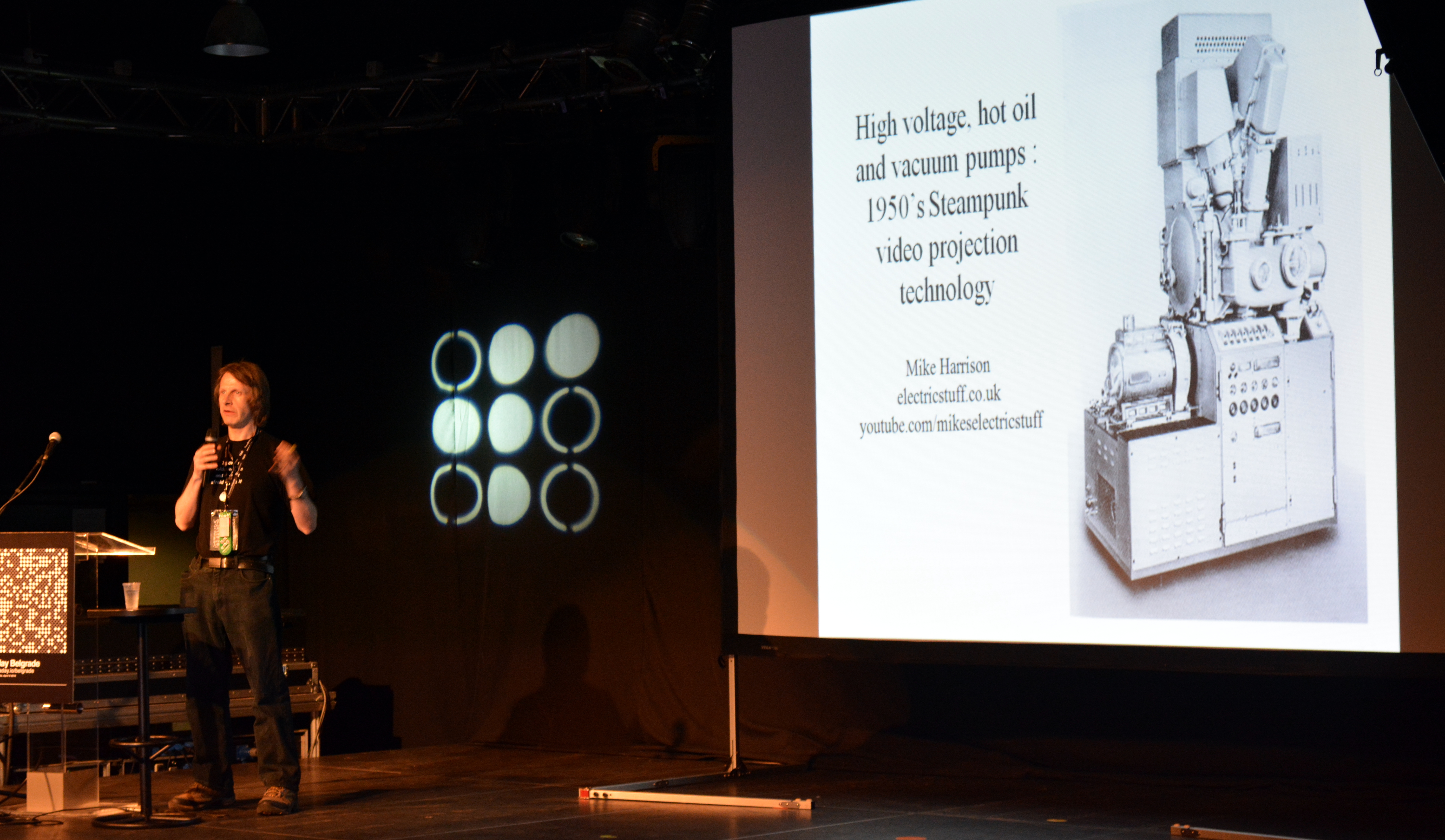
That is why Mike Harrison’s exploration of this ancient live projector remains so fascinating. Harrison, known for digging into rare, strange, and beautifully over-engineered electronics, helped bring renewed attention to the Eidophor: a large-screen video projection system that once solved a very serious problem. How do you project live television or real-time data onto a theater-sized screen before LCD, DLP, or affordable digital projection exists?
The answer was not simple. In fact, it was delightfully ridiculous. The Eidophor did not merely “display” a picture. It sculpted an image into a thin film of oil using electric charge, blasted light at it, and turned tiny surface ripples into a giant moving picture. In other words, it was part projector, part chemistry experiment, part high-voltage science fair, and part industrial beast.
The Forgotten Giant Of Live Video Projection
The Eidophor was developed to solve a brightness problem. Early television screens were cathode-ray tubes, and while CRTs worked well for living rooms, they were not bright enough to light up a cinema screen or a large control-room display. If engineers tried to drive CRT projectors harder, they ran into serious limits: heat, fragile components, dangerous voltages, poor brightness, and, in some cases, radiation concerns.
Film projectors could easily fill a theater with light, but film was not live. You could not project a breaking news broadcast, a rocket launch feed, or real-time data from a mission control console by waiting for someone to develop a reel. The world needed a way to combine the brightness of a cinema projector with the instant update speed of television.
The Eidophor was that bridge. Invented in Switzerland and refined over decades, it became one of the most impressive large-screen projection technologies of the twentieth century. It was used in serious environments: aerospace, broadcast, universities, military simulation, and large public events. This was not a cute gadget for movie night. This was the kind of machine that required trained operators, careful maintenance, and probably a personality test before you were allowed near the power switch.
Why Mike Harrison’s Take Matters
Mike Harrison’s interest in the Eidophor is not just nostalgia. It is a reminder that many “obsolete” machines are forgotten not because they were bad, but because their replacements were easier, cheaper, and smaller. The Eidophor was not defeated by a single flaw. It was defeated by progress: LCD projectors, DLP systems, compact optics, digital signal processing, and light engines that did not require a small army to keep them happy.
Harrison’s work is valuable because he treats strange engineering with the respect it deserves. He does not simply point and laugh at the hot oil and high voltage, although, to be fair, both are extremely point-and-laugh-worthy from a modern consumer electronics perspective. Instead, he shows how much intelligence went into making the system work. The Eidophor was complicated because the problem was complicated.
Today, people complain when a projector remote needs two AAA batteries. The Eidophor required precision oil control, a high-voltage electron gun, a powerful light source, delicate optical alignment, and environmental cleanliness. One speck of contamination in the oil could show up as an artifact in the image. That is not a bug; that is a diva with optics.
How The Eidophor Projector Worked
The basic idea behind the Eidophor was brilliantly strange. Instead of projecting light through film, the machine used a thin layer of transparent oil as the image medium. This oil film sat on a rotating mirrored surface or optical element. An electron beam scanned across the oil, depositing electrical charges in patterns that matched the video signal.
Those charges caused tiny deformations on the oil surface. The oil became microscopically corrugated, like a miniature landscape of waves and ridges. When intense light hit the surface, those ridges changed the direction of the light. In areas where the oil remained smooth, light went one way; where the electron beam had written an image into the oil, light was redirected through the projection optics.
This is where the magic happened. The Eidophor used optical principles similar to Schlieren systems, which are designed to make tiny changes in light direction visible. The result was a bright, large image controlled by a live video signal. The machine was not storing pictures as pixels in memory. It was physically writing and erasing the picture on a moving oil film in real time.
The Oil Was The Screen Before The Screen
In modern digital projectors, a chip or LCD panel modulates light. In the Eidophor, the oil film did that job. The oil had to be smooth, stable, clean, and predictable. It had to respond to electrical charge but also reset quickly for the next frame. A rotating mechanism carried the oil through the active image area, and a doctor blade or similar smoothing system prepared the surface for reuse.
That sounds simple until you remember that the whole process had to happen reliably, inside specialized hardware, under harsh optical and electrical conditions. If the oil was contaminated, the image suffered. If the alignment drifted, the picture suffered. If the high-voltage system misbehaved, everyone in the room suddenly remembered they had urgent business somewhere else.
The Electron Beam Was The Pen
The electron gun worked like a writing instrument. It scanned the image onto the oil surface line by line. The electrical charge changed the oil’s shape, and the light system converted that shape into brightness on the screen. The process was analog, physical, and precise. It was also gloriously high-maintenance.
Compared with modern projectors, the Eidophor feels almost theatrical. A DLP projector uses millions of microscopic mirrors tilting at high speed. A 3LCD projector splits white light into red, green, and blue paths and modulates each with LCD panels. The Eidophor, meanwhile, says, “What if we draw television into oil with electrons?” It is hard not to admire that level of engineering confidence.
Hot Oil And High Voltage: A Beautifully Dangerous Combination
The phrase “hot oil and high voltage” sounds like the warning label on a machine built by a villain with an electrical engineering degree. Yet these were real parts of the Eidophor’s operating world. The system relied on high-voltage electronics to control the electron beam and powerful illumination to generate a screen-filling image. Heat management, electrical insulation, optical cleanliness, and operator safety were not optional details. They were survival skills.
The lamp system alone was serious business. Large projection lamps, especially xenon arc lamps used in many high-brightness systems, involve intense light, heat, pressure, and ultraviolet radiation hazards. High-voltage circuits can also retain stored energy in capacitors after power is removed, which is why professional electrical safety procedures emphasize discharging and grounding energy-storage components before work begins.
This is one reason the Eidophor inspires such awe. It was not only a clever optical invention; it was a full industrial system. It combined optics, vacuum technology, electronics, fluids, mechanics, thermal control, and human discipline. In modern terms, it was not “plug and play.” It was “plug, calibrate, monitor, pray politely, and keep the manual nearby.”
Why Not Just Use A CRT Projector?
The obvious question is: if televisions already used CRTs, why not simply make a giant CRT projector? Engineers tried. The problem was brightness. A CRT produces light when an electron beam strikes phosphor, but scaling that up for a large screen was difficult. Push it too hard and you created heat, wear, electrical stress, and other hazards.
The Eidophor separated image creation from light generation. The electron beam did not need to create all the light directly. It only needed to shape the oil surface. The heavy lifting of brightness came from a powerful external lamp, much like in a film projector. That was the key insight. Use electronics to define the image, but use a serious optical lamp to illuminate it.
This made the Eidophor far brighter than many competing approaches of its era. It could serve large audiences and mission-critical rooms where tiny dim screens were not acceptable. Think of NASA mission control, military briefings, or large broadcast displays. When a room full of engineers needed to see the same live information, the Eidophor could deliver.
Eidophor At NASA And Other Big-Screen Environments
One of the most famous contexts for Eidophor-style projection was spaceflight. NASA control centers required large, shared displays for video feeds, data, maps, and mission status. During the Apollo era and beyond, large-screen projection was a crucial part of the visual language of mission control. Rows of consoles, giant boards, glowing displays, and a room full of people pretending not to be nervous: this was the theater of engineering.
The Eidophor fit that world because it could project live video at a scale that ordinary televisions could not match. It also found uses in universities, event production, flight simulation, television studios, and large venues. Long before LED walls became common, these projectors helped create the shared-screen experience we now take for granted.
Today, a stadium can use enormous LED displays. A classroom can use a bright LCD projector. A conference room can cast wirelessly from a laptop. But in the Eidophor era, large-screen live video required heavy machinery, deep knowledge, and patience. The result was impressive, but the path to get there was not exactly “tap to connect.”
The GE Talaria And The Family Tree Of Light-Valve Projectors
The Eidophor was not the only oil-based light-valve projector concept. General Electric later introduced the Talaria, another large-venue video projector that used a related principle: an electron beam modulated an oil film, and the optical system transformed that modulation into a projected image. The Talaria refined and adapted the idea for later professional applications.
These systems belong to a fascinating family of projection technologies that solved image display by controlling light rather than generating it directly. That same broad concept survives today in cleaner, smaller forms. DLP projectors use microscopic mirrors to direct light. LCD and 3LCD projectors use liquid crystal panels to regulate light transmission. The tools changed, but the core question remained: how do you control a powerful beam of light quickly enough to create moving images?
The Eidophor answered with oil and voltage. DLP answered with micromirrors. LCD answered with liquid crystals. Modern engineers may have tidier desks, but they are still wrestling with the same ancient beast: light does not behave just because you ask nicely.
Why The Eidophor Disappeared
The Eidophor did not vanish because it was unimpressive. It vanished because newer technologies made the same job easier. LCD and DLP projectors were smaller, cheaper, more reliable, and far easier to operate. They did not need rotating oil systems, intensive calibration, or specialized operators. They could be sold to offices, schools, churches, homes, and theaters at scale.
Progress often looks like simplification. A technology that once required specialists becomes something an intern can set up before a meeting. That is wonderful for productivity, but it also erases the drama. Nobody writes heroic engineering ballads about selecting “HDMI 2” from an input menu.
The Eidophor, by contrast, had drama built into its bones. It represented an era when making live video big enough for a crowd required imagination and courage. The machine was not elegant in the consumer sense, but it was elegant in the engineering sense: every strange part had a reason to exist.
What Modern Makers Can Learn From Mike Harrison’s Ancient Projector Obsession
Mike Harrison’s investigation of the Eidophor offers several lessons for makers, engineers, and technology fans. First, old technology is not primitive technology. Many vintage systems are complex because they solved hard problems with the materials and methods available at the time. Dismissing them as outdated misses the point.
Second, documentation matters. A machine as complex as the Eidophor becomes almost mythical when manuals disappear, technicians retire, and spare parts vanish. Harrison’s search for details is also a search for memory. Without people preserving these stories, major engineering achievements can become footnotes.
Third, physical computing is beautiful. The Eidophor reminds us that images are not only data. They can be charge, oil, light, heat, motion, vacuum, and glass. In a world of invisible cloud services and sealed devices, the Eidophor feels refreshingly tangible. You can understand it because it forces you to confront its machinery.
Specific Example: The Oil Film As An Analog Pixel Engine
A useful way to understand the Eidophor is to think of the oil film as an analog ancestor of a pixel engine. In a modern projector, each pixel is controlled electronically. In a DLP system, tiny mirrors tilt to send light toward or away from the lens. In an LCD system, liquid crystal elements allow more or less light to pass.
In the Eidophor, the electron beam created a continuously varying physical relief pattern. The image was not divided into neat digital squares. Instead, the beam produced fine surface distortions in the oil. Those distortions controlled how much light reached the screen. It was not digital, but it was dynamic, fast, and effective.
That makes the machine feel oddly futuristic even today. It was a real-time analog light modulator using a liquid surface. If someone pitched that as a new experimental art installation now, people would call it innovative and ask whether it accepts cryptocurrency. The Eidophor was doing the hard part decades ago, wearing industrial gray and asking for three-phase power.
The Charm Of Ridiculous Engineering
There is a special joy in machines that are obviously difficult but still work. The Eidophor has that joy. It is the same feeling people get from steam locomotives, mechanical television, early computers, and giant analog synthesizers. These devices are not convenient, but they reveal their thinking. You can see the compromises, the risks, the cleverness, and the ambition.
Mike Harrison’s fascination with the Eidophor makes sense because the projector sits at the intersection of all the good stuff: high voltage, optics, vintage electronics, real-time video, and slightly terrifying mechanical design. It is educational, impractical, and magnificent. In other words, perfect.
Experience Notes: What Working Around Vintage Projection Teaches You
Anyone who has spent time around vintage audio-visual equipment knows the experience is very different from handling modern electronics. New devices hide their complexity. Old devices announce it. You hear relays click, fans spin up, transformers hum, and mechanisms settle into motion. A vintage projector does not simply turn on; it wakes up like a large animal deciding whether it trusts you.
That is especially true for systems in the Eidophor family. Even when studying them from documentation, restoration videos, conference talks, and surviving photographs, you quickly develop respect for the operators who kept them running. These were not casual appliances. They were systems with moods. Oil quality mattered. Temperature mattered. Alignment mattered. The lamp mattered. The electrical supply mattered. Cleanliness mattered so much that dust could become part of the picture, which is a poetic way of saying maintenance was probably not relaxing.
One practical lesson from vintage projection is patience. Modern troubleshooting often begins with software: restart the device, update firmware, change the cable, blame the dongle, repeat. With older machines, the process is more physical. You inspect surfaces, check insulation, listen for mechanical faults, measure voltages carefully, and look for evidence of heat stress. The machine teaches you to slow down.
Another experience is humility. It is easy to assume that older engineers were working with crude tools. Then you study something like the Eidophor and realize they were doing advanced light modulation with oil, vacuum hardware, and high-voltage scanning. That is not crude. That is wizardry with a purchase order.
There is also a strong safety lesson. Vintage high-voltage equipment should never be treated like harmless hobby gear. Capacitors can store charge after power is removed. Projection lamps can be hot, bright, pressurized, and hazardous. Oil-filled high-voltage assemblies can create messes and risks if handled poorly. The correct emotional state near such hardware is curiosity mixed with caution, not bravery mixed with a screwdriver.
Finally, vintage projectors teach appreciation for invisible labor. The audience sees an image. The operator sees everything required to make that image behave. Behind every large, bright picture from an ancient live projector was a chain of people who understood optics, electronics, maintenance, and timing. Mike Harrison’s attention to the Eidophor honors that hidden craft. He reminds us that technology history is not just about famous inventions. It is also about the strange, heavy, hot, humming machines that made impossible things visible.
Conclusion: The Ancient Live Projector Still Has Something To Say
The story of Mike Harrison and the ancient live projector is more than a quirky tale about hot oil and high voltage. It is a window into a moment when engineers had to invent a new path between television and cinema. The Eidophor was large, expensive, demanding, and occasionally absurd, but it solved a real problem with remarkable creativity.
Its legacy lives on in every modern projector that modulates light instead of generating the whole image directly. DLP micromirrors, LCD panels, LED walls, and laser projectors may be cleaner and more convenient, but they owe something to the same engineering instinct: take control of light, shape it quickly, and make information visible to a crowd.
That is why the Eidophor deserves attention. It was not merely an obsolete projector. It was a heroic machine from the age when live large-screen video required oil, voltage, glass, mirrors, and nerve. Mike Harrison exposed the weirdness, but he also exposed the brilliance. And honestly, if your projector does not involve at least one component that sounds like it belongs in a mad scientist’s kitchen, can you even call it dramatic?