Disability etiquette is not a secret handshake, a complicated rulebook, or a test designed to catch people using the wrong fork at dinner. It is the everyday practice of treating disabled people with dignity, communicating directly, respecting personal choices, and removing barriers that make participation unnecessarily difficult.
That sounds simple. Yet awkward assumptions still appear in workplaces, schools, stores, medical offices, social events, and digital spaces. Someone grabs a wheelchair without permission. A receptionist directs every question to a companion. A meeting organizer remembers the coffee, projector, and decorative name tags but forgets captions. These moments may seem small to the person causing them, but repeated over time, they can communicate a much larger message: “This space was not designed with you in mind.”
Understanding why disability etiquette matters helps replace uncertainty with respect. More importantly, it turns inclusion from a cheerful slogan into something people can actually experience.
What Is Disability Etiquette?
Disability etiquette refers to respectful ways of interacting and communicating with people who have physical, sensory, intellectual, developmental, cognitive, psychiatric, or other disabilities. It applies whether a disability is visible, partially visible, temporary, episodic, or completely apparent only when someone chooses to disclose it.
The foundation is not memorizing a separate script for every diagnosis. It is recognizing disabled people as individuals with their own preferences, boundaries, expertise, personalities, jobs, bad jokes, excellent jokes, and opinions about office thermostats.
Respect Comes Before Assistance
Many etiquette mistakes begin with a good intention that skips an important step: consent. Helping without asking can interfere with a person’s balance, mobility, concentration, communication method, or carefully planned routine.
A better approach is straightforward: “Would you like assistance?” If the answer is yes, ask how to help. If the answer is no, accept it without taking offense. Unrequested help is not automatically helpful, just as an unrequested sandwich is not automatically lunch.
Individual Preference Matters More Than Assumptions
Two people with the same disability may use different technology, communication styles, mobility devices, terminology, or accommodations. One Deaf person may use American Sign Language, while another may prefer captions, lip reading, spoken communication, or a combination. One blind person may welcome verbal directions, while another may use a navigation app and require no assistance.
Good disability etiquette therefore depends on asking respectful questions rather than treating a disability label as an instruction manual.
Why Disability Etiquette Matters in Everyday Life
It Protects Dignity and Personal Autonomy
Autonomy means having control over one’s body, decisions, property, communication, and movement. Basic etiquette supports that control. Touching someone’s wheelchair, cane, walker, communication device, or service animal without permission can be intrusive because these tools are closely connected to the person’s independence.
Respecting autonomy also means speaking directly to the disabled person rather than automatically addressing a family member, interpreter, support professional, or personal care attendant. A companion may assist with communication, but the person with the disability remains the central participant in the conversation.
It Reduces Social Barriers
Disability is not experienced only through a health condition or physical difference. Social attitudes and environmental barriers can create just as many restrictions. An employee may be fully qualified for a presentation but excluded when the virtual platform lacks captions. A customer may be ready to make a purchase but unable to enter because boxes block the accessible route. A patient may understand complex medical information perfectly well but be treated like a child because of a speech disability.
Disability awareness helps people notice these barriers before they become someone else’s exhausting problem to solve.
It Creates Trust
Trust grows when people know they will be heard without being patronized, doubted, rushed, or forced to explain private medical information. In customer service, health care, education, and employment, respectful interaction can determine whether someone feels safe enough to ask questions, request an accommodation, report a problem, or return in the future.
An organization can publish a beautifully designed inclusion statement, but if a staff member rolls their eyes at an accommodation request, the statement becomes expensive wallpaper.
It Improves Safety
Accessible communication can become critical during medical visits, emergencies, evacuations, security screenings, and public alerts. Instructions given only through loudspeaker announcements may not reach people who are Deaf or hard of hearing. Visual-only evacuation instructions may not serve blind people. Complex language may create confusion for people with certain cognitive disabilities or for anyone under severe stress.
Providing information in multiple formats is not excessive politeness. In some situations, it is a safety measure.
Practical Disability Etiquette Guidelines
Speak Directly to the Person
Maintain ordinary eye contact when culturally appropriate and address the disabled person directly. Do not ask a companion, “What would she like?” when the person is standing right there. Interpreters facilitate communication; they do not replace the individual.
Use a natural tone and normal adult vocabulary unless the person requests a different communication style. Disability does not automatically affect intelligence, and speaking more loudly does not magically make a sentence more understandable.
Ask Before Touching or Helping
Never push a wheelchair, take someone’s arm, move a walker, or relocate a cane without permission. Moving mobility equipment can leave a person stranded or create a fall risk.
When guiding a blind or low-vision person, offer your arm rather than grabbing theirs. Let the person decide whether to accept. Describe relevant obstacles such as stairs, narrow passages, curbs, revolving doors, or unexpectedly adventurous furniture placement.
Respect Mobility Devices as Personal Space
Wheelchairs and other mobility devices are not public furniture. Do not lean on them, hang a bag from them, rest a drink on them, or move them to “make more room.” During longer conversations with a wheelchair user, sitting nearby may make communication more comfortable, but there is no need to dramatically drop to one knee like a knight requesting a royal blessing.
Do Not Distract a Service Animal
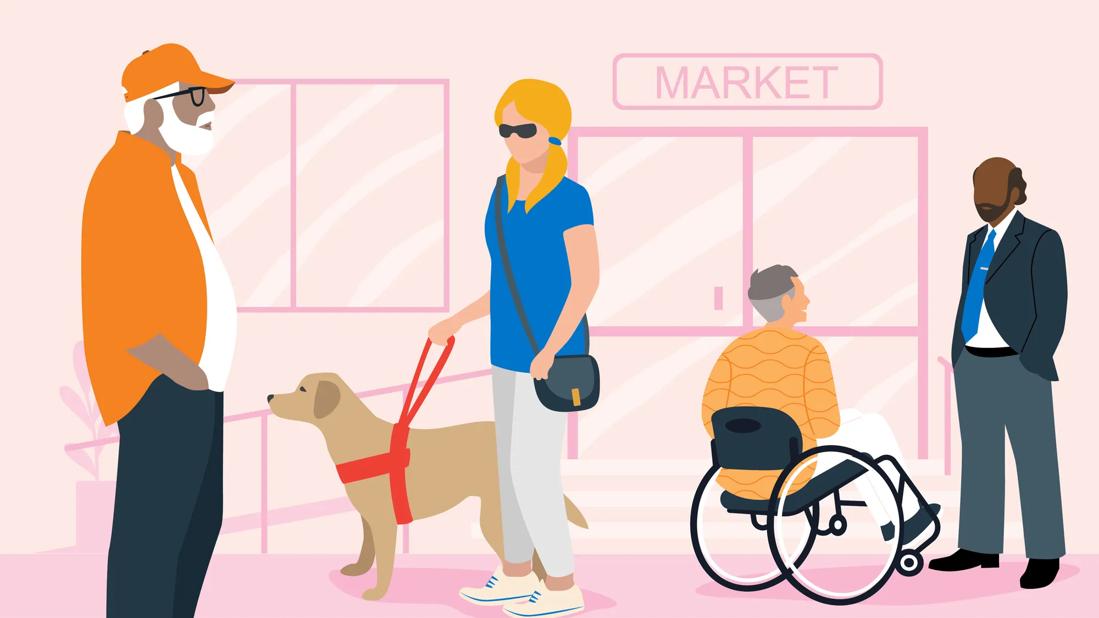
A service animal is working, even when it looks exceptionally pettable. Do not touch, call, feed, photograph, whistle at, or otherwise distract the animal without the handler’s permission. Speak to the handler, not the animal.
It is also inappropriate to demand personal details about a person’s disability. In public-facing settings, staff should understand the limited questions permitted under applicable disability law and avoid turning an ordinary visit into an amateur medical investigation.
Communicate Respectfully with Deaf and Hard-of-Hearing People
Ask which communication method works best. Face the person, keep your mouth visible, and avoid speaking while turning away. Shouting can distort speech and may not help. Depending on the setting and the individual, effective communication may involve qualified sign language interpreters, real-time captions, assistive listening systems, written notes, accessible video, or other tools.
Automatic captions can be useful, but they should not automatically be treated as a perfect replacement for professional communication access, especially in medical, legal, employment, or highly technical conversations.
Give People with Speech Disabilities Time
Listen patiently without finishing sentences unless invited to do so. If you do not understand, say so respectfully and ask the person to repeat or rephrase. Pretending to understand may feel polite for three seconds and become very unhelpful immediately afterward.
Some people communicate through augmentative and alternative communication devices. Allow enough time for them to compose a response, and maintain the conversation with the person rather than focusing on the device.
Use Clear Language Without Infantilizing
Plain language can help people with intellectual, developmental, learning, or cognitive disabilities, as well as people processing unfamiliar information. Present one idea at a time, explain specialized terms, and use visual or written information when useful.
Clarity should not become condescension. Speak to adults as adults. A person who needs additional processing time does not necessarily need baby talk, exaggerated praise, or a voice usually reserved for an unusually talented puppy.
Respectful Disability Language Is Not One-Size-Fits-All
Language affects how society understands disability, but preferences are not universal. Some individuals prefer person-first language, such as “person with a disability.” Others prefer identity-first language, such as “disabled person,” “Autistic person,” or “Deaf person,” because disability is understood as an important part of identity and community.
The safest practice is to follow the language used by the individual or community. When possible, ask. Avoid outdated or demeaning expressions, dramatic descriptions of people as helpless, and inspirational language that treats ordinary activities as heroic simply because a disabled person performed them.
Expressions such as “wheelchair-bound” can also create misleading images. Wheelchairs commonly provide freedom, mobility, and independence. “Wheelchair user” is generally more accurate.
Ordinary expressions such as “see you later” or “let’s take a walk through the plan” usually do not require frantic correction when speaking with someone who is blind or uses a wheelchair. Natural conversation is generally preferable to verbal gymnastics.
Disability Etiquette in the Workplace
Workplace disability inclusion involves more than hiring a diverse team. It includes accessible recruitment, interviews, meetings, technology, training, professional development, social events, and promotion pathways.
Treat Accommodation Requests as Normal Business
A reasonable accommodation is a change that helps a qualified employee or applicant access the hiring process, perform essential job functions, or receive equal workplace benefits. Examples may include modified schedules, accessible software, interpreters, captioning, ergonomic equipment, telework, written instructions, or changes to nonessential procedures.
Managers should respond promptly, protect confidentiality, and discuss effective options with the individual. Coworkers do not need access to someone’s medical details merely because they are curious about a flexible schedule or different piece of equipment.
Design Meetings for Participation
Accessible meetings may require captions, interpreters, accessible documents, readable slides, microphone use, keyboard-accessible platforms, advance materials, quiet spaces, or breaks. Speakers should identify themselves when needed and describe meaningful visual information rather than saying, “As everyone can clearly see from this microscopic chart.”
Building access in from the beginning is usually more effective than scrambling after someone reports a barrier five minutes before the meeting starts.
Digital Disability Etiquette Also Matters
Modern interaction frequently happens through websites, apps, documents, email, social media, and video. Digital accessibility is therefore part of respectful communication.
Useful practices include writing meaningful alternative text for informative images, adding accurate captions and transcripts, using descriptive link text, ensuring keyboard navigation, maintaining readable contrast, structuring pages with proper headings, and avoiding content that flashes or moves without user control.
Alternative text should communicate the purpose of an image, not produce a full forensic report on every decorative houseplant in the background. Likewise, captions should include important spoken information and relevant sounds rather than presenting viewers with a creative guessing game.
Accessible digital design benefits many people beyond those who identify as disabled, including users with temporary injuries, aging-related changes, slow internet connections, noisy surroundings, or devices that make audio and visual content difficult to access.
Common Disability Etiquette Mistakes
- Assuming help is required: Ask before intervening.
- Speaking to a companion instead: Address the person directly.
- Asking intrusive medical questions: Let individuals decide what personal information to share.
- Praising routine activities as inspirational: Respond to actual achievements, not stereotypes.
- Blocking accessible routes: Keep ramps, entrances, elevators, and wide pathways clear.
- Petting service animals: Allow the animal to work without distraction.
- Assuming all disabilities are visible: Respect accommodation needs without demanding visual proof.
- Creating access only after a complaint: Include accessibility during planning and design.
Mistakes will happen. The best response is usually a brief apology, a correction, and continued respectful interaction. Turning the apology into a 20-minute speech can force the disabled person to comfort the person who made the mistake, which is an impressive but unnecessary reversal of responsibilities.
Real-World Experiences That Show Why Disability Etiquette Matters
Consider a job candidate who arrives for an interview using a wheelchair. The hiring manager enthusiastically offers assistance and begins pushing the chair before receiving an answer. The candidate must quickly stop the manager because unexpected movement can cause pain and loss of balance. The manager meant well, but the experience begins with the candidate’s physical boundaries being ignored. A simple question“Would you like any assistance?”would have created a respectful start.
In another workplace, a Deaf employee attends weekly strategy meetings. The company provides automatic captions but does not correct major transcription errors involving product names, deadlines, and client instructions. Everyone technically attended the same meeting, yet they did not receive equal information. After the employee explains the problem, the company arranges more reliable captioning, distributes written agendas in advance, and records key decisions in follow-up notes. The improvements help the entire team, including employees joining from noisy airports and colleagues who process information better in writing.
A restaurant customer who is blind asks where the restroom is located. A server responds by taking the customer’s arm and pulling them toward the hallway. The customer steps back and explains that verbal directions are sufficient. The server apologizes and provides specific information: proceed about 20 feet, turn left after the counter, and use the second door. The lesson is not that offering help is wrong. The lesson is that the person receiving help should determine what useful assistance looks like.
Now imagine an employee with a nonvisible disability who occasionally needs a quieter workspace. Coworkers speculate that the person is receiving special treatment. A supervisor protects the employee’s privacy and reminds the team that workplace arrangements are based on individual business and access needs. The employee is not forced to disclose medical information to satisfy office gossip, and the team learns that fairness does not always mean giving everyone an identical setup.
At a community conference, organizers choose an accessible venue but place registration tables directly across the ramp entrance. Inside, the sessions have narrow seating aisles, videos without captions, and presentation files that screen readers cannot navigate. The building may meet certain physical requirements, but the event experience remains inaccessible. After receiving feedback, organizers involve disabled participants in planning the following year. They test routes, request accommodation information during registration, provide accessible materials, caption videos, reserve flexible seating, and train volunteers to communicate directly and ask before assisting.
These examples reveal a recurring pattern: disability etiquette works best when people replace assumptions with communication. The most effective question is often not “What do people with this disability need?” but “What does this person need in this situation?” That small change recognizes individual expertise and prevents a surprising number of avoidable problems.
Experience also shows that accessibility rarely benefits only one individual. Captions help viewers in loud spaces. Clear signage helps first-time visitors. Flexible participation options help people with temporary injuries, caregiving responsibilities, fatigue, or transportation problems. Plain language makes complex information easier for nearly everyone. Disability etiquette begins with respect for disabled people, but its practical benefits spread throughout a community.
How to Build Better Disability Awareness
Organizations should provide recurring disability etiquette training developed with meaningful input from disabled people. Training should include realistic scenarios, communication access, privacy, service animals, nonvisible disabilities, inclusive technology, emergency planning, and procedures for requesting accommodations.
Individuals can improve by following disabled writers and advocates, learning from disability-led organizations, noticing environmental barriers, and becoming comfortable asking respectful questions. The goal is not to achieve flawless vocabulary and receive an imaginary etiquette trophy. The goal is to become more attentive, flexible, and willing to correct barriers.
Most importantly, include disabled people in decisions that affect them. The principle “nothing about us without us” reflects a practical truth: policies and services become more useful when the people who encounter barriers help design the solutions.
Conclusion
Disability etiquette matters because respect is expressed through behavior, not merely intention. Speaking directly, asking before helping, protecting privacy, respecting mobility devices, supporting preferred communication methods, and designing accessible environments all reinforce dignity and participation.
No one needs encyclopedic knowledge of every disability before starting a respectful conversation. Begin by treating the person as an individual, listening carefully, and asking rather than guessing. When organizations combine that attitude with accessible systems, inclusion stops being ceremonial and becomes part of ordinary lifewhich is exactly where it belongs.