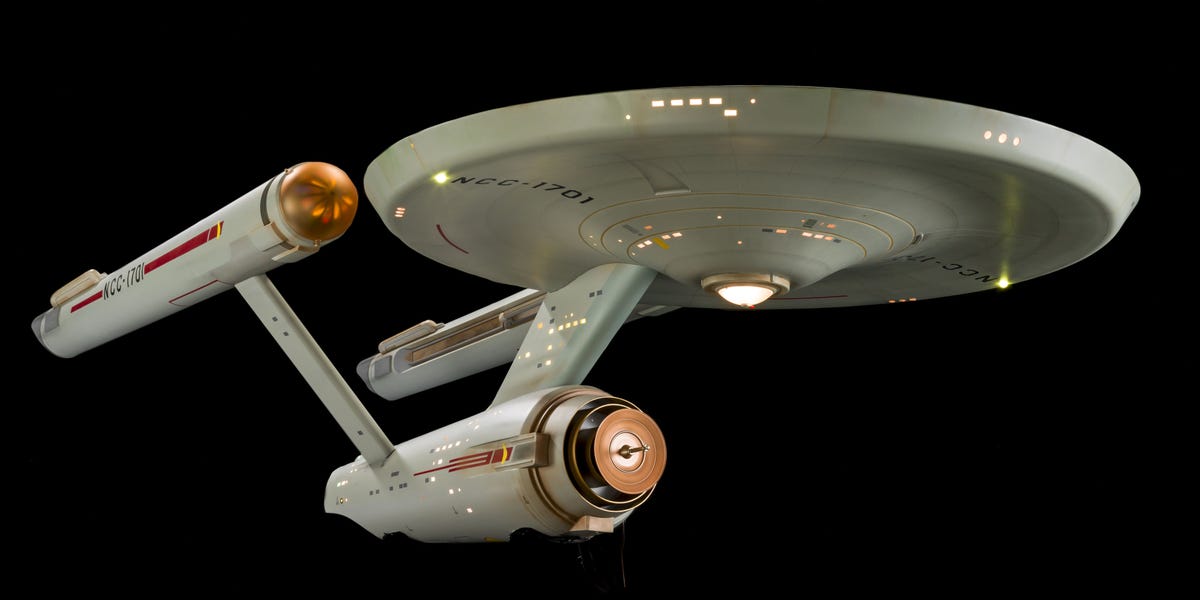
Some museum stories are about a plane, a capsule, or a moon rock. This one is about a starship that never technically left Earth, yet somehow helped millions of people imagine leaving it. When the fully restored Star Trek Enterprise was unveiled at the Smithsonian’s National Air and Space Museum, the moment felt bigger than a routine exhibit refresh. It was a public acknowledgment that pop culture can shape real history, real careers, and real scientific curiosity.
The restored Enterprise did not arrive with warp drive, a transporter room, or Mr. Spock quietly judging everyone from the corner. What it did bring was something museums prize just as highly: meaning. The famous 11-foot studio model from the original 1960s television series had spent years in less-than-glamorous surroundings, including the museum gift shop, before undergoing a careful restoration. When it returned to public view in a prominent gallery, the Smithsonian was making a statement. This was no longer just a TV prop. It was an American cultural artifact.
And honestly, that feels right. The Enterprise was always more than set dressing. It was the moving symbol of a future where people of different backgrounds worked together, argued intelligently, trusted science, and still had time for dramatic bridge speeches. Not bad for a model made from wood, plastic, metal, and plenty of television magic.
Why the Unveiling Mattered Beyond Fandom
The unveiling of the restored Enterprise mattered because it sat at the crossroads of entertainment, technology, memory, and national identity. Museums like the Smithsonian do not elevate objects simply because fans love them. They elevate objects because those things tell a larger story about who we were, what we valued, and where we imagined we were going.
Star Trek earned that kind of treatment. The original series pushed television toward a more expansive future, showing a racially integrated, multinational crew and presenting science, exploration, and diplomacy as heroic pursuits. That message landed during a period when the United States was also living through the real-world Space Race. So when the Enterprise appears inside the National Air and Space Museum, it feels less like a joke and more like a perfect fit.
In other words, the museum was not putting a spaceship from fiction next to serious history by accident. It was recognizing that fiction itself can influence serious history. Plenty of engineers, astronauts, designers, and researchers have pointed to Star Trek as a spark. The show did not invent every futuristic idea it displayed, but it gave those ideas a human setting. It made advanced technology feel normal, useful, and even hopeful.
That is why the restored Enterprise belongs in a gallery of milestones. It represents not only television craftsmanship but also the cultural power of imagination. Few objects prove more clearly that stories can change what people choose to build in the real world.
The Long Voyage from TV Prop to Museum Treasure
From Paramount Gift to Smithsonian Collection
The Enterprise studio model used in the original series was donated to the Smithsonian in 1974, only a few years after Star Trek ended its first television run. At the time, the franchise was admired by devoted fans, but it had not yet become the giant cultural universe we know today. That matters, because it explains why the model was initially treated more like a curious prop than a crown jewel.
When the model arrived, it was not exactly in pristine command-ready condition. It came to the Smithsonian in rough shape, packed in pieces, with visible wear and earlier alterations. The model itself was large, about 11 feet long and roughly 200 pounds, and it had been built as a filming miniature, not as a permanent museum object. Hollywood props are made to look convincing on camera, not to survive half a century of gravity, heat, dust, and public fascination.
Even so, the Smithsonian saw potential. The Enterprise had already become iconic enough to deserve preservation, and the museum understood that America’s story of flight and space was not only about rockets that really launched. It was also about the dreams that made people care about launch pads in the first place.
How the Model Moved Through Different Museum Lives
Before settling into its modern display, the Enterprise had a surprisingly eventful museum life. It appeared publicly before the National Air and Space Museum’s current building even opened, and once the museum opened in 1976, the model was displayed as part of a broader vision of future space travel. For years it hung from above, which looked dramatic but was not ideal for long-term preservation.
Later, it moved through several display arrangements and restoration attempts. By the early 2000s, the model was placed in the museum’s lower-level gift shop. That decision may have kept it visible rather than buried in storage, but it also frustrated many fans. To Trekkies, putting the Enterprise near souvenirs and checkout traffic felt a little like parking a beloved starship between a postcard rack and a novelty mug stand. Even museum staff later acknowledged that the location was far from perfect for conservation.
Over time, concerns grew. Paint was cracking. Structural problems became more visible. The engine nacelles showed signs of sagging. The model was aging, and the Smithsonian knew it needed a more serious plan.
What the Restoration Team Set Out to Do
Not Just Make It Pretty, but Make It Accurate
The restoration that led to the unveiling was not a quick cosmetic tune-up. It was a research-heavy conservation project designed to stabilize the artifact and return it as closely as possible to a specific moment in its working life: its appearance in August 1967, during and after production of the episode “The Trouble with Tribbles.”
That goal matters because the Enterprise changed over time. The model underwent multiple modifications during production and additional changes after arriving at the Smithsonian. By the time the museum launched its major conservation effort, staff had identified that the ship had experienced eight significant modifications since its creation in 1964. So the question was not simply, “What color should this be?” It was, “Which version are we preserving, and why?”
The Smithsonian chose the late-1967 version because it represented the last known production-era modification from the original series. That gave the team a historically defensible target instead of an imaginary “best of” version built from nostalgia. In museum terms, that is the difference between conservation and wish fulfillment. Fans may remember the ship one way through decades of reruns, merchandise, and memory, but conservators had to go where the evidence led.
A Restoration Powered by Research and Fan Knowledge
One of the smartest parts of the project was the Smithsonian’s willingness to ask for help. The museum openly reached out to Star Trek fans for pre-1976 photographs and film footage of the model. That public call was not a publicity stunt. It was a recognition that dedicated fan communities often preserve visual history in ways institutions cannot. Old snapshots, convention photos, and obscure images can become valuable evidence when experts are trying to reconstruct lost details.
That collaboration gave the restoration a wonderful extra layer of meaning. The Enterprise is a screen-used object, but it is also a beloved character in its own right. Many fans speak of the ship almost as if it were alive, and while museums usually avoid sentimentality, this project understood that affection could be useful. Devotion turned into documentation. Nostalgia became research support.
Paint, Lights, Structure, and the Little Things That Matter
Once the research phase was in place, the physical work became painstaking. Conservators addressed structural issues, corrected earlier restoration choices, and returned missing or inaccurate details to something closer to the ship’s original filmed appearance. That included work on the nacelles, surface finish, decals, and the ship’s lighting system.
One of the most discussed changes was the paint color. Many people assumed the Enterprise should look plain gray because that is how it appeared on television. But studio lighting in the 1960s changed the way the model read on camera. When conservators studied surviving original paint, they found a subtle green-gray tone that better matched the actual object. The result surprised some fans, but it also made the restoration more authentic. Sometimes the truth looks unfamiliar because memory has better public relations than history.
The lighting system also received major attention. Older incandescent lights had created heat and conservation concerns, so the restored display used modern LED lighting to recreate the visual effect more safely. That may sound like a technical footnote, but it changed the viewing experience dramatically. The blinking and spinning lights help the model feel alive again. It stops being a static relic and starts looking like a ship awaiting its next impossible assignment.
The museum also placed the restored model in a climate-controlled display environment, which signaled that the Enterprise had fully graduated from “cool thing visitors like” to “artifact we are preserving for the long haul.” That is a significant institutional shift, and it reflects how much the meaning of the object has grown since 1974.
Why the Smithsonian Treats Science Fiction as Real Cultural History
Some people still hear “TV prop in a museum” and instinctively shrug. But that reaction misses the point. Museums are not only warehouses for machines that worked exactly as advertised. They are also places that document what a society admired, feared, invented, and imagined.
The Enterprise checks every box. It represents design history, television production history, fan culture, postwar futurism, and the growing importance of science fiction in American public life. More than that, it symbolizes a vision of exploration that is optimistic rather than apocalyptic. Plenty of science fiction warns that the future will crush us. Star Trek argued that the future could challenge us and still be worth building.
That optimism is part of why the model resonates in a museum devoted to air and space history. Real aerospace history is full of failure, delay, risk, and engineering compromise. Star Trek never erased those realities, but it turned them into a larger moral project. Exploration mattered because people mattered. Discovery mattered because cooperation mattered. For many visitors, seeing the Enterprise in the Smithsonian feels like seeing aspiration itself placed under museum glass.
It also helps that the object is genuinely beautiful. Even by modern standards, the silhouette still works. The saucer, the engineering hull, the nacelles, the proportions, the strange elegance of it all. It looks futuristic in a way that remains surprisingly graceful, which is not something every 1960s design can say without blushing.
What Visitors See When They Encounter the Restored Enterprise
The strongest thing about the restored Enterprise is scale. Fans know it is 11 feet long, but measurements on a screen do not prepare you for the physical encounter. Once you stand in front of it, the model becomes less like memorabilia and more like industrial sculpture. You notice the craftsmanship. You notice the surface texture. You notice how cleverly it was built to read as a massive vessel through the camera lens.
The display setting matters too. Placing the Enterprise in the Boeing Milestones of Flight Hall gives it context. It is not floating in a vacuum of fandom. It is in conversation with aircraft, spacecraft, and icons of human ambition. That framing quietly says the artifact belongs here. It belongs in the same broad story about flight, technology, and the future.
And then there is the emotional response, which should not be underestimated. For some visitors, the model brings back childhood memories of watching Kirk, Spock, and Uhura explore strange new worlds. For younger visitors, it can feel like discovering the blueprint for a huge slice of modern science fiction. Either way, the encounter tends to produce the same expression: a long stare followed by the mental equivalent of, “Wow, that is actually the one.”
The Bigger Lesson of the Enterprise Restoration
The restoration of the Enterprise teaches an important lesson about preservation in the 21st century. Cultural history is not neatly divided between “high” art and “popular” entertainment anymore, if it ever was. A television object can be historically important. A mass audience can assign lasting meaning to something built for commercial storytelling. And a museum can take that meaning seriously without losing scholarly rigor.
In fact, this restoration shows what rigor looks like when applied to fandom. The Smithsonian did not simply repaint the model to match popular memory. It documented, researched, compared evidence, consulted experts, and even asked the public for firsthand visual records. That process respected both the object and the audience.
The result was not merely a refreshed display. It was a reinterpretation of what counts as heritage. The restored Enterprise tells us that imagination leaves artifacts behind, and those artifacts deserve care because they shaped real lives. A generation inspired by this ship went on to build technologies, pursue scientific careers, and think more expansively about humanity’s place in the universe.
That is why the unveiling matters. It was not just the return of a famous prop. It was the elevation of a shared dream.
Experiences Related to Seeing the Restored Enterprise in Person
Seeing the restored Enterprise at the Smithsonian is the kind of museum experience that sneaks up on you. You may walk in expecting a quick glance, maybe a nostalgic smile, and then move along to the moon hardware. Instead, the model has a way of stopping people in their tracks. The first experience is almost always surprise at its size. On television, the ship was a symbol. In person, it becomes an object with weight, volume, and texture. You suddenly realize that the illusion of a starship was built by human hands, careful design, and a lot of problem-solving.
The second experience is recognition. Even visitors who are not hardcore fans usually know the silhouette immediately. That outline has become part of American visual culture. The saucer section feels familiar before your brain fully catches up, and that instant recognition creates a strange emotional shortcut. It is like meeting a fictional celebrity who somehow became part of your family’s living room years ago.
For longtime fans, the reaction can be even more personal. Many people connect the Enterprise to childhood routines: watching reruns with parents, discovering old episodes on cable, borrowing VHS tapes, collecting paperbacks, or arguing about captains with the seriousness normally reserved for constitutional law. Standing in front of the restored model can bring all of that back at once. It is not just that you are seeing a prop. You are seeing a physical anchor for decades of memory.
There is also a powerful contrast between the object’s humble construction and its enormous symbolic reach. Up close, it is easy to imagine the craftspeople, effects teams, and artists who made this vessel believable before digital effects existed. That realization creates admiration of a different kind. The Enterprise is impressive as an icon, but it is also impressive as a piece of analog ingenuity. You can almost feel the era that built it, an era when imagination had to be engineered with tangible materials.
Another memorable part of the experience is the setting. Because the restored Enterprise sits within a major national museum devoted to air and space history, visitors do not view it as isolated fandom. They see it alongside machines and artifacts tied to real human ambition. That pairing can be surprisingly moving. It reminds people that dreams and hardware are not rivals. Dreams often come first.
Families tend to have some of the best reactions. Older visitors explain what the ship meant in the 1960s or 1970s. Younger visitors ask why it looks different from newer versions. Someone points out the lights. Someone else quotes a line. Suddenly the museum becomes less about silent observation and more about shared storytelling. The Enterprise is excellent at doing that. It makes generations talk to each other.
The final experience is reflection. After the initial thrill fades, many visitors end up thinking about why this object still matters. Why preserve it so carefully? Why give it such an honored place? The answer usually becomes obvious while standing there. The Enterprise represents a future that believed intelligence, curiosity, teamwork, and moral courage were worth celebrating. In a museum, that message lands with unusual force. You do not leave feeling like you simply saw a television artifact. You leave feeling like you visited a monument to optimism.
Conclusion
The fully restored Star Trek Enterprise at the Smithsonian Air and Space Museum is more than a nostalgic attraction. It is a carefully conserved artifact that shows how fiction can influence real science, real careers, and real cultural values. Its journey from studio miniature to museum centerpiece mirrors the journey of Star Trek itself: from cult television to lasting American legacy.
What makes the unveiling so compelling is not only the craftsmanship of the restoration, though that is impressive. It is the deeper recognition behind it. The Smithsonian treated the Enterprise with the seriousness usually reserved for objects that changed how humans move, think, or explore. And in its own way, this ship did exactly that. It helped people imagine a future worth reaching for.
That is why the restored Enterprise feels right at home in the museum. It is not there because fans shouted loudly, even though they definitely helped. It is there because the object earned its place. The Enterprise belongs among milestones not because it flew, but because it made so many people want humanity to keep flying farther.