For a long time, predicting a solar storm felt a little like trying to forecast a bar fight by staring at the front door of a saloon. You could tell something ugly might be coming, but not exactly when the punch would land, how hard it would hit, or whether it would wreck the furniture. Today, that picture has changed a lot. Scientists still cannot predict every solar storm with perfect accuracy, but they have come impressively, gloriously, annoyingly close.
That matters because solar storms are not just pretty aurora generators for social media. They are serious space weather events that can disrupt GPS, radio communications, satellites, aviation, power systems, and astronaut safety. As the Sun ramps up activity during its more dramatic moods, researchers are getting better at forecasting coronal mass ejections, estimating geomagnetic storm risk, and even using AI to sort signal from solar chaos. In other words, the forecast is no longer “something spicy may happen eventually.” It is increasingly, “a CME is likely headed our way, here is the arrival window, here is the probable storm strength, and here is what could go wrong.”
That is a huge leap. It is also not the same thing as perfection. The forecast is smarter, faster, and more useful than it used to be, but the Sun still keeps one hand behind its back. And, like every difficult genius, it enjoys being unpredictable at exactly the wrong moment.
Why Predicting Solar Storms Is So Ridiculously Hard
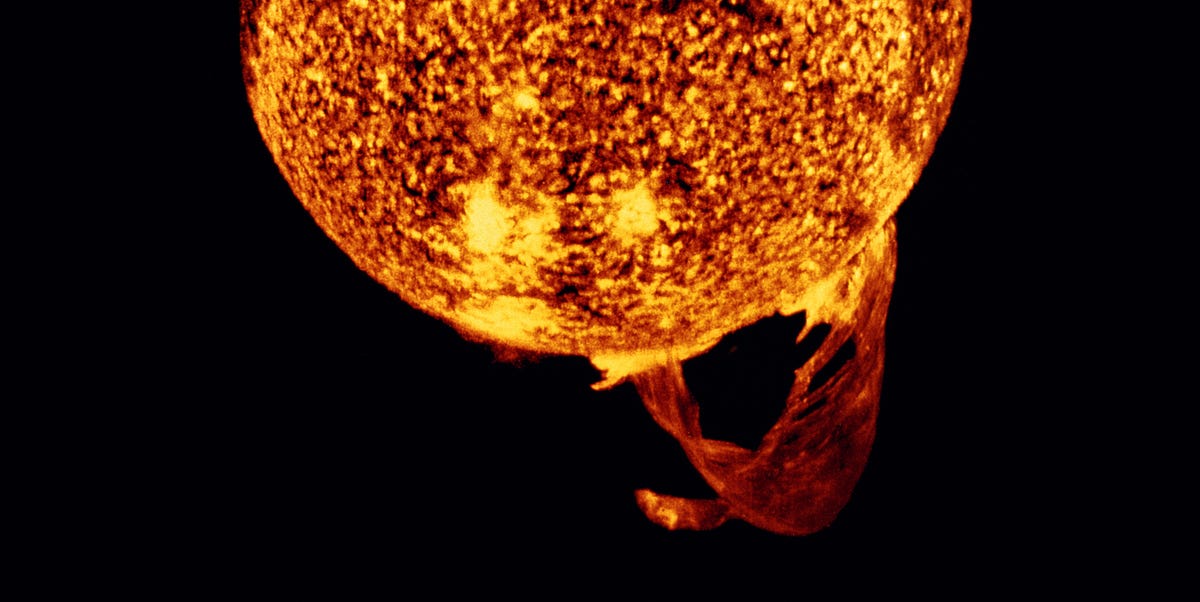
The phrase “solar storm” covers several related events, but the real troublemakers are often CMEs, or coronal mass ejections. These are giant eruptions of plasma and magnetic field thrown off the Sun. When one is directed toward Earth, the big question is not merely whether it will arrive. The bigger question is whether its magnetic field will connect with Earth’s magnetic field in a way that dumps a lot of energy into our planet’s near-space environment.
That is where the forecast gets tricky. Scientists can often detect the eruption itself fairly quickly. They can estimate speed. They can model the CME’s travel through space. They can narrow down the arrival window. But the hardest part is understanding the magnetic structure inside that cloud before it gets here. That internal magnetic orientation is the difference between a flashy aurora show and a genuinely disruptive geomagnetic storm.
So, yes, researchers can see the truck coming down the highway. What they are still working on is figuring out whether the truck is carrying a box of confetti or a piano.
Spotting the Blast Is Easier Than Predicting the Punch
Modern space weather forecasting is already strong at several things. Scientists can identify active regions on the Sun, monitor flares, watch CMEs leave the corona, and run models that estimate when solar material may arrive at Earth. NOAA’s operational forecasting system even provides three-day geomagnetic outlooks, which is something nobody would call primitive unless they had never tried forecasting an exploding magnetic star 93 million miles away.
But what forecasters most want is earlier confidence about severity. A CME can look modest at launch and still become nasty if it rotates, deflects, merges with other eruptions, or arrives with a strongly southward magnetic field. That is why one of the most important themes in modern heliophysics is not simply seeing more eruptions. It is measuring the Sun’s magnetic field better, especially in the chromosphere and corona, where the seeds of trouble are planted.
What Scientists Can Predict Pretty Well Now
Here is the good news: researchers are no longer working with guesswork and vibes. Forecast skill has improved in several important ways, especially for CME detection, transit modeling, and short-term warning.
1. Arrival Windows Are Better Than They Used to Be
Scientists can now estimate when many Earth-directed CMEs will arrive with genuinely useful accuracy. Not perfect accuracy, but useful accuracy. That distinction matters. A forecast that narrows impact to a practical time window can help satellite operators shift modes, airlines reroute if necessary, power system managers prepare for disturbances, and mission planners monitor astronaut exposure more carefully.
Some CMEs take several days to arrive. The fastest severe events can get here in less than a day. That means every improvement in speed estimates, trajectory tracking, and mid-course updating has real operational value. In practical terms, forecasting has moved from “maybe sometime soon” to “watch this window closely.” That is not sexy enough for a movie trailer, but it is extremely sexy if you run infrastructure.
2. Near-Earth Warning Is Already Operational
Once solar wind and magnetic-field data are sampled upstream from Earth at the Sun-Earth L1 point, forecasters can issue direct warnings with far more confidence. This is where spacecraft such as ACE and DSCOVR have been invaluable. They do not tell us everything days in advance, but they do provide the crucial last look before the punch lands. That final warning window can range from about 10 minutes to roughly an hour, depending on the event.
That may sound short, but in operational terms it is a lifesaver. Short-warning data helps forecasters decide whether a storm is likely to ramp up fast, whether magnetic coupling looks favorable for stronger impacts, and whether conditions are deteriorating quickly. In the world of geomagnetic storm prediction, an hour is not pocket change. It is rent money.
3. Scientists Are Learning Why Some “Meh” CMEs Become Monsters
One of the most important advances in recent years is not just prediction, but explanation. Researchers are getting better at understanding why some apparently modest events end up producing stronger storms than expected. A major lesson is that the Sun’s environment matters. Nearby coronal holes, background solar wind, CME rotation, and interactions with earlier eruptions can all alter the final impact.
In one recent line of research highlighted by NASA, a CME associated with a relatively weak flare still triggered a severe geomagnetic storm because fast solar wind from a coronal hole likely nudged and rotated it into a more geoeffective orientation. That kind of result matters because it turns “surprise” into “pattern.” And once scientists can recognize patterns, forecasting begins to improve fast.
The New Tools Making Solar Storm Prediction Smarter
Machine Learning Is No Longer Just a Buzzword in a Lab Coat
AI and machine learning are now doing real work in solar flare forecasting and CME assessment. NASA has highlighted a model called GeoCME, which uses imagery from SOHO to predict whether a CME will be geoeffective. Another NASA-backed AI effort, Surya, has shown promising results in forecasting solar flares hours in advance. These systems do not replace physics. They help sort through huge volumes of solar data, identify patterns humans might miss, and improve the odds of early warning.
That is especially important because the Sun is a data monster. Spacecraft and observatories collect far more imagery and magnetic information than human analysts can manually process in real time. Machine learning helps triage the chaos. It is not a crystal ball, but it is a very caffeinated assistant that never blinks.
More Vantage Points Mean Earlier, Better Warnings
Forecasting improves when scientists can observe the Sun and heliosphere from more than one location. That sounds obvious, but it is a profound limitation in practice. Earth usually gets a front-row seat to only one side of the Sun at a time. If a dangerous active region is rotating toward view, even a few extra days of notice can change the preparation timeline.
NASA recently described how its Perseverance rover on Mars can help provide an early look at large sunspots from the far side of the Sun, sometimes offering up to two weeks of advance notice before those regions rotate into Earth view. Meanwhile, heliophysics missions such as STEREO and Parker Solar Probe have helped scientists study CME structure and evolution in ways that were impossible when Earth was basically flying blind with one rearview mirror.
Mid-Flight CME Tracking Is a Big Deal
Another major advance is using heliospheric imaging to update CME forecasts while the eruption is already on its way. That may not sound glamorous, but it is one of the most practical improvements in the field. Instead of relying only on what a CME looked like close to the Sun, forecasters can refine the prediction during transit. Think of it as switching from “we saw the pitch leave the hand” to “we tracked the baseball all the way to the plate.”
That matters because CMEs can speed up, slow down, distort, or interact with the solar wind. More imaging during transit means better arrival estimates and, in some cases, better understanding of likely storm strength.
The Gannon Storm Proved Forecasting Has Entered a New Era
The May 2024 geomagnetic superstorm, often called the Gannon storm, was the biggest real-world reminder that solar storm prediction is no academic hobby. It was the first G5 geomagnetic storm in more than 20 years, and it became one of the best-documented storms ever observed.
It also showed both how far forecasting has come and where it still needs work. NOAA issued severe storm watches in advance. Spacecraft and ground systems captured unprecedented data. Scientists later found that if STEREO-A had been used operationally as a sentinel farther upstream than L1, forecasters could have had more than two extra hours of accurate warning about storm strength. That is a stunning glimpse of what future forecasting architecture could deliver.
At the same time, the storm reminded everyone that real impacts are messy. GPS disruptions affected precision agriculture. Aurora appeared far beyond its usual haunts. Infrastructure operators got a live demonstration of why space weather belongs in serious risk planning. In other words, the Sun hosted a surprise exam, and humanity did not fail, but nobody left saying, “Wow, I hope we do that every weekend.”
Why Scientists Still Cannot Promise Perfect Forecasts
The biggest obstacle remains magnetic-field prediction before arrival. Scientists still do not have complete, continuous measurements of the Sun’s magnetic field in the regions where eruptions are built and launched. That missing information is why new mission concepts and observatories focus so heavily on chromospheric and coronal magnetism.
Projects such as CMEx, STRUVE, and COSMO are aimed squarely at this problem. Their promise is simple but powerful: if researchers can better measure the magnetic architecture that drives solar eruptions before the blast leaves the Sun, then the forecast can move from “good timing, fuzzy severity” to something much more confident.
And that is really the story here. Scientists are not standing at the finish line. But they are no longer wandering around the parking lot asking where the race is. They are on the track, running hard, and the gap between “close” and “actionable” has narrowed dramatically.
Why the Future of Solar Storm Forecasting Looks Bright
Maybe “bright” is not the ideal adjective for violent electromagnetic weather, but you get the idea. The future looks stronger because several improvements are arriving at once: better operational spacecraft, better models, more data assimilation, better machine learning, and broader recognition that space weather is an infrastructure issue, not just a science headline.
NOAA’s new SOLAR-1 mission is a perfect example. The observatory reached its final destination near L1 in January 2026, and NOAA released the first images from its CCOR-2 coronagraph in April 2026. That matters because SOLAR-1 is the nation’s first satellite built specifically for continuous operational space weather observations. Translation: this is not just cool science. It is working hardware meant to improve real warnings for the real world.
So, have scientists cracked solar storm prediction? Not fully. Have they come damn close? Absolutely. Close enough that forecasts are already useful, increasingly trusted, and getting better with every storm the Sun throws at us.
Experience: What This Progress Feels Like in the Real World
If you want to understand what improved solar storm forecasting really means, do not just picture scientists in dark rooms staring at solar images like cosmic detectives. Picture a lot of ordinary people whose days quietly depend on systems above their heads.
For satellite operators, better prediction changes the feeling from helpless suspense to controlled urgency. A vague threat is hard to manage. A narrowed arrival window, even if it is not perfect, gives teams time to shift spacecraft into safer configurations, delay delicate maneuvers, and pay closer attention to anomalies. That does not eliminate risk, but it replaces blind panic with informed decision-making. In high-stakes operations, that difference is enormous.
For forecasters themselves, the experience has become more sophisticated and more intense at the same time. Modern space weather teams are no longer relying on one instrument and a hopeful shrug. They are synthesizing solar imagery, upstream solar-wind measurements, ensemble models, probabilistic forecasts, and machine-learning tools. The job still involves uncertainty, but it is a smarter kind of uncertainty. It feels less like guessing and more like managing a complex weather system with incomplete but improving data.
For astronauts, the experience is even more personal. NASA’s planning for Artemis II makes that crystal clear. Once crews leave Earth’s protective magnetic field, solar activity is not an abstract scientific curiosity. It is a radiation concern that can shape mission decisions in real time. In that environment, every extra minute of warning matters. Every better forecast matters. And every improved model becomes part of a chain of protection that is both technical and deeply human.
For pilots, GPS-dependent industries, and communication systems, improved forecasting means fewer nasty surprises. The May 2024 storm showed that solar activity can disrupt positioning and navigation in ways that ripple into the economy. Precision agriculture is a striking example. When planting schedules depend on accurate guidance, GPS degradation is not just inconvenient. It can become expensive fast. Better forecasts will not stop the ionosphere from acting weird, but they can help users prepare, adjust, and recover more intelligently.
Then there is the public experience, which is oddly split between awe and vulnerability. On one hand, stronger forecasting means more people get advance notice of aurora displays. A severe storm can turn millions of people into accidental skywatchers. On the other hand, the same event can quietly expose how dependent daily life has become on fragile technological systems. The beautiful green curtains in the sky and the nervous infrastructure briefings are two sides of the same story.
That is why this topic feels so fascinating right now. We are living in a period when solar storms are becoming easier to anticipate but not fully tame. Humanity is no longer watching the Sun with crossed fingers and a paper map. We now watch it with satellites, AI, predictive models, deep-space monitors, and a growing operational playbook. The experience is still humbling, because the Sun remains bigger, meaner, and more complicated than our confidence. But it is also encouraging. We are no longer just reacting. We are beginning to read the mood of the star that runs our whole neighborhood.
Conclusion
Scientists have not solved solar storm prediction in the neat, movie-friendly sense of the word. They still cannot promise exact impact severity days in advance for every event, and the Sun’s magnetic field continues to guard some of its best secrets. But the progress is real, substantial, and already changing how governments, operators, researchers, and mission planners prepare for space weather.
The modern forecast can identify threats earlier, estimate arrival windows more effectively, improve warning confidence with upstream monitors, and increasingly use AI and multi-point observations to separate dangerous storms from solar drama that only looks scary from a distance. That is not a minor upgrade. That is a transformation.
So yes, scientists have come damn close to predicting solar storms. And if the current pace of progress holds, “damn close” may turn into “reliably actionable” sooner than most people think.