Every great comedy group eventually faces the same absurd question: should they reunite? In the case of Monty Python, the answer from Terry Gilliam is not merely “no.” It is a very Python-ish no: sentimental, practical, slightly brutal, and somehow funny because it refuses to put on a false mustache and pretend everything is fine.
Gilliam, the American-born animator, filmmaker, performer, and visual lunatic behind many of Monty Python’s most unforgettable cutout animations, has argued that a new Monty Python reunion would be “pointless.” That might sound harsh at first, especially to fans who still quote Monty Python and the Holy Grail as if coconuts are a valid transportation technology. But his reasoning is not simple grumpiness. It is about chemistry, mortality, timing, and the strange truth that some creative miracles cannot be reheated like leftover spam.
Monty Python was never just a brand. It was Graham Chapman, John Cleese, Terry Gilliam, Eric Idle, Terry Jones, and Michael Palin colliding in a rare comic formation. Their work was silly, scholarly, anarchic, musical, literary, rude, elegant, and occasionally dressed as a pepperpot. Remove one piece, Gilliam suggests, and the mechanism changes. Remove two, and the machine is no longer the same machine. It may still make noises. It may even sell tickets. But is it Monty Python?
Why Terry Gilliam Thinks a Monty Python Reunion Would Be Pointless
Gilliam’s point centers on what he has described as the group’s “magical chemical balance.” That phrase matters because Monty Python’s comedy was not built like a normal sketch show. The Pythons did not simply assemble jokes, wait for applause, and bow politely like civilized citizens. They often attacked the very idea of structure. Sketches dissolved into animations. Authority figures became fools. Historical settings became playgrounds for philosophical nonsense. A scene could begin in a pet shop and end in a courtroom, a military office, or under a giant foot from the heavens.
That kind of comedy depends on trust. It also depends on conflict. Cleese and Chapman brought a sharp, argumentative Cambridge precision. Palin and Jones added historical curiosity, warmth, and wild character work. Idle brought songs, wordplay, and show-business timing. Gilliam connected the live sketches with surreal visual explosions that made the whole thing feel like Victorian clip art had eaten questionable mushrooms.
So when Gilliam says a reunion would not work, he is not saying the surviving Pythons have forgotten how to be funny. He is saying the original organism no longer exists. Graham Chapman died in 1989. Terry Jones died in 2020. Their absence is not a casting problem; it is an identity problem. A reunion without them could become a tribute, a panel, a documentary, or a nostalgic evening of fond stories. But as Gilliam’s argument implies, it would not be the same volatile mixture that made Python dangerous in the first place.
The Original Six Were the Joke, the Engine, and the Argument
Monty Python’s great achievement was not merely writing classic sketches. It was creating a comic grammar that audiences still recognize instantly. The term “Pythonesque” survives because their humor had a repeatable flavor: absurdity delivered with academic confidence, rebellion wearing a cardigan, nonsense that sounded suspiciously well-read.
Monty Python’s Flying Circus, which ran on the BBC from 1969 to 1974, arrived at a moment when television comedy still expected clear punchlines and tidy endings. Python preferred ambushes. A sketch could be funny because it refused to end, because it ended too early, or because a colonel walked in to stop it for being too silly. That anti-format format became part of the joke.
The films widened the audience. Monty Python and the Holy Grail turned budget limitations into comedy gold, with coconut-shell “horses” becoming one of the most famous cheap solutions in movie history. Life of Brian sharpened the troupe’s satirical bite, taking on religious hysteria, political factionalism, and the human talent for missing the point while shouting slogans. The Meaning of Life pushed their sketch sensibility into musical, grotesque, and philosophical territory, asking life’s largest questions with a straight face and a bucket nearby.
What united all of it was not politeness. The Pythons disagreed. They had different rhythms, different egos, and different comic obsessions. But that friction was productive. It gave the work its odd tension: highly educated men behaving like schoolchildren, but schoolchildren who had read medieval history, Greek philosophy, and the small print on a government form.
Why the 2014 Reunion Worked—And Why It May Have Been Enough
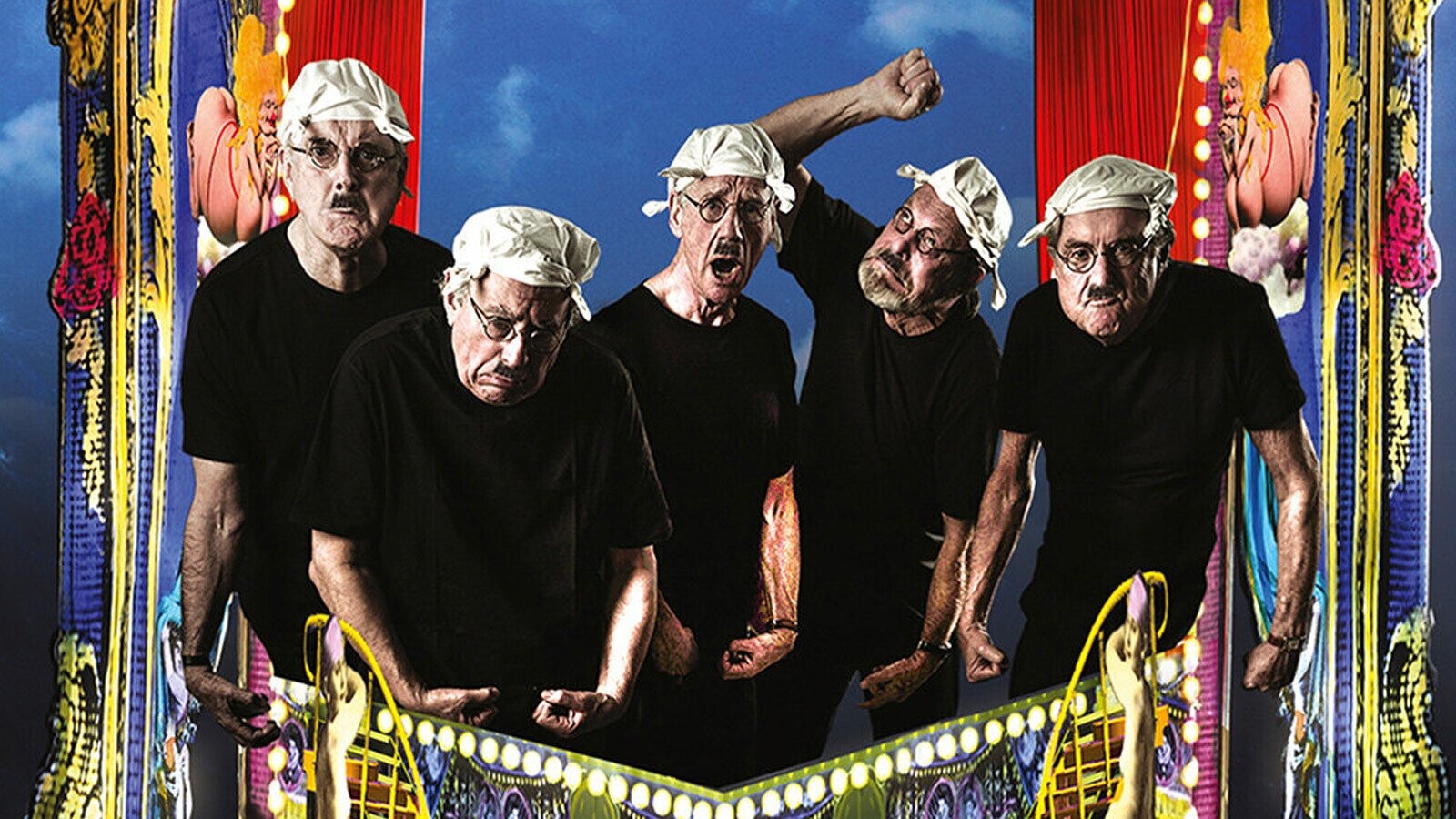
The closest modern fans got to a true reunion was Monty Python Live (Mostly): One Down, Five to Go, staged at London’s O2 Arena in July 2014. The five surviving Pythons performed classic sketches and songs across ten shows, with Carol Cleveland joining them and archival material helping fill the Chapman-shaped hole in the room.
That production was both celebration and farewell. It was openly nostalgic, knowingly creaky, and cheerfully aware that the performers were no longer the young men who had once sprinted through television history with a rubber chicken under one arm. The show leaned into the age factor rather than denying it. In true Python style, even the title turned death into a gag.
There was also a practical reason behind the reunion: the group had faced a costly legal dispute related to Spamalot, the hit musical inspired by Holy Grail. That context made the live shows feel unusually honest. They were not pretending to be a spontaneous rebirth of youthful rebellion. They were a goodbye, a money-making necessity, and a fan service event rolled into one enormous theatrical sandwich.
And that may be why the 2014 reunion remains satisfying in hindsight. It did not try to create a new Monty Python era. It assembled beloved pieces, let fans laugh together one more time, and ended with the emotional usefulness of a final curtain. A new reunion would have to justify itself beyond “people remember this.” For Gilliam, memory is not enough.
Why Fans Still Want Another Monty Python Reunion
Fans ask for reunions because endings are rude. Nobody likes being told that the dead parrot is, in fact, dead. Nostalgia is powerful because it lets people revisit the first time a joke rearranged their brain. For many viewers, Monty Python was not just entertainment; it was a secret handshake. If someone laughed at the Ministry of Silly Walks, the Spanish Inquisition, the Argument Clinic, the Knights Who Say “Ni,” or the Black Knight’s indestructible optimism, they probably belonged to your tribe.
That tribal feeling is why reunion rumors keep returning. Monty Python sits at the intersection of comedy history and personal memory. People remember watching Holy Grail in college dorms, quoting Life of Brian with friends, discovering Flying Circus on late-night television, or realizing that high intelligence and absolute stupidity can peacefully share the same sofa.
But the desire for reunion often confuses two different wishes. One is the wish to see the surviving members together again. That is understandable. The other is the wish to experience Monty Python as if time has not passed. That is impossible. Chapman and Jones are gone. The culture has changed. The performers have changed. The audience has changed. Even the jokes have changed, because jokes age inside the ears of the people hearing them.
The Bigger Lesson: Some Comedy Should Stay Unrebooted
Modern entertainment loves resurrection. If a show, film, game, comic, cereal mascot, or mildly recognizable toaster once made money, someone somewhere is probably planning a revival. But comedy is more fragile than superhero franchises. It depends on timing, context, voice, and the specific madness of the people making it.
A Monty Python reboot or reunion could easily become a museum exhibit with better lighting. The danger is not that the surviving Pythons would be unfunny. The danger is that the expectations would be impossible. Fans would want the shock of the old work, but shock cannot be repeated on command. The first giant foot is surreal. The hundredth giant foot is merchandise.
Gilliam’s “pointless” remark therefore feels less like a rejection of fans and more like a defense of the original achievement. It says: let the miracle remain a miracle. Let the work be available, quoted, argued over, rediscovered, and loved without forcing the remaining artists into a theatrical séance.
That is a surprisingly generous position. It protects the audience from disappointment and the artists from becoming their own tribute act. It also protects the weirdness of Python itself. After all, this was a group that made comedy by refusing ordinary rules. The most Python ending may be the one that refuses to give people the sentimental reunion they expect.
Specific Examples That Prove Gilliam Has a Point
The Dead Parrot Sketch
The “Dead Parrot” sketch works because Cleese’s volcanic outrage meets Palin’s smooth denial. It is a duet of incompatible energies. Replace either half and the rhythm changes. The joke is not just the writing; it is the collision.
The Holy Grail Coconuts
The coconut gag in Holy Grail is a perfect example of Python turning limitation into identity. No horses? Fine. Two coconut halves become one of cinema’s most durable sound effects. A reunion could reference that joke, but it could not rediscover the original accident.
Life of Brian’s Crowd Satire
Life of Brian endures because it attacks groupthink with surgical silliness. The crowd insists it is made of individuals while chanting in unison. That scene still works because it is rooted in human behavior, not topical headlines. Python’s best comedy was timeless because it was not chasing trends.
Gilliam’s Animations
Gilliam’s cutout animations gave Python its dream logic. They made the show feel as if an old encyclopedia had rebelled against its owner. Those animations were not decoration; they were connective tissue. They allowed sketches to melt into one another without apology.
Experiences Related to the Topic: Why Saying Goodbye Is So Difficult
Part of the emotional tug around a possible Monty Python reunion comes from the way fans experience comedy in groups. Python is rarely a private pleasure for long. Someone watches Holy Grail, laughs at the Black Knight, and immediately wants to test the line on a friend. Someone discovers “Always Look on the Bright Side of Life” and suddenly it becomes the song played at parties, road trips, awkward office farewells, and moments when optimism needs a ridiculous whistle.
For many American viewers, Monty Python arrived like a strange broadcast from a smarter, sillier planet. It was British, but not in the postcard sense. It had castles, judges, bishops, soldiers, philosophers, accountants, and peasants, but none of them behaved responsibly. Watching it for the first time could feel like being given permission to laugh at institutions that usually demanded respect. School, church, government, television, war movies, historical epics, self-important intellectuals—all became fair game.
That is why the idea of “one more reunion” keeps tempting people. It is not only about seeing Cleese, Idle, Gilliam, or Palin on the same stage. It is about trying to recover the room where you first laughed until breathing became a negotiation. Maybe it was a dorm lounge with bad pizza. Maybe it was a family living room where one parent laughed and the other wondered if the television was broken. Maybe it was a YouTube rabbit hole that started with “just one sketch” and ended three hours later with a deep emotional commitment to shrubbery.
Yet those experiences also prove Gilliam’s point. What fans want back is not simply the performers. They want the moment. They want the surprise of not knowing where a sketch is going. They want to be young again, or at least younger than they are while reading an article about whether a reunion is pointless. A new show cannot return that exact feeling. It can only acknowledge it.
The healthiest way to experience Monty Python now may be through rediscovery rather than resurrection. Show Holy Grail to someone who has never seen it. Watch Life of Brian with a friend who enjoys sharp satire. Revisit Flying Circus and notice how experimental it still feels compared with comedy built for algorithms and instant clips. Let the jokes continue traveling from person to person, not as a preserved museum specimen, but as living mischief.
There is also something oddly comforting about accepting that no reunion can recreate the original. It means the original mattered. It means chemistry is real. It means art is not just content produced by interchangeable parts. Monty Python happened because six particular people met at a particular time and made something that should not have worked nearly as well as it did. The fact that it cannot simply be summoned again is not a failure. It is evidence that the magic was genuine.
Conclusion: The Parrot Is Not Coming Back, and That Is Okay
A Monty Python reunion would be “pointless,” according to Terry Gilliam, because the group’s genius was never just a logo, a playlist of sketches, or a set of famous quotes. It was the chemistry of six distinctive artists whose differences created something larger than any individual member. With Graham Chapman and Terry Jones gone, the balance has changed forever.
That does not make the legacy weaker. If anything, it makes it clearer. Monty Python does not need another reunion to prove its importance. The work already escaped the cage. It lives in comedy writing, internet absurdity, musical theater, political satire, fan rituals, and everyday conversations where someone suddenly says “Ni” and waits to see who smiles.
Gilliam’s view may disappoint fans who dream of one last glorious gathering. But it also honors the truth of what made Python special. Some groups should not be rebooted, reassembled, or polished into nostalgia machines. Some should be allowed to remain gloriously, permanently, historically silly.
Note: This article is written for web publication based on publicly reported interviews, historical information, and widely documented Monty Python milestones. No external source links or content-reference placeholders are included.