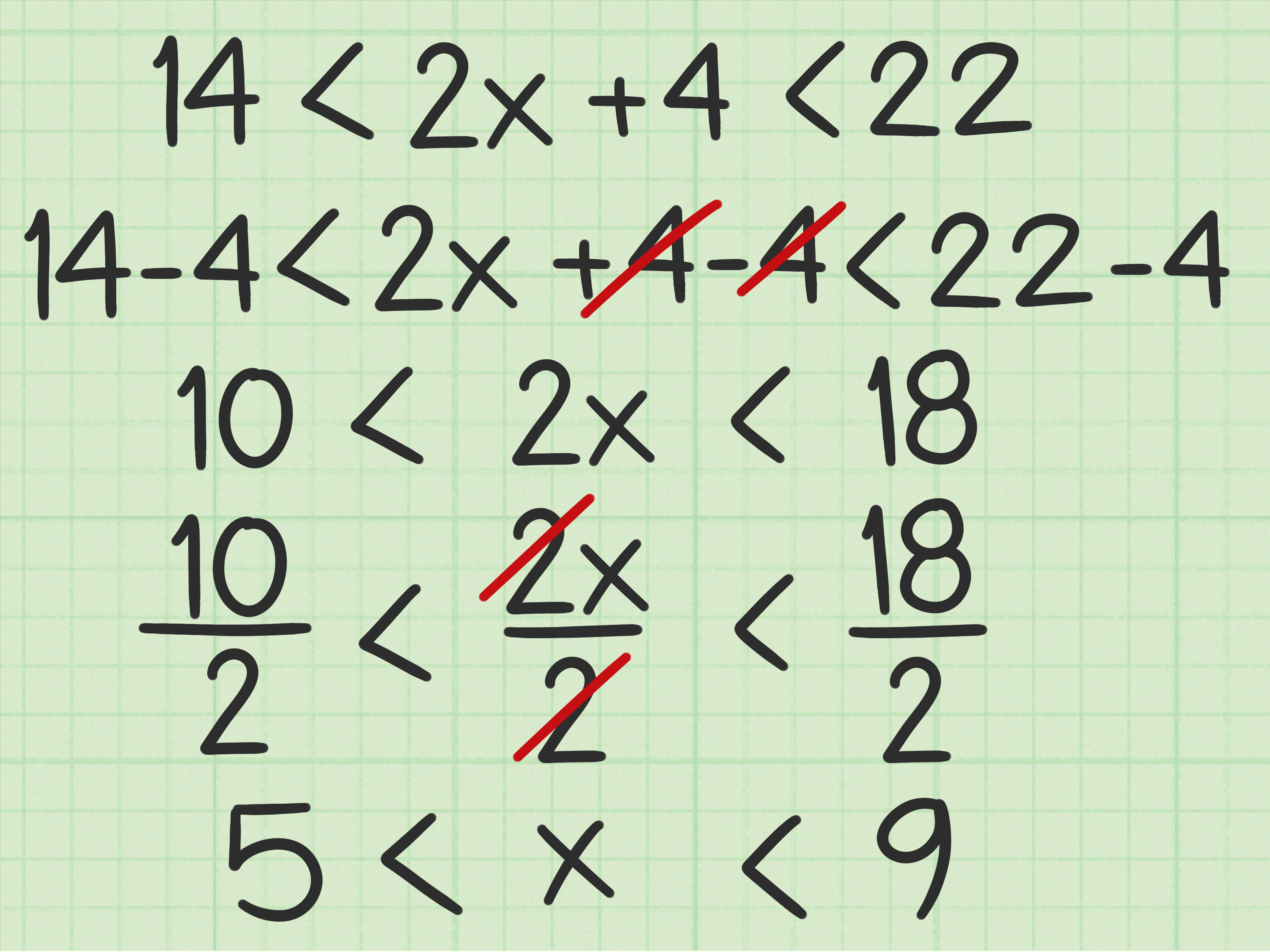
Solving a simple linear inequality can feel a little like negotiating with a tiny algebraic gatekeeper. The variable is hiding on one side, the numbers are standing around looking suspicious, and the inequality symbol is quietly saying, “Careful, I am not an equal sign.” The good news? Once you know the rules, linear inequalities are much friendlier than they first appear.
A linear inequality is a math statement that compares two expressions using symbols such as <, >, ≤, or ≥. Instead of finding one exact answer, as you often do with an equation, you usually find a solution set: a range of numbers that make the inequality true. For example, if you solve and get x < 5, the answer is not only 4. It is 4, 3, 0, -100, 4.999, and every other number less than 5. Algebra suddenly becomes a crowd event.
In this guide, you will learn 3 ways to solve a simple linear inequality: using inverse operations, simplifying both sides, and graphing or checking the solution. Each method helps you understand not just how to get the answer, but why the answer makes sense.
What Is a Simple Linear Inequality?
A simple linear inequality is an inequality with a variable raised only to the first power. You will not see squared terms like x2, square roots, or anything that looks like it escaped from a calculus textbook. Common examples include:
- x + 4 < 10
- 3x – 2 ≥ 13
- -5x ≤ 20
- 2(x + 1) > x – 6
The goal is usually to isolate the variable. That means you want x standing alone on one side of the inequality, looking confident and slightly dramatic.
The Golden Rule of Linear Inequalities
Most inequality rules are almost identical to equation rules. You can add, subtract, multiply, or divide both sides by the same number. However, inequalities have one famous “gotcha”:
When you multiply or divide both sides of an inequality by a negative number, reverse the inequality sign.
For example:
-2x > 6
Divide both sides by -2. Because you divided by a negative number, flip the symbol:
x < -3
That symbol flip is the algebra version of checking your mirrors before changing lanes. Forget it, and the whole answer may point in the wrong direction.
Way 1: Solve a Simple Linear Inequality Using Inverse Operations
The first and most common way to solve a simple linear inequality is to use inverse operations. Inverse operations undo each other. Addition undoes subtraction. Multiplication undoes division. This method works beautifully for one-step and two-step inequalities.
Example 1: One-Step Inequality
Solve:
x + 7 < 12
The variable x has 7 added to it, so subtract 7 from both sides:
x + 7 – 7 < 12 – 7
x < 5
The solution is all numbers less than 5. You can test it quickly. If x = 4, then 4 + 7 = 11, and 11 < 12 is true. If x = 6, then 6 + 7 = 13, and 13 < 12 is false. The answer passes the sniff test.
Example 2: Two-Step Inequality
Solve:
4x – 3 ≥ 13
First, add 3 to both sides:
4x – 3 + 3 ≥ 13 + 3
4x ≥ 16
Now divide both sides by 4:
4x / 4 ≥ 16 / 4
x ≥ 4
Because you divided by a positive number, the inequality symbol stayed the same. The solution includes 4 and every number greater than 4.
When This Method Works Best
Use inverse operations when the inequality is already fairly simple. If there is only one operation or two operations attached to the variable, this method is fast, clean, and unlikely to cause algebraic emotional damage.
Way 2: Solve by Simplifying Both Sides First
Some linear inequalities arrive with parentheses, like terms, or variables on both sides. In those cases, do not panic. The inequality is not difficult; it is just wearing extra accessories. Your first job is to simplify.
The basic process is:
- Distribute if there are parentheses.
- Combine like terms on each side.
- Move variable terms to one side.
- Move constant terms to the other side.
- Divide or multiply to isolate the variable.
- Flip the sign if you multiply or divide by a negative number.
Example 3: Inequality With Parentheses
Solve:
3(x – 2) + 4 ≤ 2x + 9
First, distribute 3:
3x – 6 + 4 ≤ 2x + 9
Combine like terms on the left side:
3x – 2 ≤ 2x + 9
Subtract 2x from both sides:
x – 2 ≤ 9
Add 2 to both sides:
x ≤ 11
The solution is every number less than or equal to 11. Notice that no sign flip was needed because we did not multiply or divide by a negative number.
Example 4: Inequality That Requires a Sign Flip
Solve:
-3x + 5 < 17
Subtract 5 from both sides:
-3x < 12
Divide both sides by -3. Since you divided by a negative number, reverse the inequality sign:
x > -4
This is where many students lose points. They do all the arithmetic correctly, then forget to flip the sign at the final step. It is like baking a perfect cake and then dropping it frosting-side down. Tragic, but preventable.
Why Simplifying Matters
Simplifying first makes the inequality easier to read. It also reduces mistakes because you are not trying to solve everything at once. Think of it as cleaning your desk before doing homework. Will it make you a math genius instantly? No. Will it stop your paper from vanishing under a pile of snack wrappers? Absolutely.
Way 3: Solve by Graphing, Checking, and Interpreting the Solution
The third way to solve a simple linear inequality is to use a visual approach. After solving algebraically, you can graph the solution on a number line or check values to confirm the direction of the inequality. This method is especially helpful when you want to understand what the answer means.
How to Graph a Linear Inequality on a Number Line
Graphing a one-variable linear inequality is simple once you know the symbols:
- Use an open circle for < or > because the endpoint is not included.
- Use a closed circle for ≤ or ≥ because the endpoint is included.
- Shade to the left for “less than.”
- Shade to the right for “greater than.”
For example, if the solution is x < 5, place an open circle at 5 and shade left. If the solution is x ≥ -2, place a closed circle at -2 and shade right.
Using Test Values
Test values are a practical way to check whether your final answer makes sense. Suppose you solve an inequality and get:
x > -4
Choose a number greater than -4, such as 0, and plug it into the original inequality. If it works, choose a number that should not work, such as -5. This quick check helps you catch sign mistakes before they become permanent residents on your worksheet.
Interval Notation
Sometimes you may be asked to write the answer in interval notation. This is another way to describe the solution set.
- x < 5 becomes (-∞, 5)
- x ≤ 5 becomes (-∞, 5]
- x > -2 becomes (-2, ∞)
- x ≥ -2 becomes [-2, ∞)
Parentheses mean the endpoint is not included. Brackets mean the endpoint is included. Infinity always uses parentheses because infinity is not a number you can actually reach and invite to dinner.
Real-Life Example: Budget Inequality
Linear inequalities are not just classroom decorations. They show up in budgeting, planning, shopping, fitness goals, travel, and business decisions.
Suppose you have $65 to spend at an event. Entry costs $25, and each ride ticket costs $8. How many ride tickets can you buy?
Let t represent the number of tickets:
25 + 8t ≤ 65
Subtract 25 from both sides:
8t ≤ 40
Divide by 8:
t ≤ 5
You can buy at most 5 tickets. Since ticket numbers must be whole numbers, the practical answer is 0, 1, 2, 3, 4, or 5 tickets. Sadly, “5.5 tickets” is not usually accepted by carnival employees, even if your algebra is persuasive.
Common Mistakes When Solving Linear Inequalities
Forgetting to Reverse the Inequality Sign
This is the classic mistake. Always flip the inequality symbol when multiplying or dividing by a negative number. Not when adding a negative number. Not when subtracting. Only when multiplying or dividing by a negative.
Treating the Answer Like a Single Number
An inequality usually has many solutions. If x < 8, the answer is not only 7. It is every real number less than 8. Your final answer should show the full range.
Using the Wrong Circle on the Number Line
Open circle means the endpoint is not part of the answer. Closed circle means it is included. If the symbol has “or equal to,” close the circle. If not, leave it open.
Shading the Wrong Direction
Less than means shade left. Greater than means shade right. When in doubt, test a point. If your shaded side includes a number that works, you are probably headed in the right direction.
Helpful Strategy for Students
When solving a simple linear inequality, use this checklist:
- Simplify both sides if needed.
- Use inverse operations to isolate the variable.
- Flip the sign only when multiplying or dividing by a negative number.
- Write the solution clearly.
- Check with a test value.
- Graph the solution if required.
This routine keeps your work organized and helps prevent small mistakes from sneaking into your final answer wearing fake mustaches.
Experiences and Practical Lessons From Learning Linear Inequalities
One of the most useful experiences related to learning linear inequalities is discovering that the topic becomes much easier when you stop memorizing steps blindly and start asking what the inequality is actually saying. Many students first see a problem like 2x + 3 < 11 and immediately begin moving numbers around. That is fine, but understanding the sentence behind the symbols makes the work less mysterious. This inequality simply asks, “What values of x make 2x plus 3 less than 11?” Once that idea clicks, the math feels less like a secret code and more like a puzzle with rules.
A helpful classroom experience is using a number line early, even before interval notation appears. When students graph x < 4, they can see that the answer is not one number. It is a whole region. That visual moment matters. It explains why inequalities behave differently from equations. An equation like x = 4 points to one exact place. An inequality like x < 4 opens the door to an entire neighborhood of numbers. Suddenly, the shaded line is not just decoration; it is the answer.
Another memorable lesson is the negative-number rule. Many learners forget to reverse the inequality symbol at least once. Honestly, almost everyone does. The mistake is common because the steps look so similar to solving equations. A good way to remember it is to test a simple statement. Start with something true, such as 2 < 5. Now multiply both sides by -1. You get -2 and -5. Is -2 < -5? No. The true statement is -2 > -5. That quick example proves why the symbol must flip. It is not a random teacher rule invented during a low-caffeine morning.
In real life, inequalities often appear as limits. You may have at most $100 to spend, need at least 30 minutes of exercise, want fewer than 10 errors on a practice quiz, or must keep a package weight under 50 pounds. These situations are inequalities because they involve boundaries. You are not always looking for one exact value; you are looking for what is allowed. That makes linear inequalities useful far beyond algebra class.
The best learning habit is checking answers with real numbers. If your answer is x ≥ 6, test 6, test 10, and test 5. Values that should work must make the original inequality true, and values outside the solution should fail. This habit builds confidence and catches errors fast. It also trains you to think like a problem-solver instead of a step-copying robot. And while robots are cool, they are famously bad at showing their work neatly.
Conclusion
Solving a simple linear inequality comes down to understanding the structure, isolating the variable, and interpreting the solution correctly. The three best methods are using inverse operations, simplifying both sides before solving, and checking or graphing the answer on a number line. Once you remember the biggest rulereverse the inequality sign when multiplying or dividing by a negative numberyou can handle most basic inequality problems with confidence.
Linear inequalities may look small, but they teach a powerful idea: math often describes ranges, limits, and possibilities, not just single answers. Whether you are solving homework problems, planning a budget, or figuring out how many snacks you can buy without financially embarrassing yourself, inequalities help you make smart decisions inside real boundaries.
Note: This article is written in standard American English for web publication and is based on established algebra principles from reputable math education resources.