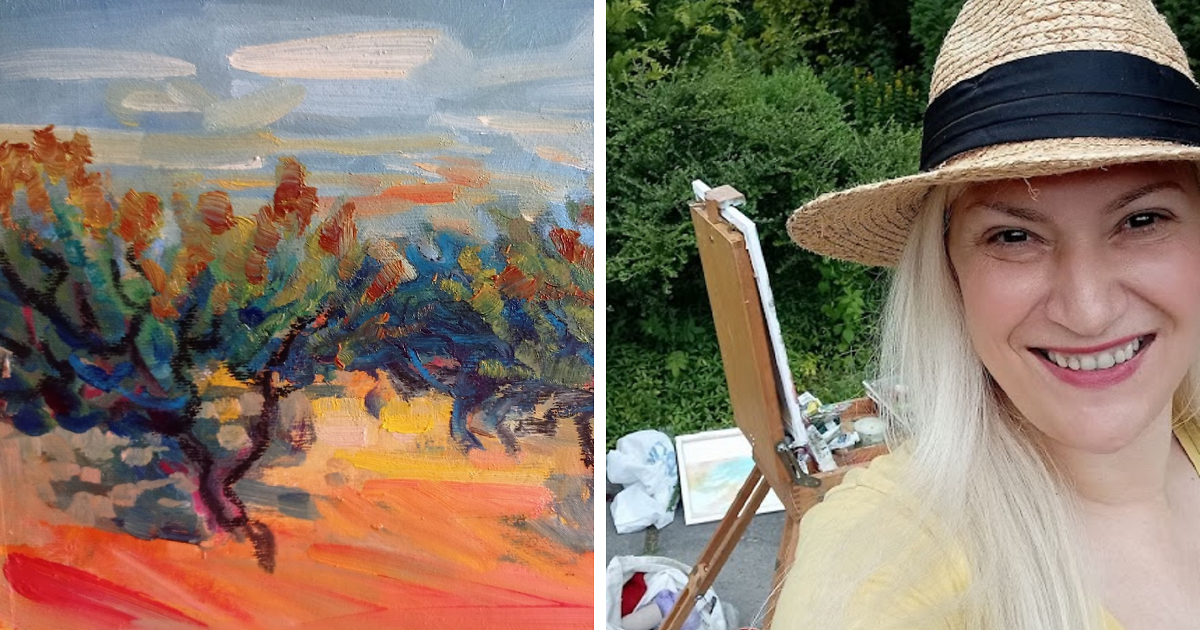
Painting outdoors in Dnipro is not a casual hobby; it is a conversation with wind, river light, cracked sidewalks, old trees, apartment blocks, church domes, industrial silhouettes, and a city that keeps standing when the world keeps testing it. Plein air painting asks an artist to show up with a portable easel, a small kit of paints, a stubborn amount of optimism, and the humility to admit that clouds do not care about your schedule.
My plein air landscapes from Dnipro began as sketches of place, but they became something larger: a record of resilience. Dnipro, a major city in south-central Ukraine, sits along the Dnieper River, where broad water, steep banks, bridges, parks, and working neighborhoods create a landscape that is both beautiful and unpolished. It is not a postcard city in the sugary sense. It has edges. It has weather. It has history under its fingernails. For a painter, that is gold.
The title “Painted Resilience” fits because every outdoor canvas from Dnipro seems to hold two realities at once. There is the visible scene: sunlight on the river, a tram line, a cluster of poplars, the geometry of Soviet-era buildings, a quiet courtyard, a bench with peeling paint. Then there is the invisible scene: endurance, memory, alertness, loss, humor, and the daily decision to continue. A landscape is never just land. In Dnipro, it is testimony with a sky attached.
What Plein Air Painting Means in a City Like Dnipro
Plein air painting, from the French phrase meaning “in the open air,” is the practice of painting outside, directly from life. Instead of working from a photo in a controlled studio, the artist steps into the weather and lets the landscape argue back. The light changes. People pass by. A dog may inspect your brush water with deep professional interest. The wind may flip your canvas like it is auditioning for theater school.
That unpredictability is exactly the point. Plein air art captures the living pulse of a scene. It favors immediacy over perfection, observation over polish, and atmosphere over overthinking. In Dnipro, this approach feels especially honest. The city is not still. The river moves, traffic hums, sirens can interrupt ordinary afternoons, and the mood of the sky can shift from pearl gray to fierce gold in minutes.
The Landscape Is the First Teacher
When I paint outdoors in Dnipro, I do not begin by asking, “What should this painting say?” I begin by looking. Where is the light coming from? Which shapes carry the scene? What is the temperature of the shadows? Is the river blue, gray, green, silver, or all of them before lunch?
The landscape answers through details. The Dnieper River often becomes the visual anchor, a wide ribbon of reflected sky. The embankment offers long horizontal lines that calm the composition. Bridges add structure, while trees soften the city’s industrial rhythm. Even a patch of dry grass can become unexpectedly heroic when late-afternoon light hits it just right. Nature is dramatic. It simply has better manners than most actors.
Dnipro as a Subject: River, Steel, Memory, and Sky
Dnipro is a city of contrasts, and that makes it a powerful subject for landscape painting. Its beauty is not fragile or decorative. It is practical, muscular, and alive. The Dnieper River brings openness and reflection. The city’s industrial heritage gives its skyline weight. Parks and courtyards offer pockets of tenderness. Historic streets and renamed avenues carry the marks of changing identity.
For a plein air painter, these contrasts are irresistible. A single view may include water, concrete, trees, apartment windows, a church roof, and a sky big enough to humble everybody. This mixture keeps the eye moving and gives each painting emotional range. Dnipro does not ask to be idealized. It asks to be seen clearly.
The Dnieper River as a Living Line
The river is more than scenery. It is movement, history, and orientation. When painting near the water, the first challenge is value: the river often reflects the sky more than it reveals its own color. On bright days, it can become a sheet of broken light. On overcast days, it turns heavy and quiet, like polished metal. At sunset, it can suddenly look theatrical, as if someone backstage spilled orange paint across the horizon.
In my Dnipro landscapes, the river often functions as a breathing space. It gives the composition room. It also gives the viewer a place to pause. In a city shaped by pressure and endurance, that pause matters. The water says, “Keep moving.” The banks say, “Hold your ground.” A good painting needs both.
Industrial Forms and Urban Poetry
Not every landscape needs a meadow and a cow looking philosophical. Some of the strongest Dnipro scenes come from industrial forms: cranes, bridges, rail lines, warehouses, distant smokestacks, and apartment blocks catching the evening sun. These structures create bold shapes and strong perspective, which are useful for composition.
They also tell the truth about the city. Dnipro has long been associated with engineering, manufacturing, and strategic importance. Painting only its soft corners would feel incomplete. The industrial landscape has its own poetry: rust, rhythm, repetition, shadow, and the stubborn elegance of things built to work rather than charm. When warm light hits concrete, even the most practical building can briefly become a cathedral. A very boxy cathedral, perhaps, but still.
Painting Resilience Without Turning It Into a Slogan
Resilience is a word that can become thin if used too casually. In Dnipro, resilience is not a motivational poster taped above a desk. It is visible in ordinary behavior: people going to work, repairing windows, walking children to school, buying bread, planting flowers, meeting friends, and making art while uncertainty hangs in the air.
The challenge for the artist is to paint resilience without forcing it. A landscape does not need a dramatic symbol in every corner. Sometimes resilience appears in a sunlit balcony. Sometimes it is a woman carrying groceries across a square. Sometimes it is a tree blooming near a damaged wall. Sometimes it is the decision to set up an easel outdoors at all.
Color as Emotional Weather
Color carries emotion before the viewer even identifies the subject. In my plein air landscapes from Dnipro, I often use restrained grays, river blues, dusty greens, and warm ochres. These tones match the city’s atmosphere and prevent the painting from becoming sentimental. Then I add small notes of brighter color: a red coat, a yellow bus, a blue railing, a pink cloud, a shop sign, a child’s hat.
Those accents matter. They remind the viewer that life is not a single mood. Even in difficult times, color appears. It sneaks in through laundry on a balcony, fruit at a market stall, spring flowers near a walkway, or sunlight bouncing off windows. Color becomes a form of witness: modest, specific, and stubbornly alive.
Brushwork That Lets the City Breathe
Plein air brushwork must be decisive because the scene changes quickly. I use broader strokes for skies and river reflections, sharper edges for buildings and bridges, and broken marks for trees, grass, and moving figures. The goal is not to describe every brick. The goal is to capture the sensation of being there.
Too much detail can make a painting stiff. Dnipro is not stiff. It is restless, layered, and alert. Loose brushwork allows the surface to vibrate. It lets the viewer feel wind moving through leaves, light flickering on water, and the quiet tension of a city that has learned to continue under pressure.
The Human Side of Outdoor Painting in Dnipro
Painting outside always attracts attention. In Dnipro, passersby often become part of the experience. Some people stop and watch silently. Some nod and continue. Some offer advice with the confidence of retired museum directors, even if their main qualification is owning a very opinionated scarf.
These interactions are part of the artwork’s memory. A man may point out that I made the bridge too short. A child may ask why the water is purple. An older woman may tell me the courtyard looked different decades ago. Each comment adds another layer to the place. Plein air painting is solitary work, but it is never completely private.
Why People Recognize Their City in Paint
A painted landscape can feel more personal than a photograph because it shows attention. When people see familiar streets, riverbanks, or parks translated into brushstrokes, they often recognize not just the location but the feeling of living there. The slight exaggeration of warm light, the softened edge of a building, the mood of the skythese choices can reveal the emotional truth of a place.
That is why Dnipro makes such a meaningful subject. Residents know the city’s practical face, but painting can uncover its quiet lyricism. A bus stop becomes a composition of rectangles and shadows. A riverside path becomes a ribbon of movement. A gray morning becomes a study in silver. The ordinary becomes visible again.
How I Choose a Scene for a Dnipro Plein Air Painting
Choosing a scene is part instinct, part strategy, and part negotiation with the nearest patch of shade. A beautiful view is not always a paintable view. The best plein air subjects need a clear structure: a strong light pattern, interesting shapes, and a focal point that gives the viewer somewhere to land.
In Dnipro, I often look for three elements. First, a strong horizontal or diagonal line, such as the riverbank, a bridge, a road, or a row of buildings. Second, a contrast between natural and built forms. Third, a mood that feels specific to the day. A painting should not look like “generic city with river.” It should feel like Tuesday at 5:40 p.m. after rain, when the clouds are lifting and everyone is pretending not to be cold.
Morning Light
Morning in Dnipro can be beautifully restrained. The colors are cooler, the shadows longer, and the city seems to clear its throat before beginning the day. Morning is ideal for painting quiet river scenes, empty paths, and soft architectural silhouettes. The challenge is speed: the sun climbs quickly, and the delicate first light can disappear before the first layer of paint stops looking confused.
Afternoon Energy
Afternoon brings movement. Streets fill, reflections sharpen, and the city’s geometry becomes more assertive. This is the best time for urban compositions with people, traffic, and strong contrasts. The danger is overcomplication. Dnipro offers so much visual information that the painter must edit ruthlessly. Not every lamppost deserves a starring role. Some must accept their destiny as background.
Evening Atmosphere
Evening is when Dnipro becomes cinematic. Warm light catches windows, the river darkens, and the sky often delivers more drama than requested. For plein air painting, evening offers emotional richness but limited time. The artist must work fast, simplify shapes, and commit to the main color relationships before the scene changes completely.
Techniques That Help Capture Dnipro’s Mood
Painting Dnipro outdoors requires flexible technique. The city’s atmosphere can be subtle one moment and intense the next. A successful plein air landscape depends on preparation, observation, and the ability to stop before the painting becomes overworked.
Start With a Strong Value Design
Before adding color, I establish the darks, midtones, and lights. This value structure holds the painting together. In Dnipro, strong value patterns often come from bridges, tree masses, building shadows, or the contrast between bright sky and darker riverbank. If the value design works, the painting can survive loose brushwork and changing light.
Limit the Palette
A limited palette helps maintain harmony. For Dnipro landscapes, I like combinations that can create muted urban tones and lively natural colors: ultramarine blue, burnt sienna, yellow ochre, cadmium red, titanium white, and a cool green or viridian when needed. With a small palette, the painting feels unified rather than decorated like a holiday cookie that lost adult supervision.
Paint the Big Shapes First
Outdoor painting rewards simplification. I block in the sky, river, land, buildings, and tree masses before touching smaller details. This prevents the painting from becoming a collection of unrelated objects. Dnipro’s complexity needs organization. Big shapes create calm; details create life. The trick is knowing when to invite the details to the party and when to leave them outside with the snacks.
Why Dnipro Landscapes Matter Now
Landscape painting can seem quiet compared with headlines, but quiet things can carry great force. A plein air painting made in Dnipro records more than scenery. It records presence. It says: this place exists, this light fell here, this river moved here, these people lived here, and someone stopped long enough to pay attention.
In times of disruption, attention becomes an act of care. Painting a park, a street, or a riverbank may not change history, but it preserves a human scale within it. It refuses to let a city be reduced only to conflict, statistics, or damage. Dnipro is also morning coffee, wet pavement, balcony plants, drifting clouds, stubborn trees, and the glow of evening windows.
Art as Cultural Memory
Every city needs images of itself that are made with affection and honesty. Dnipro’s landscapes deserve to be painted not as background but as cultural memory. The river, neighborhoods, museums, parks, and industrial edges all belong to the visual identity of the city. When artists paint them, they help build an archive of feeling.
This is especially important for places undergoing rapid change. Streets are renamed, buildings are repaired or lost, public spaces evolve, and personal memories become attached to specific views. A plein air painting can hold a moment before it shifts. It becomes both artwork and evidence: not official evidence, perhaps, but emotional evidence, which is often what people carry longest.
Experience Notes: What Painting Dnipro Taught Me
My most meaningful experiences painting in Dnipro have rarely come from perfect conditions. In fact, perfect conditions are suspicious. When the sky is flawless, the temperature pleasant, and no one asks whether you are “almost done,” something feels missing. The paintings that stay with me usually begin with a small inconvenience: a sudden wind, a crooked easel leg, a cloudbank swallowing the sun, or a curious stranger who stands directly in the view with the confidence of a monument.
One morning near the river, I set up to paint a calm view of the embankment. The composition seemed simple: water in the foreground, a line of trees, pale buildings beyond, and a soft sky. Within twenty minutes, the light changed completely. The gentle gray morning turned bright and sharp. My careful first washes suddenly looked too sleepy for the scene. I had two choices: chase the new light or preserve the first impression. I chose the first impression. That decision taught me something essential about plein air painting: the painting is not a surveillance camera. It does not have to record every change. It has to remain loyal to the moment that made you stop.
Another time, I painted a courtyard where laundry moved between apartment balconies. The scene was ordinary, almost too ordinary at first glance. But the more I looked, the more it opened. The hanging clothes created small flags of color. The windows formed a grid. A tree leaned across the composition like it had gossip to share. Someone had placed flowers in a repurposed container near the entrance. Nothing was grand, yet everything felt human. That painting reminded me that resilience is often domestic. It is not always heroic in the cinematic sense. Sometimes it is clean shirts drying in the wind.
Painting in public also changed how I understand the relationship between artist and city. In a studio, the artist controls the environment. Outdoors, the city participates. Dnipro has interrupted me with traffic, conversations, bells, wind, construction noise, and sudden silences. At first, these interruptions felt like obstacles. Later, I began to see them as part of the work. The city was not disturbing the painting; the city was entering it.
I have also learned to respect unfinished edges. Some Dnipro scenes do not need to be polished into neatness. A rough passage of paint can better express broken pavement, moving leaves, or uncertain weather. A visible brushstroke can feel more truthful than a blended surface. This matters because Dnipro itself is not a smooth decorative object. It is layered, practical, wounded in places, proud in others, and full of unexpected beauty.
The greatest lesson, however, is that painting outside trains hope. Not easy hope. Not greeting-card hope with a butterfly and suspiciously perfect handwriting. Real hope. The kind that packs brushes, walks to the river, studies the sky, and begins again. Each Dnipro landscape I paint tells me that attention is a form of loyalty. To look closely at a place is to say it matters. To paint it is to make that attention visible.
Conclusion: A City Painted in Light and Endurance
“Painted Resilience: My Plein Air Landscapes From Dnipro” is more than a title. It is a way of seeing. Dnipro’s landscapes hold river light, urban strength, cultural memory, and everyday courage. Through plein air painting, the city becomes immediate and intimate: not an abstract symbol, but a living place made of weather, architecture, movement, and people who continue.
For artists, Dnipro offers a rare combination of visual drama and emotional depth. Its river opens the composition. Its industrial forms add structure. Its parks and courtyards bring tenderness. Its changing skies provide endless challenge. Most of all, its resilience gives the paintings a pulse.
To paint Dnipro outdoors is to accept uncertainty and work anyway. That may be the deepest connection between plein air art and the city itself. The light changes. The wind rises. The world refuses to hold still. So the artist adjusts, observes, and keeps painting.
Note: This article is written as original, publication-ready HTML content based on synthesized public information about Dnipro, plein air painting, landscape art, and Ukrainian cultural resilience. No raw source links or unnecessary content reference markers are included.