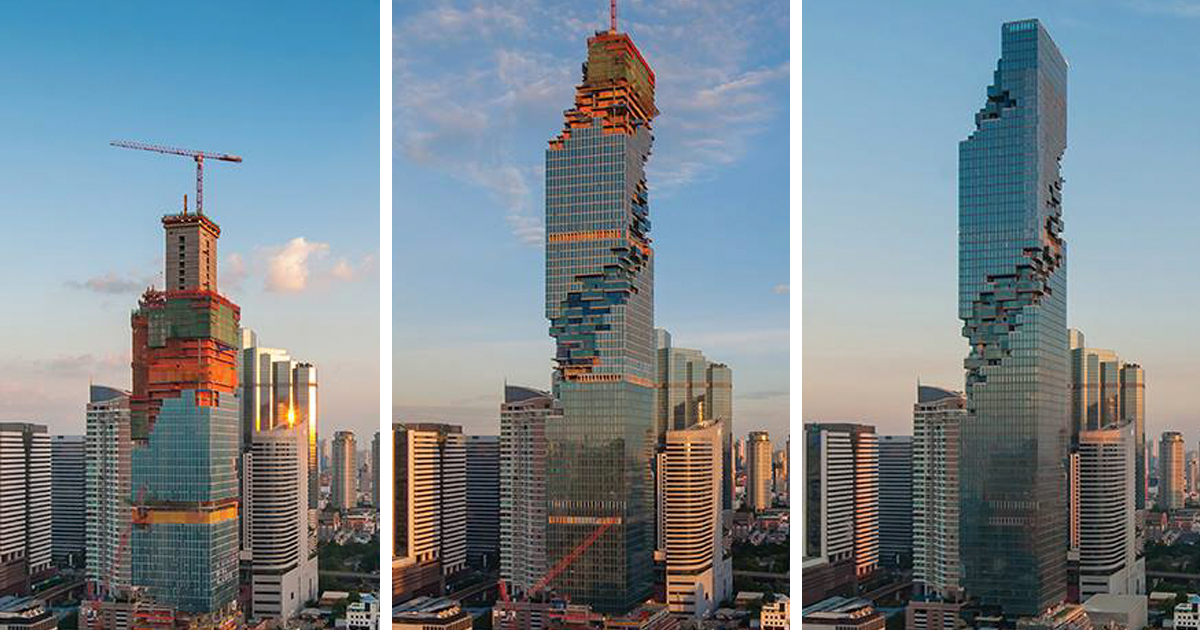
Bangkok has never been shy about making an entrance. This is a city where golden temples gleam beside luxury malls, street food sizzles under neon signs, and rooftop bars compete to see who can make visitors say, “Wait, are we above the clouds now?” But even in a skyline full of drama, one building looks like it forgot to finish rendering: King Power Mahanakhon, the pixelated skyscraper that turned Thailand’s high-rise race into a full-blown architectural plot twist.
Formerly known simply as MahaNakhon, this 314-meter tower became Thailand’s tallest building when it opened, and even though it later lost that height crown, it still wins the award for “most likely to make tourists stop mid-sidewalk and point upward.” Its most famous feature is not a spire, dome, or shiny crown. It is a jagged spiral of cutaway blocks that wraps around the glass tower like someone took a giant digital eraser to the building. In other words, it looks like Bangkok downloaded a skyscraper and the Wi-Fi briefly gave up.
But those “missing pixels” are not a construction accident, a budget problem, or the result of an architect playing Minecraft during office hours. They are the whole point. Designed by Büro Ole Scheeren, MahaNakhon was created to challenge the smooth, sealed-off skyscraper. Instead of standing as a simple glass column, it breaks open visually, revealing terraces, skyboxes, balconies, and human-scaled spaces inside the vertical city.
Meet King Power Mahanakhon: Bangkok’s Glitched-Out Landmark
King Power Mahanakhon sits in Bangkok’s Silom/Sathon business district, close to Chong Nonsi BTS station. That location matters. This is not a lonely tower dropped randomly into the city like a fancy toothpick. It rises from one of Bangkok’s busiest commercial areas, surrounded by offices, hotels, restaurants, transit, and the never-ending choreography of motorbikes, taxis, pedestrians, and food carts.
When the tower officially debuted in 2016, it was recognized as Thailand’s tallest building. At roughly 314 meters and 77 to 78 floors depending on how the levels are counted, it overtook older Bangkok icons such as Baiyoke Tower II. For a time, MahaNakhon was the tallest statement in Thailand’s skyline. Later, newer riverside towers edged past it, but height is only one way to measure a skyscraper. In memory, photography, and pure “what am I looking at?” power, MahaNakhon remains hard to beat.
The tower is mixed-use, which is architecture-speak for “a lot is happening in one very tall package.” It includes luxury residences, hotel space, retail, restaurants, and the King Power Mahanakhon SkyWalk, one of Bangkok’s most famous observation experiences. The tower is also associated with The Ritz-Carlton Residences and The Standard, Bangkok Mahanakhon, making it not just a building to look at but a vertical neighborhood for living, staying, dining, shopping, and standing on glass while pretending your knees are totally fine.
Why Does It Look Like It’s Missing Pixels?
The visual trick that made MahaNakhon famous is its “pixelated” ribbon. From a distance, the tower looks like a clean glass prism that has been carved, chipped, or digitally dissolved in a spiral pattern. This ribbon curls around the building from bottom to top, interrupting the smooth façade with cuboid cutouts and projections.
That effect is not just decoration. The carved-looking sections create terraces, balconies, skyboxes, and indoor-outdoor spaces. In a tropical city like Bangkok, where outdoor life is part of the rhythm of the place, this makes the tower feel more connected to the city than a typical sealed glass skyscraper. Instead of saying, “Look at me, I am a perfect corporate rectangle,” MahaNakhon says, “Come closer; there is life inside this thing.”
Ole Scheeren’s design philosophy for the tower was partly about breaking down the idea of the skyscraper as a smooth, silent object. Many modern towers are elegant but emotionally distant. They reflect the city but do not seem to belong to it. MahaNakhon does the opposite. It looks interrupted, animated, and slightly rebellious. The missing-pixel pattern suggests movement, as if the city has climbed the building and left a digital trail behind.
That is why the building has become so photogenic. During the day, sunlight catches its fractured surfaces and makes the façade look sharp and sculptural. At night, the tower becomes even more theatrical, with light running across the pixelated edges like a futuristic circuit board. It is one of those rare buildings that looks equally at home in an architecture magazine, a travel vlog, and someone’s “Bangkok trip, day two” photo dump.
The Opening: A Light Show for a Skyscraper That Already Looked Electric
When MahaNakhon opened to the public, Bangkok did not exactly whisper about it. The tower’s debut was marked with a major light show, emphasizing the pixelated cuts that made the building instantly recognizable. This was smart branding as much as celebration. If a skyscraper looks like it has been sliced by digital lightning, you might as well introduce it with actual light.
The public opening helped position the tower as a symbol of contemporary Bangkok: ambitious, global, photogenic, luxurious, and a little bit wild. In a city already known for visual contrasts, MahaNakhon added a new layer. It was not a temple, not a mall, not a colonial relic, and not a traditional corporate tower. It was Bangkok in high-resolution chaos: polished, vertical, surprising, and impossible to ignore.
The later opening of the observation deck and SkyWalk made the building even more accessible. Instead of being an exclusive object for residents and hotel guests, the upper levels became a public attraction. Visitors could ride up, look across the city, and experience Bangkok from a height that turns traffic into toy cars and the Chao Phraya River into a silver ribbon winding through the urban sprawl.
Inside the Tower: More Than a Pretty Glitch
It would be easy to treat King Power Mahanakhon as a visual stunt, but the building’s program gives it real depth. Its luxury residences are among the most prestigious addresses in Bangkok, offering private living spaces with sweeping city views. The hotel component brings international hospitality into the tower, while restaurants and retail areas connect it to Bangkok’s lifestyle scene.
The SkyWalk is the most public-facing attraction. Located near the top of the building, it offers panoramic views of Bangkok and includes a glass-floor experience that has become one of the city’s signature tourist moments. Visitors step onto a transparent platform high above the street, look down, and suddenly remember every life choice that led them there. It is thrilling, slightly ridiculous, and perfect for anyone who wants a vacation photo that says, “I am brave, but only after signing a waiver.”
From the top, Bangkok becomes easier to understand. The city is famously sprawling, but from MahaNakhon, its patterns reveal themselves. You can see dense business districts, elevated train lines, clusters of towers, older neighborhoods, temple roofs, and the river bending through the city. The view explains why Bangkok’s skyline keeps growing: this is not just a tourist capital, but a major economic and cultural hub in Southeast Asia.
How MahaNakhon Changed Bangkok’s Skyline
Before MahaNakhon, Bangkok already had tall buildings. Baiyoke Tower II, completed in the late 1990s, had long been one of the city’s best-known vertical landmarks. But MahaNakhon brought a different kind of identity. It did not rely only on height. It relied on shape.
That distinction matters because skyscraper cities often fall into a familiar competition: who can build taller, shinier, and more expensive? MahaNakhon entered that game, but it also changed the rules. Its pixelated design gave Bangkok a silhouette that was instantly recognizable internationally. Many cities have glass towers. Far fewer have one that looks like a digital sculpture caught halfway between completion and collapse.
The tower also reflects Bangkok’s transition from a city known mainly for temples, markets, and nightlife into a city increasingly recognized for design, luxury travel, and contemporary architecture. That does not mean the old Bangkok disappeared. The magic of the city is that the old and new continue to overlap. A visitor can eat noodles from a street vendor, ride the BTS past luxury malls, and then end the day on top of a pixelated skyscraper with a skyline view. Bangkok does not choose one identity. It stacks them, sometimes 78 floors high.
The Architecture: A Skyscraper That Refuses to Behave
Architecturally, MahaNakhon is interesting because it challenges the “perfect tower” idea. Many skyscrapers aim for purity: a clean line, a symmetrical form, a smooth envelope. MahaNakhon appears to break that envelope. Its façade looks torn open, but in a controlled way. The missing-pixel design creates visual tension between order and disruption.
The building still has a clear geometric form. It is not random. The main tower reads as a strong vertical prism, while the pixelated spiral introduces complexity. That balance is why the design works. If the whole building were chaotic, it might feel messy. If it were completely smooth, it might feel forgettable. Instead, MahaNakhon lands in the sweet spot: disciplined enough to be elegant, strange enough to be memorable.
The tropical context also gives meaning to the carved spaces. Bangkok’s climate encourages shaded terraces, outdoor dining, and semi-open areas. The tower’s cutaways suggest that life can spill outward, even hundreds of meters above the street. That idea feels especially appropriate in a city where indoor and outdoor life often blur together.
Why People Love Photographing the “Missing Pixels”
Some buildings are impressive in person but oddly boring in photos. MahaNakhon is the opposite. Its pixelated form gives cameras something to grab. From one angle, it looks like a skyscraper being unzipped. From another, it resembles a stack of glass blocks interrupted by a digital storm. At sunset, the shadows deepen the cutouts. At night, the tower can look like it is loading into reality one square at a time.
This makes it ideal for modern travel culture. Visitors do not just want to see landmarks; they want landmarks that create a story in one frame. MahaNakhon does that instantly. You do not need a long caption to explain why it is unusual. A single photo says it: Bangkok built a skyscraper, then made it look like the future got slightly corrupted.
That visual identity also helps the tower stand out in a competitive tourism market. Bangkok has no shortage of attractions, from the Grand Palace to Chatuchak Market to riverside hotels and rooftop bars. King Power Mahanakhon adds a modern architectural stop to the itinerary, especially for travelers interested in design, city views, or mild altitude-based panic.
Is King Power Mahanakhon Still Thailand’s Tallest Building?
Here is where the headline needs a careful update. MahaNakhon was Thailand’s tallest building when it opened and held that status from 2016 until it was surpassed by newer developments, including towers in the ICONSIAM area. Today, it is no longer the absolute tallest building in Thailand. However, it remains one of the tallest, most famous, and most visually distinctive skyscrapers in the country.
That does not weaken its importance. In fact, it proves something important about architecture: records fade, but identity lasts. A building can lose the height crown and still dominate the conversation. MahaNakhon may no longer be the tallest by measurement, but it is still one of Thailand’s strongest architectural brands. People remember the pixel tower. They ask about it. They photograph it from hotel rooms, sky bars, trains, sidewalks, and traffic jams.
In a skyline that keeps growing, recognizability is its own kind of height.
What Visitors Can Expect at the Mahanakhon SkyWalk
The Mahanakhon SkyWalk is one of the easiest ways to experience the tower beyond admiring it from the street. Visitors typically enter through the lower levels, ride a high-speed elevator upward, and emerge into an observation area with broad city views. The star attraction is the glass tray, where people can stand above the city and look straight down.
The experience is part sightseeing, part theater. Staff help manage the flow of visitors, and the setting is designed for photos. On clear days, the view stretches far across Bangkok. In the late afternoon, the light can be spectacular, especially as the city shifts from daytime haze to evening glow. At night, Bangkok becomes a glittering grid of roads, towers, and moving headlights.
For travelers, the best part is how the tower connects different versions of Bangkok. From the top, you can see the business district, luxury hotels, older neighborhoods, transit lines, and distant riverfront development. It is a reminder that Bangkok is not one simple postcard. It is a living, expanding city with layers of history, commerce, creativity, and very determined traffic.
Experience Section: A Day With Bangkok’s Pixel Skyscraper
The best way to experience King Power Mahanakhon is to let it sneak up on you. You might first spot it from the BTS, rising between other towers like a normal skyscraper until your brain catches the strange part. Then you notice the spiral of missing blocks. For a second, it looks like a glitch in the skyline. You blink. The pixels are still gone. That is when the building wins.
Arriving near Chong Nonsi station, the tower feels less like a distant postcard and more like a vertical event. The street level is busy, polished, and very Bangkok: commuters moving quickly, tourists moving slowly, office workers holding iced coffee, and someone somewhere probably deciding that a sidewalk is an acceptable motorbike lane. Above all of it, the tower rises with its impossible-looking cuts, as if it has been carved by a giant invisible hand.
The elevator ride up adds to the sense of occasion. Modern observation decks understand suspense. You do not just go up; you are transported into the brand. By the time the doors open, you are ready for the view, and Bangkok delivers. The city spreads out in every direction, dense and restless. High-rises cluster like metallic trees. Roads curve and tangle. The river glints in the distance. Even if you have spent days walking through Bangkok, seeing it from above feels like reading the map after wandering through the story.
Then comes the glass tray. This is the moment when confident people become philosophers. Standing on transparent glass hundreds of meters above the ground is perfectly safe, but your ancient survival software does not care about engineering certificates. Your feet say yes. Your stomach says, “Let’s discuss this as a team.” Some visitors walk out casually. Others shuffle forward like penguins with mortgages. Everyone, eventually, looks down.
What makes the experience memorable is not only the height. It is the contrast. Bangkok at street level is noisy, fragrant, warm, and immediate. Up here, the same city becomes quiet and patterned. You can still imagine the food stalls, the tuk-tuks, the mall entrances, the temple courtyards, and the office towers, but they become part of a larger system. The view turns Bangkok from a rush of moments into a grand urban composition.
As sunset approaches, the tower’s pixelated identity becomes even stronger. Light hits the cutaways differently, and the building’s edges seem to sharpen against the sky. From nearby rooftops or hotel windows, MahaNakhon looks almost cinematic. It is not just tall; it has character. Many skyscrapers want to impress you. This one seems to wink at you first.
For travelers who love architecture, King Power Mahanakhon is worth more than a quick photo stop. It shows how a building can become a city symbol without copying tradition. For casual visitors, it is simply fun: a dramatic tower, a wild view, and a glass floor that turns everyone into either a hero or a very polite coward. For Bangkok, it is a sign that the city’s future will not be boring. It may be shiny, vertical, luxurious, and occasionally pixelated, but boring is clearly not on the menu.
Final Thoughts: The Beauty of a Building That Looks Broken on Purpose
King Power Mahanakhon proves that a skyscraper does not need to be perfectly smooth to be powerful. In fact, its apparent imperfection is what makes it unforgettable. The missing pixels are not a flaw; they are a visual language. They turn a tall building into a conversation, a tourist attraction, and a symbol of Bangkok’s modern confidence.
When it opened, MahaNakhon claimed Thailand’s height record. Today, even after being surpassed, it continues to claim attention. That is the real achievement. Anyone can measure meters. It is much harder to build something people remember after they leave the city.
Bangkok has always been a place of layers: ancient and modern, spiritual and commercial, chaotic and elegant. MahaNakhon fits that personality perfectly. It is polished but playful, luxurious but strange, futuristic but deeply tied to the urban life around it. It looks like it is missing pixels, but maybe that is the joke. The tower is not missing anything. It found a way to make absence iconic.
Note: This article is written as original SEO content based on real publicly available information about King Power Mahanakhon, its design, public opening, observation deck, architectural concept, and role in Bangkok’s skyline.