Note: This web-ready draft is written in standard American English, formatted for publication, and intentionally omits inline source links.
Following Seinfeld was always going to be a dangerous hobby. How do you top a sitcom that made waiting for a table, finding a marble rye, and arguing about soup feel like high art? You do not. You absolutely do not. Yet television executives, stars, and producers kept trying to bottle that same weird lightning. The result was a string of post-Seinfeld projects that looked promising on paper, sounded marketable in meetings, and then hit the screen with all the grace of George Costanza attempting an athletic feat.
To be fair, not every project connected to the Seinfeld legacy was bad. Some were simply mismatched. Some were overhyped. Some had one smart idea buried under six bad ones. And some seemed to be built on the mistaken belief that viewers did not want something new; they just wanted a slightly rearranged version of Jerry, George, Elaine, and Kramer wearing different hats. That was never going to work. The magic of Seinfeld came from chemistry, rhythm, timing, and a glorious commitment to social pettiness. Once you removed that ecosystem, all that remained was the terrifying possibility that a catchphrase, a famous face, or a familiar brand of neurosis would have to do the heavy lifting.
So let us revisit five of the weakest, strangest, or most awkward attempts to follow up Seinfeld. Some were canceled fast. Some limped along longer than expected. All of them reveal the same lesson: you cannot build a new comedy classic by chasing the ghost of an old one and hoping the ghost still knows how to hit its marks.
Why Following Seinfeld Was So Hard
Before we rank the lamest attempts, it helps to understand why the post-Seinfeld hangover was so intense. The original show was not just successful; it rewired sitcom expectations. It made selfishness funny, made anti-growth into a philosophy, and proved that a series could be “about nothing” while actually being about modern anxiety, vanity, and the thousand tiny humiliations of everyday life.
That meant every follow-up got judged against an impossible standard. Audiences did not just want Michael Richards to be funny. They wanted him to be funny in that precise Kramer way. They did not just want Jason Alexander to star in a sitcom. They wanted a new George without calling him George. Julia Louis-Dreyfus faced the same trap, except with the added burden of having played one of TV’s sharpest comic characters. And Jerry Seinfeld himself discovered that being a comedy icon does not mean every idea deserves a network order and a giant premiere slot.
In other words, these shows were not merely trying to succeed. They were trying to prove that the so-called “Seinfeld curse” was nonsense. That is a lot of pressure to put on a multi-camera comedy with a shaky premise and two good jokes.
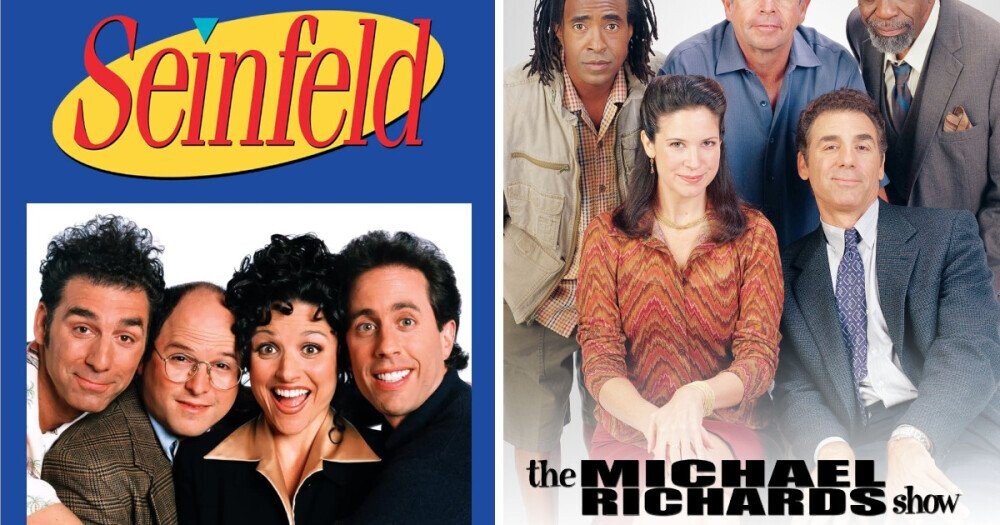
1. The Michael Richards Show: Kramer, But Make Him a Private Investigator
What it was trying to do
The Michael Richards Show took one of television’s most gifted physical comedians and handed him a premise that sounded suspiciously like a dare. Richards played a bumbling private investigator, a character who was quirky, flailing, and clearly designed to let him do variations on the elastic, off-balance style that made Kramer such a phenomenon. On a whiteboard in some NBC office, this probably looked bulletproof. “People love Michael Richards. People love oddballs. People sort of like mysteries. Boom. Lunch?”
Why it fell flat
The problem was obvious the moment the show began: it did not feel like a fresh role. It felt like someone had taken Kramer, stripped away the supporting cast that made him sparkle, and tossed him into a louder, weaker show. Richards’ talent was still visible, but the writing treated that talent like a cheat code. Instead of building a smart comic world around him, the series leaned too hard on broad shtick, frantic movement, and the hope that audiences would confuse familiar mannerisms with actual laughs.
That is the central tragedy of this show. Richards was not the problem. The show was. Physical comedy works best when it has structure, contrast, and stakes. Kramer bursting into Jerry’s apartment worked because it disrupted an already humming comic system. A random detective series built around “Look, he is doing weird stuff again!” is not a system. It is a hostage situation with canned laughter.
Among all the early post-Seinfeld stumbles, this one may be the clearest example of a series misunderstanding what audiences loved in the first place. People did not want Kramer unplugged. They wanted good comedy. Instead, they got a gimmicky vehicle that felt assembled from leftover parts.
2. Bob Patterson: George Costanza as a Self-Help Guru
A premise that practically begged for irony
If you pitched Jason Alexander as a smug motivational speaker who cannot quite hold his own life together, that sounds promising. In theory, Bob Patterson had comic potential. Alexander excels at bluster, insecurity, and collapsing ego. A self-help celebrity with a cracked foundation could have been a terrific satirical target, especially in the early 2000s, when personal-brand gurus were becoming their own weird American species.
Why it never clicked
But Bob Patterson did not turn its premise into a sharp comedy. It turned it into a strain. The series leaned into the star’s neurotic energy without giving him the Seinfeld ecosystem that made that energy sing. George Costanza worked because the show knew exactly how pathetic, manipulative, and doomed he was. Bob Patterson was murkier. Was Bob supposed to be a fraud? A jerk? A lovable mess? A guy in spiritual free fall? The answer seemed to change depending on the scene.
That tonal confusion mattered. Sitcom audiences will follow an unpleasant character if the show knows what it is doing. They will even follow a monster if the writing is precise enough. But Bob Patterson often felt like it wanted Alexander’s trademark panic while also asking viewers to buy into the character as a viable lead. The result was a show that mistook frantic energy for comic design.
There is also something darkly hilarious about the symbolism here. George Costanza, the patron saint of bad instincts, spiritually reappearing as a life coach is funny in concept. But the show never squeezed that irony hard enough. It just stood there in a nice suit, smiling weakly, while the audience wondered whether it had accidentally wandered into a seminar at an airport hotel.
3. Watching Ellie: An Interesting Experiment That Still Could Not Escape the Shadow
The most ambitious failure on this list
Calling Watching Ellie lame requires a little nuance, because it was also the most inventive project here. Julia Louis-Dreyfus starred as Ellie, and the first version of the show used a real-time format, presenting a 22-minute slice of her life as a full episode. That was ambitious. That was different. That was at least trying not to be Seinfeld 2.0 in a cheap wig.
So why is it on this list?
Because ambition alone does not save a sitcom. The real-time gimmick gave Watching Ellie a hook, but a hook is not a heartbeat. At times the series felt like it was working overtime to prove how clever its structure was, instead of making the characters feel vivid enough that viewers would care whether the clock was ticking. The experiment was admirable, but admiration is not the same thing as laughter.
Louis-Dreyfus herself was never the issue. She brought intelligence, looseness, and comic control to the role. In fact, that may be why the show remains such a frustrating artifact. You can see the talent. You can see the intent. You can even see moments where the series almost becomes something special. But “almost” is the loneliest word in TV comedy.
Then came the even stranger twist: the show later shifted into a more conventional sitcom format, which made it feel like it had lost the one genuinely distinctive thing about it. That pivot exposed the deeper problem. Watching Ellie was caught between wanting to be an artistic corrective to the Seinfeld curse narrative and wanting to survive as an NBC sitcom. It never fully solved that identity crisis.
So yes, it was better than some titles on this list. But it still counts as one of the lamest follow-ups because it proved that even a smart, creative swing can look awkward when the audience is measuring every beat against Elaine Benes at full power.
4. Listen Up!: Jason Alexander Tries Again, and the Room Gets Quiet
The setup
After Bob Patterson stumbled, Jason Alexander returned to sitcom territory with Listen Up!, a series loosely based on sportswriter and TV personality Tony Kornheiser. Alexander played a columnist and broadcaster juggling family life, work, and his own chronic irritability. In simpler terms, this was another chance to package his exasperated, high-strung persona inside a mainstream network comedy.
The trouble with “perfectly fine”
The biggest problem with Listen Up! was not that it was disastrous. It was that it was ordinary. Disastrous at least leaves a scar. Ordinary just evaporates. The show had some competence, some recognizable sitcom mechanics, and a premise audiences could understand in one sentence. But nothing about it felt urgent, surprising, or specific enough to justify its existence in the post-Seinfeld landscape.
And that is death for a follow-up vehicle. If you are Jason Alexander starring in a new sitcom after playing George Costanza, “solidly acceptable” is not enough. Viewers need a reason to stop comparing. Listen Up! never supplied one. It let Alexander do a toned-down version of his familiar frustrations, but without the barbed insanity, social humiliation, and ensemble interplay that once made those frustrations hilarious.
The series wound up feeling like the television equivalent of reheated leftovers. Not rotten. Not inedible. Just sad in a way that makes you miss the original meal. It is one thing to build a sitcom around a recognizable persona. It is another thing entirely to build one that just reminds people they liked that persona better six years earlier with Larry David in the kitchen.
5. The Marriage Ref: Jerry Seinfeld’s Strange Detour Into Celebrity-Paneled Domestic Combat
Proof that even Jerry could misread the room
If the cast follow-up flops were about actors struggling to separate from beloved characters, The Marriage Ref was a different kind of post-Seinfeld misfire. This was Jerry Seinfeld stepping into the role of comedy tastemaker and bringing audiences a reality-panel hybrid in which celebrities weighed in on real married couples’ arguments. The concept was part game show, part talk show, part social experiment, and part “How did this get a prime-time rollout?”
Why it felt so wrong
Seinfeld’s genius has always depended on observation. He notices absurd behavior, strips it down, and turns it into clean, devastating comedy. The Marriage Ref somehow took that skill set and buried it under format clutter. Instead of sharp comic observation, viewers got bickering strangers, rotating celebrity commentary, and a tone that never settled on whether it was affectionate, mocking, or just exhausted.
Worse, the show seemed to believe that celebrity presence itself was funny. It is not. A famous person reacting to a domestic squabble is not a joke. It is an event coordinator’s idea of a joke. The series had the unmistakable odor of executive confidence: a whiff of “This has stars, a brand-name producer, and a broad premise, therefore America will definitely watch.” America did watch, briefly, largely to confirm that the whole thing was bizarre.
This is what makes The Marriage Ref such a fascinating late entry in the post-Seinfeld stumble file. It was not a desperate actor vehicle. It was a powerful creator swinging big and still missing the strike zone. Even Jerry Seinfeld, it turns out, cannot manufacture comic alchemy simply by standing near an NBC logo and inviting famous people to comment on other people’s marriages.
What These Failed Follow-Ups Got Wrong
All five projects made different mistakes, but they shared one fatal misunderstanding: they treated Seinfeld like a style that could be reproduced instead of a chemistry that happened once. Some leaned too hard on familiar comic personas. Some chased concept over character. Some mistook celebrity for substance. And some felt terrified of being different while also terrified of being compared to the thing they were obviously being compared to.
The original Seinfeld was not great because its stars were quirky in isolation. It was great because the show built a moral vacuum where those quirks could collide in perfect rhythm. Remove the collisions, and the quirks stop feeling like brilliance. They start feeling like old bits trying on new name tags.
The Real Legacy: The Best Follow-Up Was Finally Doing Something Else
The funniest twist in this whole saga is that the so-called answer to following Seinfeld was never to follow it at all. Julia Louis-Dreyfus truly broke free when she moved into projects that allowed her to build new comic identities rather than defend Elaine’s throne. Jerry Seinfeld did better when he embraced his own voice more directly. The mythology of a curse was always overblown, but the creative trap was real: once audiences know you as part of one of the greatest ensembles in TV history, your next smart move is not imitation. It is reinvention.
That is why these five attempts remain so instructive. They are not just weak shows. They are case studies in what happens when television mistakes familiarity for momentum. Everyone wanted the next Seinfeld. Instead, they got detective slapstick, motivational whining, a ticking sitcom experiment, a muted sports-family comedy, and celebrity marriage court. Somewhere, George would call that a bad streak. Jerry would call it a shame. Kramer would slide through a door and somehow make even this sound plausible.
Rewatching the Post-Seinfeld Era: The Experience of Seeing the Magic Miss the Landing
There is a very specific feeling that comes with revisiting these post-Seinfeld projects now, especially if you grew up with the original series looming over American comedy like Mount Neurotica. At first, the experience is almost exciting. You queue up one of these forgotten shows and think, “Maybe history was too harsh. Maybe there is an overlooked gem in here.” And for a few minutes, that hope feels reasonable. You recognize the faces. You hear rhythms that seem faintly familiar. You catch the occasional line reading that reminds you why these performers became stars in the first place.
Then the strange sadness sets in.
Not because the actors suddenly became untalented. They did not. In fact, rewatching these series often makes the opposite point. Michael Richards is still fearless with physical business. Jason Alexander still knows how to turn irritation into music. Julia Louis-Dreyfus still has that sharp, restless intelligence that can elevate an ordinary line. Jerry Seinfeld still understands comic premises better than most people in television. The disappointing part is seeing how often the surrounding material fails them. It is like watching elite athletes compete on a field made of pudding.
Another part of the experience is realizing how much Seinfeld depended on contrast. George was funnier because Jerry stayed dry. Kramer was funnier because Elaine could react with disbelief or contempt. Elaine was funnier because George and Jerry gave her space to spike the ball. Once you pull one person out of that machine and ask them to carry a whole new show, the balance changes. Some of these follow-ups do not just fail because the writing is weak. They fail because they reveal how perfectly engineered the original ensemble really was.
There is also a nostalgia trap for the audience. Viewers bring baggage to every follow-up. You are not meeting a new character with a blank slate. You are silently asking whether this person is as funny as Kramer, as sharp as Elaine, or as gloriously pitiful as George. That is not fair, but it is real. It shapes the experience whether the show wants it to or not. Watching these projects now, you can feel that burden in almost every scene, as if the actors are competing not only with the script in front of them, but with the memory of a much louder laugh from years earlier.
And yet that is what makes the whole post-Seinfeld era fascinating. These follow-ups are not just failed sitcoms or awkward TV experiments. They are artifacts of a culture trying to answer an impossible question: what comes after one of the most influential comedies ever made? The answer, as it turns out, was not another Seinfeld-adjacent clone. The answer was time, distance, and eventually letting these performers become something else entirely. Rewatching the misses makes the later reinventions feel even more satisfying. Sometimes the lamest attempt is still useful, because it shows you exactly which door should have stayed closed.
Conclusion
The five lamest attempts to follow up Seinfeld were not all equally awful, but they were united by one big problem: each one misread what made the original show untouchable. Some copied surface quirks. Some hid behind gimmicks. Some trusted star power to do the writing’s job. None of them recreated the balance, tension, and beautifully petty chaos that made Seinfeld a legend.
That is the final joke, really. A sitcom famous for being about nothing ended up being impossible to follow because it was secretly about everything awkward, selfish, and absurd in modern life. Once that formula was gone, TV spent years trying to fake it. The results were sometimes fascinating, occasionally watchable, and often very, very lame.