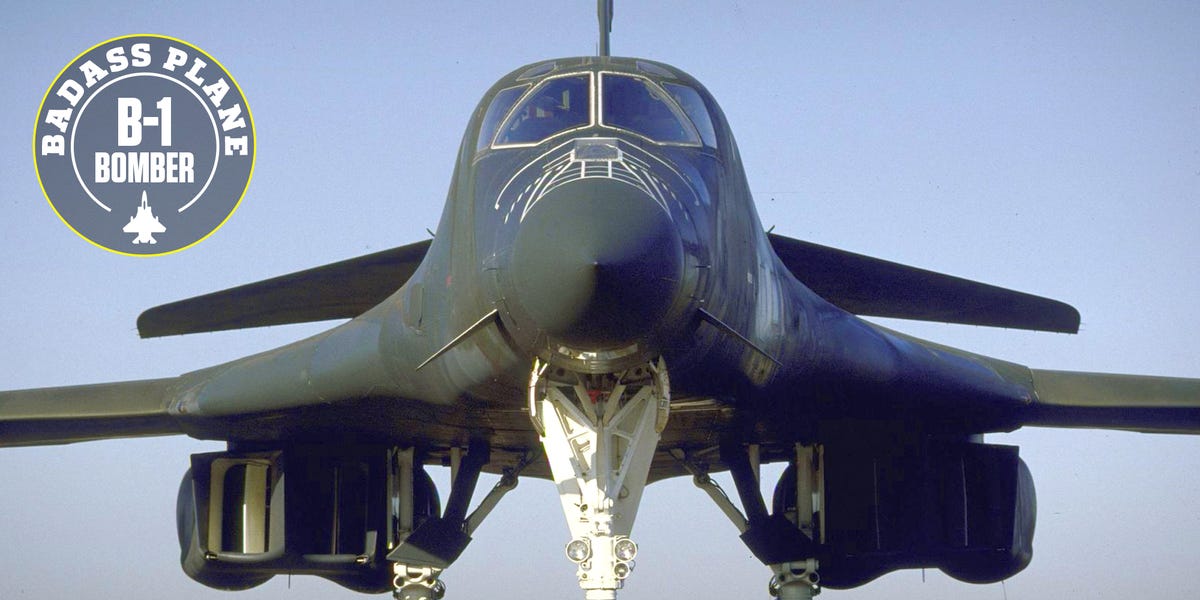
The B-1B Lancer does not enter a scene quietly. It arrives looking like a giant steel predator, folds its wings backward, lights four afterburners, and proceeds to make the atmosphere regret being in the way.
Nicknamed the “Bone” because “B-One” naturally runs together, the B-1 is one of the most visually dramatic aircraft ever placed into operational service. Yet its appeal goes far beyond its swept-back wings and thunderous takeoffs. The B-1B combines supersonic speed, intercontinental reach, a huge conventional weapons load, sophisticated sensors, and the ability to accept new missions decades after it was designed.
That combination explains why an aircraft conceived during the Cold War remains relevant in an era of precision-guided missiles, maritime warfare, digital cockpits, and future hypersonic weapons. The B-1 is not perfect, cheap, young, or easy to maintain. It is, however, an extraordinarily capable flying weapons truckand that is exactly what makes it such a badass plane.
The B-1B Lancer at a Glance
| Primary role | Long-range conventional heavy bomber |
|---|---|
| Crew | Four |
| Engines | Four General Electric F101-GE-102 afterburning turbofans |
| Maximum speed | More than 900 mph, approximately Mach 1.2 at sea level |
| Maximum conventional payload | Approximately 75,000 pounds |
| Maximum takeoff weight | Approximately 477,000 pounds |
| Wingspan | 137 feet extended and 79 feet swept back |
| Weapons bays | Three internal bays |
Each of the B-1’s four engines produces more than 30,000 pounds of thrust with afterburner. The aircraft is 146 feet long, can carry roughly 75,000 pounds of weapons, and has an intercontinental mission range that can be extended through aerial refueling. In simple terms, it is a building-sized aircraft that can fly faster than sound while carrying the military equivalent of a very angry warehouse.
It Looks Like Speed Was Given a Zip Code
Most bombers look large because they are large. The B-1 looks fast even when parked.
Its blended wing-and-body shape creates a smooth, aggressive profile rather than the traditional tube-and-wing appearance of an older heavy bomber. Four engines sit close to the fuselage, while the long nose and swept tail give the airplane the proportions of an enormous supersonic fighter.
The signature feature is its variable-geometry wing. During takeoff and landing, the wings extend forward to produce more lift and improve low-speed handling. At higher speeds, they sweep backward, reducing drag and helping the aircraft operate efficiently in high-subsonic and supersonic flight. The fully swept span shrinks from 137 feet to just 79 feet.
Swing wings are mechanically complicated, heavy, and largely absent from modern aircraft design. They also remain undeniably cool. Watching the B-1 change its wing position in flight is like watching an ordinary aircraft transform into its final boss form.
Four Afterburners Make a Persuasive Argument
The B-1B is powered by four F101 afterburning turbofan engines. Together, they provide more than 120,000 pounds of thrust. When the afterburners ignite, additional fuel is sprayed into the exhaust stream, generating a dramatic increase in thrustand a sound that can turn a casual observer into an aviation enthusiast before the airplane leaves the runway.
The B-1A prototype was designed to reach approximately Mach 2.2. When the aircraft was redesigned as the production B-1B, its engine inlets and other features were changed to reduce its radar signature. Those changes lowered the top speed to around Mach 1.2, but the resulting airplane gained payload capacity, improved radar, greater survivability, and a more practical operational design.
Mach 1.2 may not sound remarkable beside specialized interceptors, but context matters. The B-1 is not a small fighter carrying a couple of missiles. It is a heavy bomber with four crew members, three weapons bays, enormous fuel capacity, and a maximum takeoff weight approaching a quarter-million kilograms.
Making something that large fly supersonically is the aerospace equivalent of teaching a freight train to hurdle.
Its Payload Is the Real Party Trick
Speed gives the B-1 its drama. Payload gives it strategic value.
The B-1B carries the largest conventional payload of guided and unguided weapons in the U.S. Air Force inventory. Its three internal weapons bays can accommodate different combinations of bombs, mines, and long-range missiles, allowing a single aircraft to be configured for very different missions.
Three Bays Create Serious Flexibility
Depending on the mission and approved configuration, a B-1 can carry large quantities of 500-pound general-purpose bombs, 2,000-pound weapons, Joint Direct Attack Munitions, naval mines, Joint Air-to-Surface Standoff Missiles, extended-range JASSMs, and Long-Range Anti-Ship Missiles.
That versatility is more important than simply producing an impressive number for a specification sheet. A crew may need weapons with different ranges, guidance systems, warheads, or target types. Multiple internal bays make it possible to build a loadout around the mission rather than forcing the mission to fit a single weapon.
The airplane can also update targeting information during flight. That matters in modern warfare, where targets may relocate, priorities can change, and aircraft may receive new instructions after takeoff. The B-1 is not merely a delivery truck following an address written before departure; it can participate in a dynamic targeting network.
The B-1 Reinvented Itself After the Cold War
The B-1 was developed as a nuclear-capable strategic bomber, but its career took a major turn after the Cold War. The United States removed the aircraft from the nuclear mission in 1994. Physical modifications later completed its conversion into a conventionally armed bomber under arms-control agreements.
That could have been the beginning of a slow march toward retirement. Instead, the B-1 found a new identity.
It became a high-speed conventional strike platform capable of carrying large quantities of precision weapons. The addition of the Sniper Advanced Targeting Pod expanded its ability to detect, identify, track, and designate targets from long range. The pod provides infrared and high-definition imagery, laser designation, video transmission, and accurate target coordinates.
This upgrade helped turn a bomber originally associated with Cold War penetration missions into an aircraft capable of supporting troops in contact, watching activity on the ground, assessing targets, and employing individual precision-guided weapons. A bomber carrying tens of thousands of pounds of ordnance suddenly had the eyes and finesse needed for far more selective operations.
The first combat employment by a Sniper-equipped B-1 occurred during Operation Enduring Freedom, when the aircraft used the pod to identify enemy forces and guide a precision weapon. That moment illustrated one of the B-1’s greatest strengths: it could evolve without surrendering the raw capacity that made it formidable in the first place.
Its Combat Record Backs Up the Attitude
The B-1B entered combat during Operation Desert Fox over Iraq in December 1998. It later flew missions in the Balkans, Afghanistan, Iraq, and other theaters.
During Operation Allied Force in 1999, six B-1s reportedly delivered more than 20 percent of the operation’s total ordnance while accounting for less than 2 percent of its combat sorties. During the first six months of Operation Enduring Freedom, eight B-1s dropped nearly 40 percent of the total bomb tonnage delivered by coalition aircraft. In Operation Iraqi Freedom, B-1 missions represented less than 1 percent of combat sorties but delivered 43 percent of the JDAMs used.
Those figures explain the airplane’s battlefield appeal. One B-1 sortie can bring substantial firepower, remain available for an extended period, and engage multiple targets across a wide area. Instead of launching several smaller aircraft with limited individual payloads, planners can use a B-1 when they need range, persistence, variety, and volume in one package.
The aircraft has also demonstrated extreme endurance. In February 2024, B-1s launched from the United States, struck targets in Iraq and Syria, and returned home without landing elsewhere. The mission lasted approximately 34 hours. That is a long time to sit in any chair, let alone one attached to a supersonic bomber carrying live weapons across continents.
It Can Show Up Almost Anywhere
Modern bomber deployments are not only about dropping weapons. They are also used to demonstrate readiness, train with allies, test access to distant airfields, and complicate an adversary’s planning.
The B-1 is particularly effective in this role because it combines speed, range, payload, and a visually unmistakable presence. Bomber Task Force missions have taken B-1s to operating locations across Europe and the Indo-Pacific. In April 2025, B-1 aircraft and personnel deployed to Misawa Air Base for the first rotational B-1 Bomber Task Force mission based in Japan, supporting multinational training and regional deterrence activities.
A B-1 does not need to remain permanently stationed near a potential crisis to influence it. Aircraft can deploy, integrate with local forces, practice refueling and strike procedures, and then move again. That unpredictability forces potential opponents to consider a threat that may arrive from thousands of miles away carrying up to two dozen long-range missiles.
Old Airframe, New Tricks
The B-1’s first operational delivery occurred in 1985, but its systems have not remained frozen in 1980s technology. The Integrated Battle Station modernization introduced digital cockpit displays, improved data links, better command-and-control connectivity, and onboard diagnostic tools intended to simplify troubleshooting.
The aircraft is also being prepared for expanded external carriage. A Load Adaptable Modular pylon has been developed to support large weapons and additional long-range missiles. Publicly described concepts could increase the B-1’s JASSM or LRASM capacity from 24 internally carried missiles to as many as 36 when internal and external stations are combined. The pylon has also supported testing related to larger, approximately 5,000-pound-class stores and future hypersonic systems.
Even structural maintenance is becoming more sophisticated. In May 2026, a B-1 returned to service after receiving a replacement for a critical 33-foot section of its upper fuselage. Engineers used a high-fidelity digital twin created from scanned aircraft components and historical drawings to plan the work. The repair was completed roughly three and a half months earlier than the original one-year schedule.
There is something appropriately badass about using digital-twin engineering to perform major spine surgery on a Cold War bomber and then sending it back into the fleet.
Badass Does Not Mean Indestructible
The honest version of the B-1 story must include its problems. It is an aging, mechanically complicated aircraft that spent years flying demanding missions. Swing-wing mechanisms, afterburning engines, structural loads, limited spare parts, and an aging supply chain do not create a maintenance department’s idea of a relaxing weekend.
Government reviews have repeatedly highlighted declining readiness across many older military aircraft fleets, with aging components, maintenance demands, and parts availability contributing to missed mission-capable goals. The B-1 has faced its share of structural inspections, grounding periods, sustainment expenses, and airframe availability concerns.
The Air Force retired 17 of its least serviceable B-1s in 2021 to concentrate maintenance resources on the remaining fleet. Current plans call for the B-1 to provide bomber capacity until it is replaced by the B-21 Raider, with the transition commonly targeted for the early 2030s.
These limitations do not erase the B-1’s strengths. They explain why the airplane cannot remain in service forever. Great aircraft are still machines, and machines eventually begin charging increasingly unreasonable rent for continued operation.
The B-1 Experience: Seeing, Hearing, and Understanding the Bone
Experiencing a B-1 in person helps explain why the aircraft has attracted such a devoted following. Photographs communicate its shape, but they struggle to communicate its scale. A person standing near a museum example or static display quickly realizes that the B-1 is not simply a fighter enlarged by a few percentage points. It is 146 feet long, with a nose that appears to continue forever and engine nacelles large enough to make nearby people look like misplaced accessories.
From the front, the aircraft seems broad and muscular. From the side, it looks low, sharp, and almost impossibly streamlined for something weighing roughly 190,000 pounds before fuel and weapons are added. Walk toward the tail, and the four exhaust nozzles reveal just how much machinery is required to push a heavy bomber through the sound barrier.
A takeoff provides the other half of the experience. The sound does not politely begin when the aircraft passes in front of the crowd. It builds while the B-1 is still distant, becoming a deep mechanical pressure that can be felt as much as heard. When the engines reach high power and the airplane accelerates, normal conversation becomes a charming but unrealistic ambition.
The Bone gathers speed with an urgency that appears incompatible with its size. The nose rises, the landing gear leaves the runway, and the aircraft climbs away on four columns of thrust. Once airborne, the wings may begin moving aft as speed increases. The transformation is smooth, but visually dramatic. The aircraft that took off looking like a broad-winged glider suddenly resembles a giant dart.
At an airshow, a fast pass demonstrates the B-1’s sleek profile. A slow pass demonstrates the crew’s control over an airplane that is still enormous even when flying gently. A high-power departure demonstrates why hearing protection is not a sign of weakness but evidence that your brain would like to continue owning functional ears.
A museum visit creates a different experience. Without engine noise and motion, the details become easier to appreciate: the small cockpit windows, the four-person crew arrangement, the enormous landing gear, the weapons-bay doors, the wing pivots, and the contrast between the aircraft’s graceful exterior and the industrial complexity hidden underneath it.
The most meaningful realization is that the B-1’s appeal does not come from one spectacular feature. Plenty of airplanes are fast. Others carry large payloads, fly long distances, or possess sophisticated sensors. The B-1 combines all of those characteristics in one platform and presents them with the visual subtlety of a heavy-metal concert.
Seeing the aircraft also makes its maintenance challenges easier to understand. Every pivot, actuator, hydraulic line, engine, sensor, cable, and structural joint must function under extreme stresses. The B-1’s capabilities were never free. They were purchased with engineering complexity and maintained through thousands of hours of skilled labor.
That mixture of beauty, noise, power, capability, and mechanical difficulty is the authentic B-1 experience. It is not impressive because it is flawless. It is impressive because engineers and aircrews have kept an extraordinarily ambitious machine useful through four decades of changing missions.
Why the B-1 Bomber Is Still a Badass Plane
The B-1B Lancer earns its reputation through a rare combination of qualities. Its variable-sweep wings make it instantly recognizable. Four afterburning engines push a nearly half-million-pound aircraft beyond the speed of sound. Three internal bays give it the largest conventional weapons capacity in the Air Force, while modern sensors and communications allow it to use that firepower with precision.
More importantly, the B-1 adapted. It moved from the nuclear mission to conventional warfare, from low-altitude penetration to precision strike, from massed bombing to close support, and from land-attack missions to long-range maritime warfare. Upgraded cockpits, targeting pods, data links, modular pylons, and digital engineering have continued adding relevance to an aircraft designed before many of its current crew members were born.
The B-1 will eventually leave operational service as the B-21 Raider assumes a growing share of the long-range strike mission. When that happens, the Bone will leave behind an unusual legacy: a bomber that looked outrageous, sounded apocalyptic, carried an enormous arsenal, and repeatedly found new ways to remain useful.
That is not merely cool engineering. That is badass engineering.