If you’ve ever watched an ETF price on a chaotic morning and thought, “Wait… that can’t be right,” you’re not alone.
On August 24, 2015, plenty of investors saw perfectly normal, boring index ETFs trade like they’d just stepped on a Legosudden drops, weird gaps, and
prices that looked disconnected from reality. It got dubbed (with zero subtlety) the ETF flash crash.
But here’s the twist: the ETFs didn’t “break” in the way people imagine. The plumbing got stressed, price discovery got messy, and the market briefly
showed what happens when you ask for an instant price… while the ingredients needed to calculate an instant price are still stuck in traffic.
Let’s unpack what happened, why ETFs were the headline villains, and what you can do so you never become a screenshot in someone else’s market-structure slide deck.
What people mean by “the ETF flash crash”
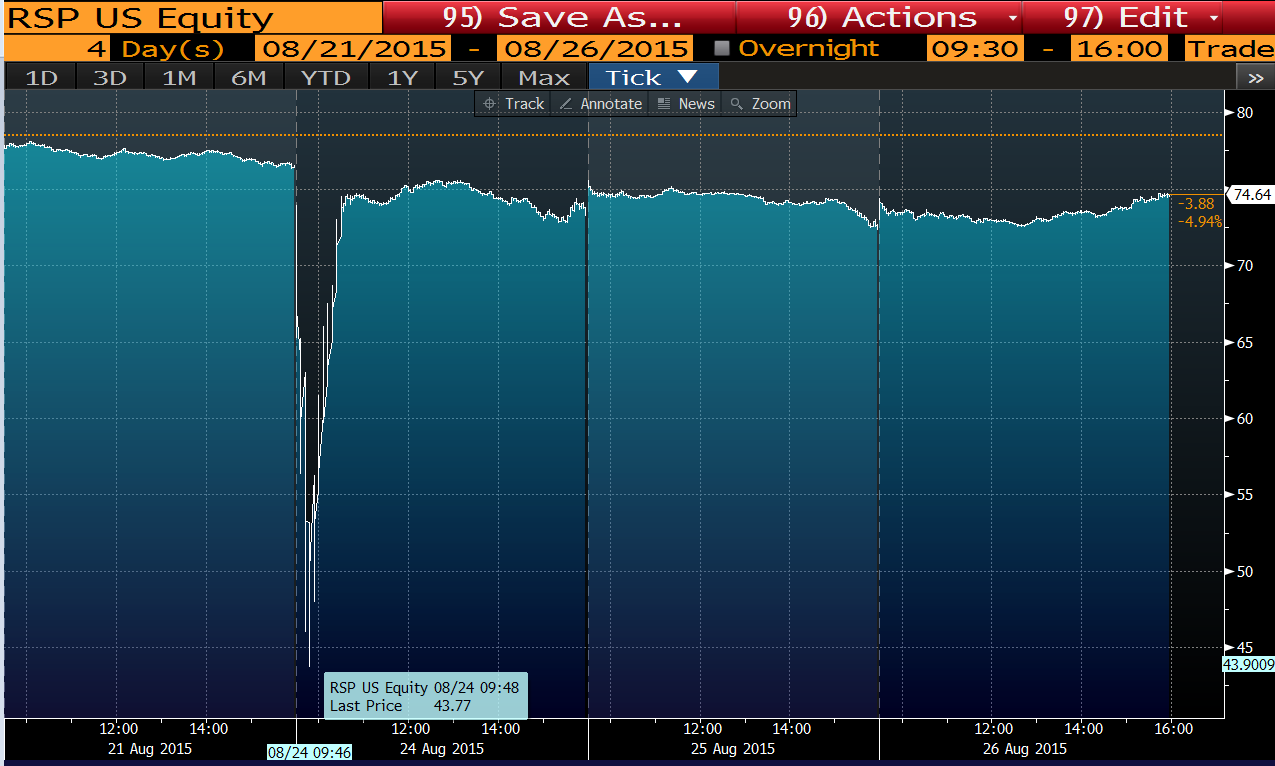
When people say “ETF flash crash,” they’re usually talking about the U.S. market open on Monday, August 24, 2015, when hundreds of ETFs
experienced extreme volatility, some trading at sharp discounts to what investors believed was “fair value.”
Many funds triggered repeated volatility halts, and bid-ask spreads widened so much they looked like a typo.
The key misunderstanding is this: an ETF has two “values” people referenceits NAV (net asset value, calculated from the underlying holdings)
and its market price (what buyers and sellers will actually trade at in real time). In calm markets these hug closely. In stressed markets,
that hug can turn into a long-distance relationship.
The morning the tape got weird (August 24, 2015)
The weekend before, global markets were rattledespecially after sharp moves in Chinaso U.S. trading started the day with anxiety already sitting in the front row.
That anxiety showed up as heavy selling pressure right when the opening bell rang, and the opening mechanics did not handle it gracefully.
A quick timeline of how chaos formed
- Pre-market: major U.S. equity index products fell sharply before the open. Liquidity was thinner and spreads were wider than usual.
-
Right around the open: many individual stocksespecially less liquid namesdidn’t open cleanly or opened late,
meaning reliable “current” prices for a lot of ETF holdings weren’t immediately available. - 9:30–9:45 a.m. ET: volatility controls (Limit Up–Limit Down, aka LULD) kicked in frequently. ETFs, in particular, experienced a large share of trading pauses.
-
After ~9:45 a.m. ET: as more underlying stocks opened and price discovery improved, many of the wild discounts and dislocations faded,
but not before plenty of “what just happened” trades had already printed.
Notably, even very liquid ETFs saw dramatic intraday moves early in the session. For example, broad index ETFs experienced sharp declines and quick rebounds
within minutes as markets tried to establish a clearing price. When the market is trying to do that many price resets at once, the open can look less like
a bell and more like a starting pistol in a crowded hallway.
How can an ETF be “wrong”? NAV, “true value,” and market price
ETFs are often described as “a basket of securities that trades like a stock.” Truebut that simplicity hides a whole production crew behind the camera.
The ETF’s market price is set by trading in the secondary market (buyers and sellers on an exchange). NAV is typically calculated from the value of the underlying holdings.
Under normal conditions, authorized participants (APs) and market makers help keep prices aligned via the creation/redemption mechanism and arbitrage.
Here’s the problem August 24 exposed: arbitrage works best when a trader can (1) accurately value the underlying basket and (2) hedge it efficiently.
If a meaningful chunk of the ETF’s holdings haven’t opened, or their quotes are stale or wildly wide, then “NAV” becomes a fuzzy number in the moment.
Market makers don’t like fuzzy numbers. Fuzzy numbers make spreads widen. Wide spreads make market orders dangerous. Dangerous market orders make headlines.
Congratulations, we have a flash crash.
Premiums and discounts aren’t always “errors”
An ETF trading below NAV is called a discount; above NAV is a premium.
Many investors assume discounts mean “mispricing,” but in a fast market they can be a real-time signal:
the ETF price may be reflecting where the underlying holdings could trade right noweven if the last recorded prices used for NAV haven’t caught up yet.
In other words: sometimes the ETF isn’t wrong; it’s early.
The perfect storm: why ETFs dislocated so violently
1) Delayed opens and missing price discovery in the underlying stocks
Think of an ETF as a smoothie and its holdings as the fruit. On August 24, some fruit hadn’t arrived yet, but the blender was already running.
Many underlying stocks opened late or experienced immediate halts. Without reliable reference prices for constituents, it became harder to calculate fair values,
hedge exposures, or confidently quote tight markets in the ETF.
2) Market makers couldn’t hedge, so they protected themselves
Market makers are often willing to provide liquidity when they can hedge quickly and cheaply. If the underlying stocks aren’t open (or are opening in disorderly fashion),
hedging becomes risky. A rational response is to widen spreads, reduce displayed size, or step back entirely until pricing stabilizes.
That reduction in liquidity is exactly when many retail orders show up looking for certaintywhich the market cannot safely provide.
3) Market orders and stop-loss orders: the chaos accelerant
“Market order” sounds comfortinglike it will give you “the market price.” In a normal open, that’s often fine.
In a stressed open, it can mean “whatever price is available at this millisecond,” including a price that exists because liquidity temporarily vanished.
Stop-loss orders can be even sneakier. When triggered, many become market orders. So a fast drop can trip stop-losses, which then send more market sells into a thin book,
which pushes prices lower, which triggers more stops… you get the idea. It’s less “invisible hand” and more “domino enthusiast with too much free time.”
4) Limit Up–Limit Down halts: guardrails that also slowed recovery
LULD is designed to prevent trades from occurring too far away from a reference price by placing “bands” around allowable trading prices.
When prices move outside those bands, trading can pause briefly.
On August 24, ETFs were heavily affected by these pauses. A large share of listed ETFs experienced LULD halts, and some halted multiple times.
While halts can prevent truly off-market prints, they also interrupt continuous trading, reduce the chance for prices to smoothly reconnect with fair value,
and can contribute to a choppy “halt-reopen-halt” rhythm that feels like the market is buffering.
5) Opening rules and Rule 48: when “no price” is still a price
Another ingredient was the way the opening auction process worked under extreme volatility. A particularly controversial piece of the 2015 story was
the NYSE’s use of Rule 48, which allowed openings without the usual advance indication of opening prices in certain circumstances.
Critics argued it reduced transparency at exactly the moment transparency mattered most. Rule 48 was later eliminated and replaced by more rules-based procedures.
Equity ETFs vs. bond ETFs: why fixed income looked calmer
“If ETFs broke, why didn’t bond ETFs implode too?” Good questionand one reason the 2015 event became a case study instead of a funeral.
Analyses of that day often found U.S. bond ETFs were comparatively resilient. Part of the reason is that the bond market’s microstructure is different,
and price discovery often happens through dealer markets and evaluated pricing rather than a single centralized exchange open.
Also, the specific shock on August 24 was concentrated in equities at the open, where the opening auction and LULD mechanics were under the most strain.
This doesn’t mean bond ETFs are immune to discountsespecially in stressed credit marketsbut it does show the “ETF wrapper” isn’t the only variable.
The underlying market matters. A lot.
What changed after 2015 (and what still hasn’t)
The August 24 event triggered a wave of analysis and proposals: exchanges, regulators, and ETF issuers all had homework.
Several themes emerged in the years after:
- More deterministic opening and reopening procedures: efforts to make reopenings after halts more standardized and auction-based.
-
Re-examining volatility bands and timing: reducing “gaps” where securities could trade without appropriate guardrails,
and tuning how bands behave around the open. - Rule 48 elimination: moving away from a discretionary “skip the indications” approach and toward clearer rules for volatile opens.
- Better investor education: a recurring message: the ETF wasn’t the villain; the trading behavior was often the villain.
What hasn’t changed? Markets can still gap, liquidity can still thin out, and any product that relies on underlying price discovery can look strange
when that discovery is interrupted. The solution isn’t “never use ETFs.” It’s “trade them like an adult.”
(Yes, even if your brokerage app has confetti.)
How to trade ETFs without becoming a cautionary tale
If August 24 had a slogan, it would be: “Use limit orders.” But let’s make that actionable.
Best practices that matter most in volatile markets
- Prefer limit orders over market orders: Set the worst price you’re willing to accept. If it doesn’t fill, you’ve avoided a bad print.
- Avoid the first 15 minutes if you can: The open is where price discovery is most fragile, especially on high-volatility days.
- Watch the bid-ask spread: A widening spread is the market telling you liquidity is expensive right now.
- Be careful with stop-loss orders: Understand how your broker triggers stops and what order type they become when activated.
- Know what you own: ETFs holding less liquid stocks (small-cap, high-yield, niche sectors) can show bigger dislocations when markets seize up.
- Use more liquid tickers for exposure: If your goal is broad market exposure, a highly liquid ETF is usually a better trading vehicle than a thin one.
FAQ: the questions everyone asks after reading “flash crash” headlines
Does the ETF flash crash mean ETFs are unsafe?
ETFs did what markets do under stress: they priced liquidity. The episode highlighted how trading mechanics, volatility controls, and investor order types can interact
in surprising ways. For long-term investors, the bigger risk is often panic trading into illiquid moments, not the ETF structure itself.
Could it happen again?
A carbon-copy rerun is unlikely because market structure evolves. But a new version of “prices get weird when liquidity vanishes” is always possible.
Any time underlying markets are disorderlyespecially at the openyou can see larger premiums/discounts and wider spreads.
What should long-term investors do during extreme opens?
Most long-term investors don’t need to trade during the noisiest minutes of the day.
If you must trade, use limit orders and patience. If you don’t need to trade, consider letting the market finish its tantrum before you engage.
Experiences From the ETF Flash Crash: 10 lessons people still talk about (and why they stick)
The ETF flash crash wasn’t just a market-structure story; it was a human storythousands of real-time decisions made with incomplete information.
Below are experiences commonly reported by investors, traders, and advisors after the event, along with what those moments taught them. These aren’t
“war stories” for drama’s sake; they’re practical reminders that how you trade can matter as much as what you buy.
1) “My ETF was down way more than the marketdid it break?”
Many investors watched broad equity ETFs print prices that looked far worse than the underlying index move. The gut reaction was mechanical:
something is wrong with the fund. The more accurate read was structural: at the open, many underlying stocks had delayed pricing or chaotic quotes,
and the ETF price was trying to clear in the secondary market while the “ingredients” were still finding their own opening levels. The lesson:
discounts can reflect uncertainty and hedging cost, not necessarily a permanent impairment.
2) The market order regret spiral
Some investors hit “sell” with a market order because they wanted out immediately. They got outsometimes at a price far below where the ETF traded minutes later.
The experience taught a simple truth: a market order guarantees execution, not a reasonable price. In calm markets the difference is small. In stressed markets,
it can feel like you sold your car during a hailstorm because you didn’t like the weather forecast.
3) Stop-loss orders that turned into surprise market orders
Advisors later reported clients being stopped out near the lows, even when they didn’t intend to “trade the open.” A fast, disorderly drop triggered stop-loss levels,
converting into market sells when liquidity was thin. Some clients then watched prices rebound without them. The lesson:
if you use stops, understand the mechanics, consider stop-limits where appropriate, and recognize that stops can amplify volatility.
4) “The spread was hugeso I waited. Best decision I made all year.”
A different group saw spreads widen dramatically and chose to do nothing. They weren’t heroic; they were observant.
Wide spreads are a visible price tag for immediacy. Waiting 10–30 minutes allowed price discovery to improve as more underlying securities opened and liquidity returned.
The lesson: patience is a strategy, not a personality trait.
5) The halt-and-reopen whiplash
Traders described watching an ETF halt, reopen, trade for seconds, then halt again. Every reopen felt like the market was trying to “reset” the price,
but without stable inputs it couldn’t settle. The lesson: volatility controls can prevent some extreme prints, but they can also create a choppy environment
where execution timing matters more than you expect.
6) “I thought NAV was the truth. Turns out it’s a reportsometimes a delayed report.”
Many investors learned that NAV is not a live, tradeable promise. It’s an accounting snapshot, typically computed from underlying prices that may be stale
in fast marketsespecially when holdings haven’t opened or are halted. The lesson: treat NAV as a reference, not a guarantee, and use multiple signals
(spreads, volume, underlying market condition) to judge execution quality.
7) The “liquidity mirage” in niche ETFs
Investors holding narrower sector ETFs or smaller, less-traded funds found that liquidity could disappear quickly. Even if the ETF itself trades on an exchange,
its true liquidity is tied to the ability to hedge or create/redeem the underlying basket. The lesson: in normal times, niche ETFs can trade smoothly;
in stressed times, their underlying markets may become the bottleneck.
8) Advisors re-wrote their client playbooks
Many advisors reported changing how they communicate about volatile markets: fewer “watch the ticker” moments, more “remember your plan” reminders,
and more explicit guidance about limit orders and avoiding the open on chaotic days. The lesson: education beats improvisation when markets get loud.
9) “My best trade was not trading” became a cliché for a reason
It sounds like a motivational poster, but for long-term investors the flash crash reinforced the value of not letting microstructure noise dictate macro decisions.
Most ETFs that looked terrifying for minutes normalized once the market found its footing. The lesson: time horizon is a risk-management tool.
10) The lasting takeaway: ETFs didn’t failexpectations did
The most durable “experience” wasn’t a single trade. It was a mindset shift.
Investors stopped assuming ETFs always trade at a neat, continuous “fair price,” and started treating them like real market instruments that price liquidity,
uncertainty, and hedging costespecially at the open. The lesson: trade ETFs with intention, not reflex.
Conclusion
The ETF flash crash wasn’t a warning that ETFs are inherently broken. It was a demonstrationloud, messy, and expensive for someof what happens when
the market open collides with extreme volatility, delayed price discovery, and order types that demand immediacy.
The practical fix is refreshingly unglamorous: use limit orders, respect spreads, avoid frantic opens when possible, and understand that “fair value” is not a single number
when the inputs are moving targets. ETFs remain powerful tools. Just don’t treat them like magic.
Magic is great for birthday parties. Markets prefer math.