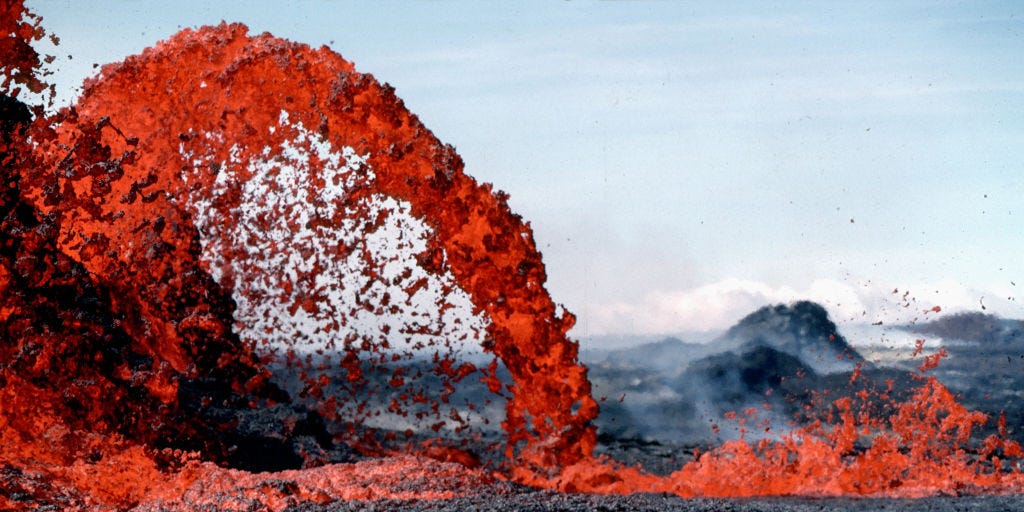
Some volcanoes rumble. Some volcanoes ooze lava like a very dramatic fondue fountain. And now, thanks to Kīlauea, scientists have a new way to describe one of nature’s stranger tricks: the stomp-rocket eruption.
What Is a Stomp-Rocket Eruption?
A stomp-rocket eruption is a newly described volcanic eruption mechanism in which collapsing rock above a magma reservoir suddenly increases pressure below, forcing trapped hot gas, rock fragments, and debris upward through a vent. The name comes from the classic stomp-rocket toy: you jump on an air-filled bladder, air rushes through a tube, and a foam rocket shoots skyward. In the volcanic version, the toy is replaced by a giant collapsing caldera, the air hose is replaced by a volcanic conduit, and the foam rocket is replaced by a plume of hot gas and shattered rock. Adorable? Not exactly. Scientifically thrilling? Absolutely.
This mechanism was identified through analysis of Kīlauea’s explosive activity in May 2018, when the Hawaiian volcano produced a sequence of 12 back-to-back explosions. These events did not fit neatly into the usual categories scientists use to explain explosive eruptions. They were not simply classic magma fragmentation events, and they were not purely steam-driven blasts caused by groundwater flashing into vapor. Instead, they appeared to be powered by pressure generated when part of the reservoir roof suddenly dropped, squeezing gas and debris upward like Earth had stepped on its own underground launch pad.
Why Kīlauea Became the Perfect Natural Laboratory
Kīlauea is one of the most closely watched volcanoes on the planet, which is fortunate because it does not exactly keep a quiet schedule. Located on the Island of Hawai‘i, it has a long history of eruptions, lava flows, summit activity, and rift-zone drama. In 2018, the volcano entered one of the most significant eruptive episodes in its modern history. Lava erupted in the lower East Rift Zone, summit magma drained, the lava lake disappeared, and the summit caldera began to collapse.
That combination created a rare scientific opportunity. Instruments were already recording earthquakes, ground deformation, gas emissions, plume behavior, and visual changes across the volcano. While the lower East Rift Zone produced devastating lava flows that destroyed communities and reshaped parts of the island, the summit was experiencing its own transformation. The floor of the caldera subsided, collapse events released earthquake-like energy, and explosions sent plumes of ash and debris into the air.
For researchers, this was not just a spectacular eruption. It was a data-rich event. Every tremor, pressure change, plume height, and collapse episode helped scientists reconstruct what happened underground. That reconstruction is what led to the stomp-rocket explanation.
How the Stomp-Rocket Mechanism Works
Step 1: The Magma Reservoir Loses Support
During the 2018 eruption, magma moved out of Kīlauea’s summit reservoir system and fed activity elsewhere. As magma drained, the rock above the reservoir lost support. Think of pulling air out of an inflatable mattress while someone is standing on it. The surface does not politely remain in place. It sags, shifts, and eventually drops. At Kīlauea, portions of the summit area collapsed downward as the underground system emptied.
Step 2: The Roof Rock Drops
In the stomp-rocket model, a sudden downward movement of reservoir roof rock acted like the foot in the toy analogy. The collapse increased pressure inside the underlying system. But instead of pushing air through a plastic tube, it pushed a mixture of high-temperature magmatic gas and lithic debris through a volcanic conduit.
Step 3: Gas and Debris Launch Upward
Once that pressure had somewhere to go, it went up. The pressurized gas and rock fragments blasted through a conduit and produced explosive plumes. In the Kīlauea case, researchers modeled a conduit about 600 meters long and eruption rates of particles around 3,000 cubic meters per second. That is not a “small puff.” That is more like a geological leaf blower with a graduate degree in chaos.
Step 4: A New Category Enters the Chat
Because the explosions were driven by collapse-induced pressure rather than the more familiar triggers of magma fragmentation or steam expansion, scientists proposed that these events represent a distinct eruption mechanism. The term does not mean Kīlauea became a different type of volcano. It means researchers identified a new way volcanic explosions can be powered.
Why This Discovery Matters
The stomp-rocket eruption is more than a catchy phrase. It improves how scientists think about volcanic hazards, especially during caldera collapse events. Explosive plumes can endanger aircraft, damage equipment, spread ash, threaten visibility, and create dangerous conditions near a volcano. If researchers can better understand what causes a particular kind of plume, they can better interpret warning signs before similar events occur.
This is especially important because caldera collapses are not unique to Kīlauea. Large volcanic systems around the world can experience collapse when magma reservoirs drain or shift. If the stomp-rocket mechanism can occur elsewhere, then scientists may need to look again at older eruptions and ask a new question: was this explosion really steam-driven, magma-driven, or did the volcano just stomp on its own pressure system?
That kind of hindsight is known as hindcasting. Researchers take existing data from past events and test whether a model can explain what happened. If the model works well, it may help improve future forecasts. In volcano science, forecasting does not mean predicting every burp and grumble like a magical lava horoscope. It means narrowing uncertainty, recognizing patterns, and giving communities better information when time matters.
How It Differs From Other Volcanic Eruptions
Magmatic Eruptions
In a typical magmatic eruption, gas dissolved in magma expands as pressure drops, causing magma to fragment and erupt. It is similar to opening a shaken soda bottle, except the soda is molten rock and the cleanup crew is the entire planet.
Phreatic and Phreatomagmatic Eruptions
Phreatic eruptions are steam-driven explosions. They occur when water is heated rapidly by hot rock or magma and flashes into steam. Phreatomagmatic eruptions involve direct interaction between water and magma. Both can be sudden and dangerous, especially because water can turn into expanding vapor with impressive speed.
Stomp-Rocket Eruptions
The stomp-rocket mechanism is different because the key driver is mechanical pressure from collapse. The eruption is not simply about magma bubbling upward or groundwater exploding into steam. It is about roof rock dropping onto a pressurized system and launching gas and debris through a vent. In plain English: the volcano squeezed itself.
The 2018 Kīlauea Sequence in Plain English
In early May 2018, Kīlauea’s lower East Rift Zone eruption began after magma migrated underground and emerged through fissures in residential areas. Lava flows damaged roads, covered land, and destroyed more than 700 homes. At the same time, the summit was changing dramatically. The lava lake at Halema‘uma‘u drained, the summit area deflated, and the caldera began to collapse.
Between May 17 and May 28, 2018, Kīlauea produced a series of 12 explosive summit events. These explosions sent plumes of rock fragments and hot gas upward, with some reaching several kilometers into the atmosphere. For years, the events were studied as part of the larger 2018 eruption. Later analysis showed that their timing, plume behavior, and pressure dynamics lined up with the stomp-rocket model.
The discovery is a reminder that volcanoes do not always read the textbook before erupting. Scientists create categories because categories help us understand the world. Then the world occasionally kicks the door open and says, “Nice categories. I made a new one.”
What the Name Gets Right
The phrase “stomp-rocket eruption” works because it makes a complicated physical process easier to visualize. Nobody needs a PhD to understand that pressing down on a bladder can launch air through a tube. The analogy is simple, memorable, and surprisingly accurate at the level that matters: sudden compression creates pressure, and pressure drives material upward.
Of course, the real volcanic system is far more complicated than a toy. Kīlauea involved magma reservoirs, collapsing rock, accumulated gas, conduit geometry, ash particles, seismic signals, and plume dynamics. Still, good science communication often starts with a mental picture. Once people can imagine the basic mechanism, they are more likely to appreciate the deeper science behind it.
Could This Happen at Other Volcanoes?
Possibly. Researchers have been careful not to claim that every caldera collapse produces stomp-rocket eruptions. Volcanoes are wildly individual. Their magma chemistry, water content, gas supply, rock strength, reservoir shape, and plumbing systems all matter. A basaltic shield volcano like Kīlauea behaves differently from a steep stratovolcano, and even the same volcano can change personality from one eruption to the next.
Still, the mechanism may not be exclusive to Kīlauea. Any volcanic system where collapse rapidly pressurizes gas-rich material could, in theory, produce similar explosions. That possibility gives researchers a fresh lens for studying past eruptions. It also encourages observatories to pay close attention to the relationship between summit collapse, pressure changes, plume generation, and seismic activity.
Why Volcano Monitoring Is Getting Smarter
Modern volcano monitoring is a mix of geology, physics, chemistry, satellite data, ground sensors, and a lot of patient people staring at squiggly lines. Instruments can track earthquakes, ground swelling or sinking, gas emissions, heat signatures, and visual changes. At Kīlauea, the long history of monitoring gave scientists enough detail to revisit the 2018 explosions and test a new model.
The stomp-rocket discovery shows why long-term monitoring matters. Data collected during a crisis may still produce insights years later. A plume observed today can become a scientific breakthrough tomorrow. That matters for communities living near active volcanoes, aviation authorities watching ash hazards, park managers protecting visitors, and researchers trying to understand how Earth releases energy.
Common Questions About Stomp-Rocket Eruptions
Is a stomp-rocket eruption a new volcano type?
No. It is a newly described eruption mechanism, not a new kind of volcano. Kīlauea remains a shield volcano. What changed is the scientific explanation for a specific set of explosive events.
Does this mean Kīlauea is more dangerous than scientists thought?
Not exactly. Kīlauea has always been hazardous, especially during major eruptive episodes. The stomp-rocket model helps clarify one kind of explosive behavior. Better understanding can improve hazard assessment rather than simply making the volcano sound scarier.
Are all Kīlauea eruptions stomp-rocket eruptions?
No. Kīlauea commonly produces lava flows, fissure eruptions, lava fountains, summit activity, and other eruptive styles. The stomp-rocket mechanism describes a particular sequence of collapse-related explosions from 2018, not every eruption at the volcano.
Why did scientists only identify this recently?
Because complex eruptions require careful analysis. Researchers needed detailed observations, physical modeling, plume measurements, and a strong understanding of the 2018 collapse sequence. Science often moves like detective work: first the clues, then the reconstruction, then the “Oh, that is what happened” moment.
What This Teaches Us About Earth
The stomp-rocket eruption is a perfect example of why Earth science is never boring. Our planet is not just a static ball of rock with oceans sprinkled on top for decoration. It is a dynamic system full of pressure, heat, motion, and feedback loops. When magma moves, rock responds. When rock collapses, pressure changes. When pressure changes, material can launch skyward.
It also shows how scientific categories evolve. For a long time, explosive volcanic eruptions were often discussed through the lens of magma, water, and gas expansion. Those remain essential concepts. But Kīlauea’s 2018 sequence adds another mechanism to the toolkit: collapse-induced pressurization. That does not overturn everything scientists knew. It sharpens the picture.
In a way, the discovery is humbling. Even one of the best-monitored volcanoes on Earth still had a surprise waiting in its plumbing. That is the beauty of science. The more carefully we look, the more specific the world becomes.
Experiences and Reflections: Watching a Volcano Rewrite the Rules
Imagine standing at a safe overlook in Hawai‘i Volcanoes National Park after the 2018 collapse, looking across a summit landscape that had visibly changed. The ground is not just scenery anymore. It feels like evidence. The crater walls, the widened collapse area, the absence of the old lava lake, and the quiet after all that violence tell a story even before a scientist opens a notebook. Visitors often arrive expecting glowing lava and postcard drama, but Kīlauea teaches a different lesson: sometimes the most powerful changes are structural, silent, and written into the shape of the land.
For people who followed the 2018 eruption from afar, the experience was different but still unforgettable. News footage showed fissures opening in neighborhoods, lava fountains rising behind homes, roads being cut off, and ash clouds climbing above the summit. It was the kind of event that made geology feel immediate. Volcanoes stopped being textbook diagrams and became active forces affecting families, parks, infrastructure, air quality, and daily decisions. The stomp-rocket discovery adds a new layer to that memory. It says that while everyone was watching lava reshape the surface, the summit was also performing a complicated pressure experiment underground.
For science lovers, the analogy is almost irresistible. A stomp rocket is one of those toys that turns physics into a backyard comedy routine. A child stomps, the rocket flies, everyone cheers, and someone probably has to retrieve it from a roof. Translating that idea to a volcano makes the science approachable without making it silly. The comparison helps readers understand pressure transfer, conduit flow, and sudden release. It is a reminder that good analogies do not make science smaller; they make the doorway wider.
For local communities, however, the story is not just fascinating. It is personal. The 2018 eruption damaged homes, changed neighborhoods, altered familiar landscapes, and left long-term recovery challenges. Any discussion of Kīlauea should balance wonder with respect. The volcano is beautiful, but it is not a theme park attraction. It is part of a living Hawaiian landscape with cultural meaning, ecological importance, and real hazards. The stomp-rocket mechanism may sound playful, but the events it describes were part of a serious eruption sequence.
The biggest takeaway from this experience is that volcanoes reward humility. We can monitor them, model them, name their behavior, and still be surprised. That does not mean science fails. It means science keeps working. Each new mechanism gives researchers a better vocabulary for risk, and each eruption leaves clues for the next generation. Kīlauea’s stomp-rocket eruption is not just a quirky headline. It is a case study in how Earth can still surprise us, even when we are watching closely.
Conclusion
The stomp-rocket eruption is one of those rare scientific ideas that sounds like clickbait until you realize it is built on serious research. Kīlauea’s 2018 summit explosions gave scientists a chance to identify a collapse-induced eruption mechanism in which falling reservoir roof rock increased pressure and launched gas and debris upward. That discovery helps explain a puzzling sequence of explosions and may improve how researchers interpret caldera-collapse hazards in the future.
It also gives the rest of us a vivid way to understand volcanic power. A stomp rocket turns pressure into flight. A volcano can turn pressure into ash, rock fragments, and towering plumes. The toy version belongs in a backyard. The Earth version belongs in journals, monitoring centers, hazard plans, and the growing list of reasons our planet remains spectacularly, inconveniently interesting.